Violence, redistricting, and democratic norms in Trump’s America
Bright Line Watch September 2025 survey
In recent months, the Trump administration has continued to challenge executive branch norms as well as legal and constitutional limits on the powers of the presidency, including dramatically expanding the capacity and activities of U.S. Immigration and Customs Enforcement and deploying the military to Los Angeles and Washington, D.C. A Republican effort to change congressional district maps to gain five seats in the U.S. House of Representatives in the 2026 election was enacted in Texas, prompting California Democrats to develop a redistricting plan to offset those losses. Most recently, the conservative activist and commentator Charlie Kirk was shot and killed during a public event at a Utah university, prompting a nationwide debate over political violence and free speech.
In this context, we fielded parallel surveys of 703 political science faculty at American colleges and universities (whom we refer to as “experts” below) and a representative sample of 2,750 Americans (whom we refer to as “the public” below). The expert survey was fielded from September 5–17, 2025 and the public survey from September 5–16, 2025.
Our key findings are the following:
Assessments of democratic performance
-
Ratings of American democracy among the public as a whole and among experts are lower since President Trump returned to office, but they have not changed measurably since our April 2025 survey. Expectations for 2027 remain pessimistic among experts.
-
Current expert ratings of U.S. democracy are closer to those of a mixed or illiberal democracy than a full democracy or countries often considered as relevant comparisons such as Great Britain and Canada.
-
The partisan gap in ratings of U.S. democracy is at its highest since we started collecting data on this question in 2017.
-
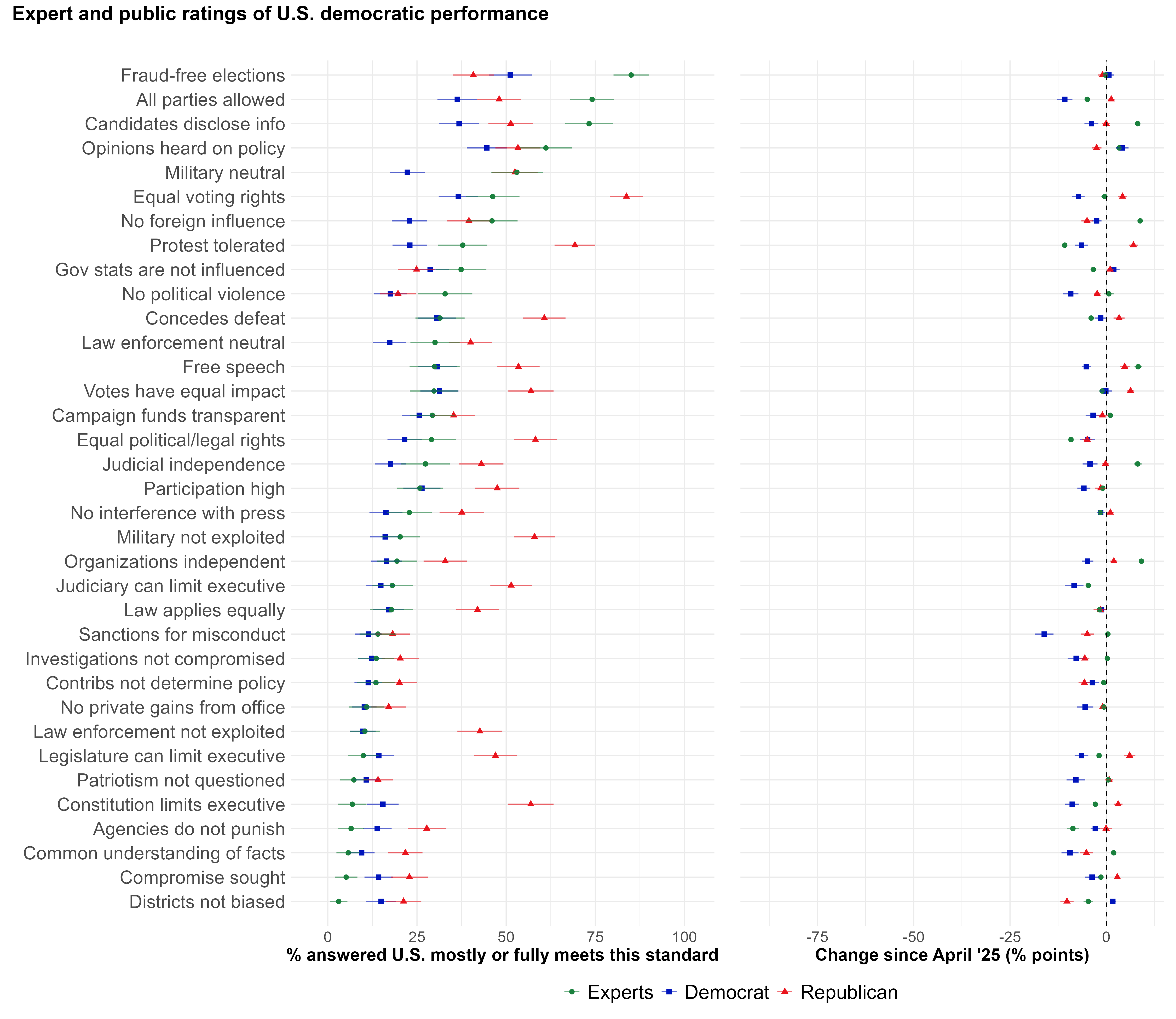
Expert ratings of U.S. performance at upholding specific democratic principles are mostly stable since April, but we observe significant declines on toleration of peaceful protest, not using government agencies to punish political opponents, and fair electoral district boundaries. Among the public, Republican ratings were largely stable, whereas Democrats perceived declines in a number of areas.
Threats to democracy
-
Most experts rated the shooting of Charlie Kirk as a threat to democracy. Evaluations of U.S. democracy did not change afterward, but the share of experts who said the government is effectively preventing political violence fell substantially.
-
Numerous events since April were rated as threats to democracy by 80% of experts or more, including Texas changing its Congressional districts and the National Guard deployment to Los Angeles. Many of these attracted widespread support among Republicans. However, only one is among the ten most often rated by experts as posing an extraordinary or serious threat to democracy since Trump took office again.
-
Looking ahead, many potential actions by the Trump administration were rated as extraordinary or serious threats to democracy by 89% of experts or more, including Trump seeking a third term, the suspension of habeas corpus, invoking the Insurrection Act, and directing law enforcement officials to not to enforce court orders.
Fighting fire with fire
-
Experts overwhelmingly view the Texas redistricting plan as a threat to democracy and were split over the California plan. They expected to rate U.S. democracy lower in 2027 if only Texas redistricts versus a scenario in which both states do so. Republicans tended to support partisan state redistricting more in general.
-
Respondents from both parties say it is inappropriate to violate democratic norms in response to a democratic norm violation when their side is described as committing the initial infraction, but reverse their stance when the other party violates norms first.
-
Support for a battery of antidemocratic actions among Democrats including illegal redistricting and restricting or shutting down Fox News has increased since 2021, though none attracts majority support. Republican support for these actions is lower or unchanged compared to 2021 except for illegal redistricting and restricting MSNBC.
Forecasting future threats to democracy
-
Human forecasts from the Metaculus prediction platform and those from experts are broadly consistent after adjusting for experts’ prior tendency toward pessimism. AI forecasts from the startup Mantic, which has created the best-performing AI forecasting bot to date, rate the likelihood of most events lower than either human source.
-
Five future events that most experts rate as extraordinary or serious threats to democracy are rated as more likely to occur than not by a composite of human, prediction platform, and AI forecasts: normal procedures being overridden in legal cases concerning both presidential allies and opponents, a military deployment to a third metro area besides Los Angeles and Washington, D.C., an order revoking naturalization based on subsequent conduct, and an order directing law enforcement to not enforce a court order. Estimated probabilities are much lower for suspending habeas corpus, invoking the Insurrection Act, a denial of birthright citizenship, and imprisoning a U.S. citizen abroad.
Overall evaluations of American democracy
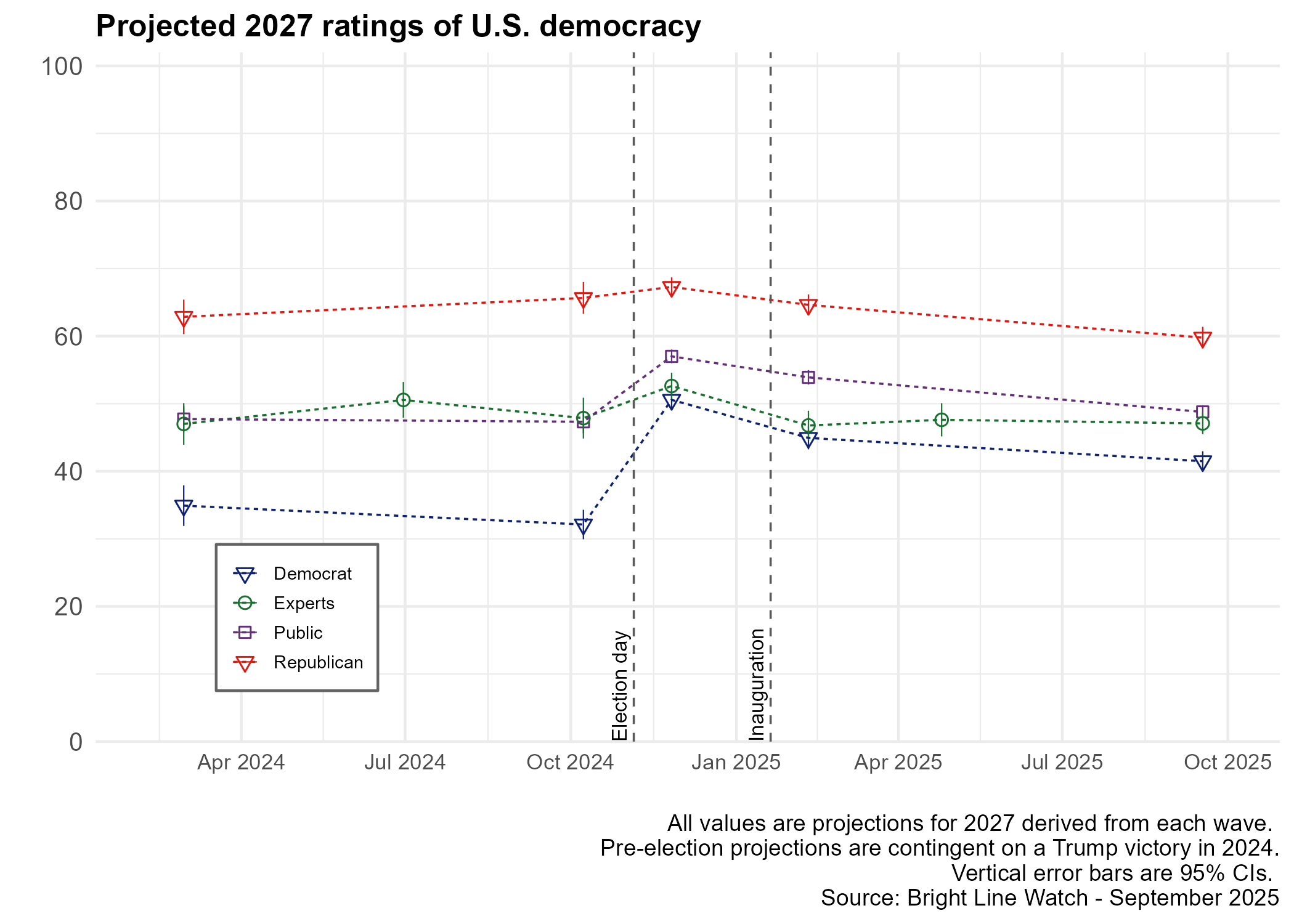
We have asked expert and public respondents to rate the overall performance of U.S. democracy on a 0–100 scale since May 2017 and September 2017, respectively. Our September 2025 survey also asked expert respondents what rating they would expect to give the U.S. on the same scale in 2027. The figure below graphs how these ratings have varied over time among experts, the public overall, and Democrats and Republicans in the public sample. We also present projected future ratings of American democracy in 2027 for each group.
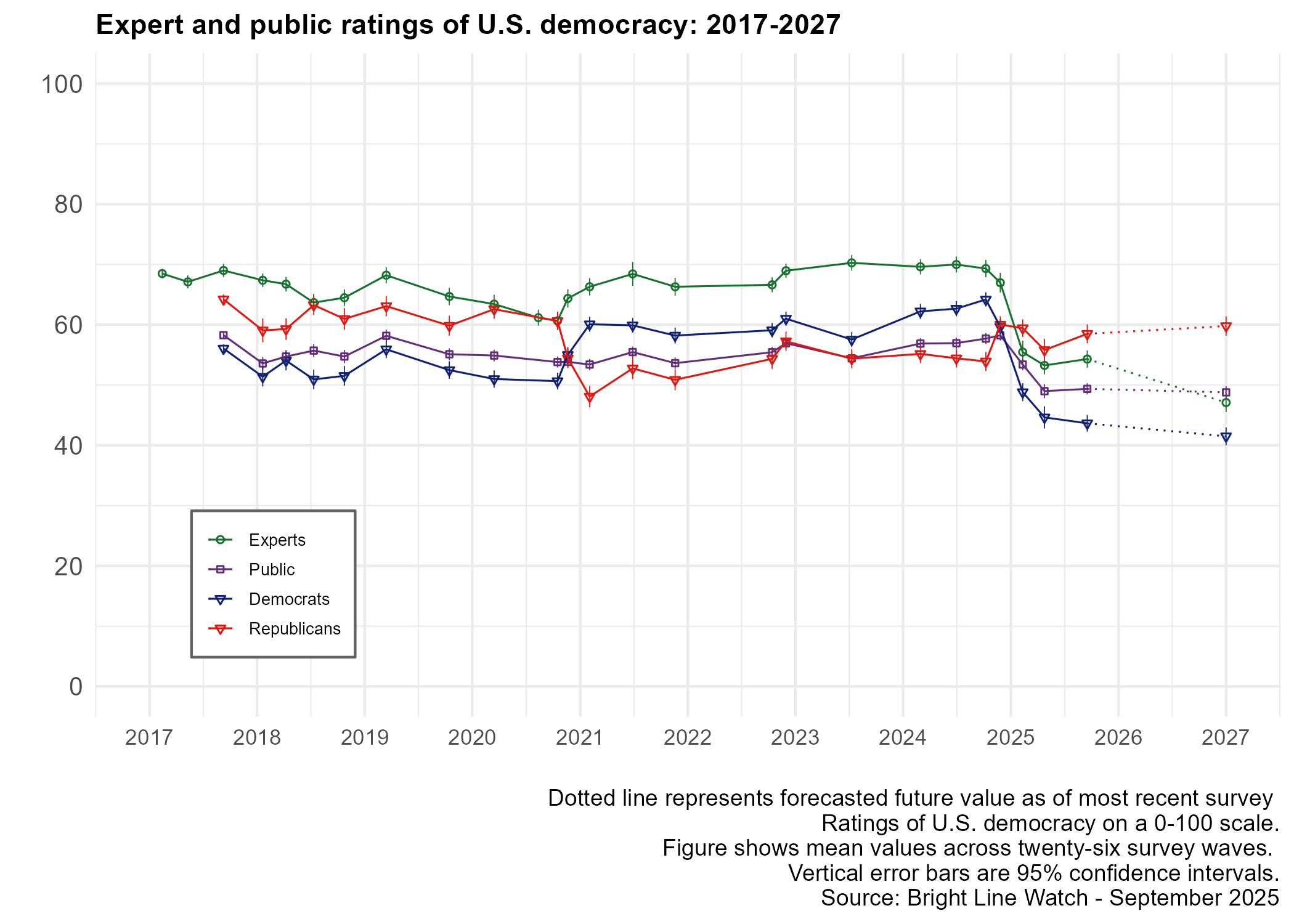
We previously observed declines in ratings of U.S. democracy among every group, including experts, since Trump returned to office. Expert ratings declined, for instance, from 67 in November 2024 to 55 in February 2025 and 53 in April 2025. Public ratings dropped, too, from 58 in November to 53 in February and 49 in April. Notably, Democrats and Republicans showed a similar decline in April.
By contrast, ratings in this wave remained stable since our last survey. Expert ratings of U.S. democracy today held at 54, statistically unchanged since April (53). Similarly, ratings are statistically unchanged from April among the public overall (consistent at 49) as well as Democrats (45 vs. 44) and Republicans (56 vs. 58).
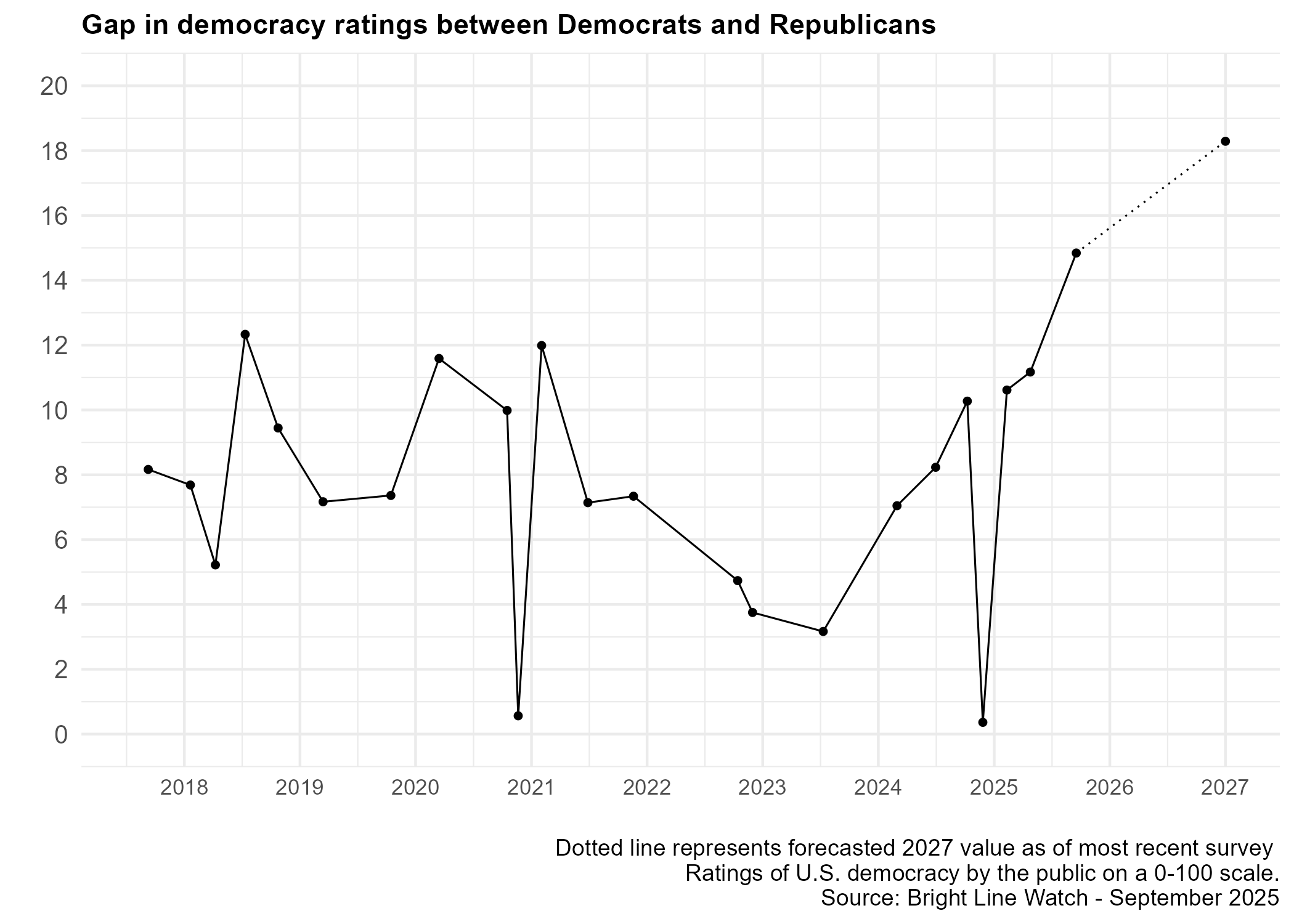
However, as the next figure shows, the partisan gap in democracy ratings has reached an all-time high. The average difference across all previous surveys was 8 points, and the previous maximum difference was 12 points, in July 2018, when the average rating among Republicans was 63 versus 51 among Democrats. In our September 2025 survey, the gap reached 15 points (58.5 among Republicans versus 43.6 among Democrats). When our respondents are asked to project a democracy rating for 2027 on the same scale, their expectations diverge by 18 points.
The current expert rating of 54 continues to place the United States between the scores that experts gave in April 2025 to Israel (49) and Mexico (60) and well below our nominal democratic peers of Great Britain (83) and Canada (88).
In this survey, we also asked experts to rate three hypothetical countries with differing levels of election competitiveness, judicial and prosecutorial independence, media freedom, and quality of data and civil service on the same 0–100 scale to provide a benchmark for ratings of the U.S. The countries were presented and rated separately in randomized order in the survey; they are grouped together in the table below for visual clarity (the descriptions in brackets were not shown in the survey). “Country A” was constructed as a strong democracy with high performance in each area; “Country B” was constructed as an illiberal democracy with performance in each area; and “Country C” was constructed as a non-democracy with low performance in each area.
| Country A [strong democracy] |
Country B [illiberal democracy] |
Country C [non-democracy] |
|
|---|---|---|---|
| Elections | Elections are regular and competitive; opposition campaigns have equal access to venues and media; incumbent use of state resources for campaigns is prohibited and enforced. | Elections are regular but not fully competitive; opposition campaigns face disadvantages in access to venues and media; incumbent use of state resources for campaigns is prohibited but weakly enforced. | Elections are regular but not competitive; opposition campaigns face severe restrictions on access to venues and media; incumbent use of state resources for campaigns is pervasive and unconstrained. |
| Courts | Judges are appointed through pluralistic, merit-based procedures; the judiciary is independent; courts regularly review and annul executive acts. | Judges are appointed through mixed procedures with executive influence; the judiciary is partly independent; courts infrequently review or annul executive acts. | Judges are appointed from ruling-party lists; the judiciary is not independent; courts do not review or annul executive acts. |
| Law enforcement | Prosecutors are legally independent; charging decisions are insulated from political direction; high-profile cases against opposition figures are not announced near elections. | Prosecutors are subordinate to the executive; charging decisions are exposed to political influence; high-profile cases against opposition figures are rarely announced near elections. | Prosecutors are directed by the prime minister’s office; charging decisions follow political directives; high-profile cases against opposition figures are frequently announced near elections. |
| Media | Media regulation protects editorial independence; national broadcasters follow independence codes; accreditation and access rules are viewpoint-neutral. | Media regulation nominally protects editorial independence; national broadcasters face administrative pressure; accreditation and access rules are selectively applied. | Media regulation permits executive control; national broadcasters face severe pressure to conform; accreditation and access rules exclude critical outlets. |
| Government data | Official statistics and the national audit institution are legally independent; release calendars and methods are set without political input and reports are published without pre-clearance. | Official statistics and the national audit institution are subordinate to line ministries; release calendars and methods are shaped by input from political leaders; reports are sometimes reviewed before publication. | Official statistics and the national audit institution are controlled by the executive branch; release calendars and methods are directed by political leaders; reports are frequently delayed, altered, or withheld. |
| Civil service | Senior civil service appointments are made by open, merit-based competition; political appointments are limited by law; vacancies are publicly advertised. | Senior civil service appointments are governed by merit rules with wide discretion for political appointments; political criteria affect career progression; vacancies are unevenly advertised. | Senior civil service appointments are made at the government’s discretion without competitive merit procedures; political appointments are standard; vacancies are not publicly advertised. |
As the graph below indicates, the current U.S. democracy rating of 54 among experts is closest to the 44 rating experts gave to our hypothetical illiberal democracy (“Country B”). Experts put the U.S. at approximately equal distance from the strong democracy (“Country A”), which received an average rating of 92, and the non-democracy (“Country C”), which received an average rating of 18.
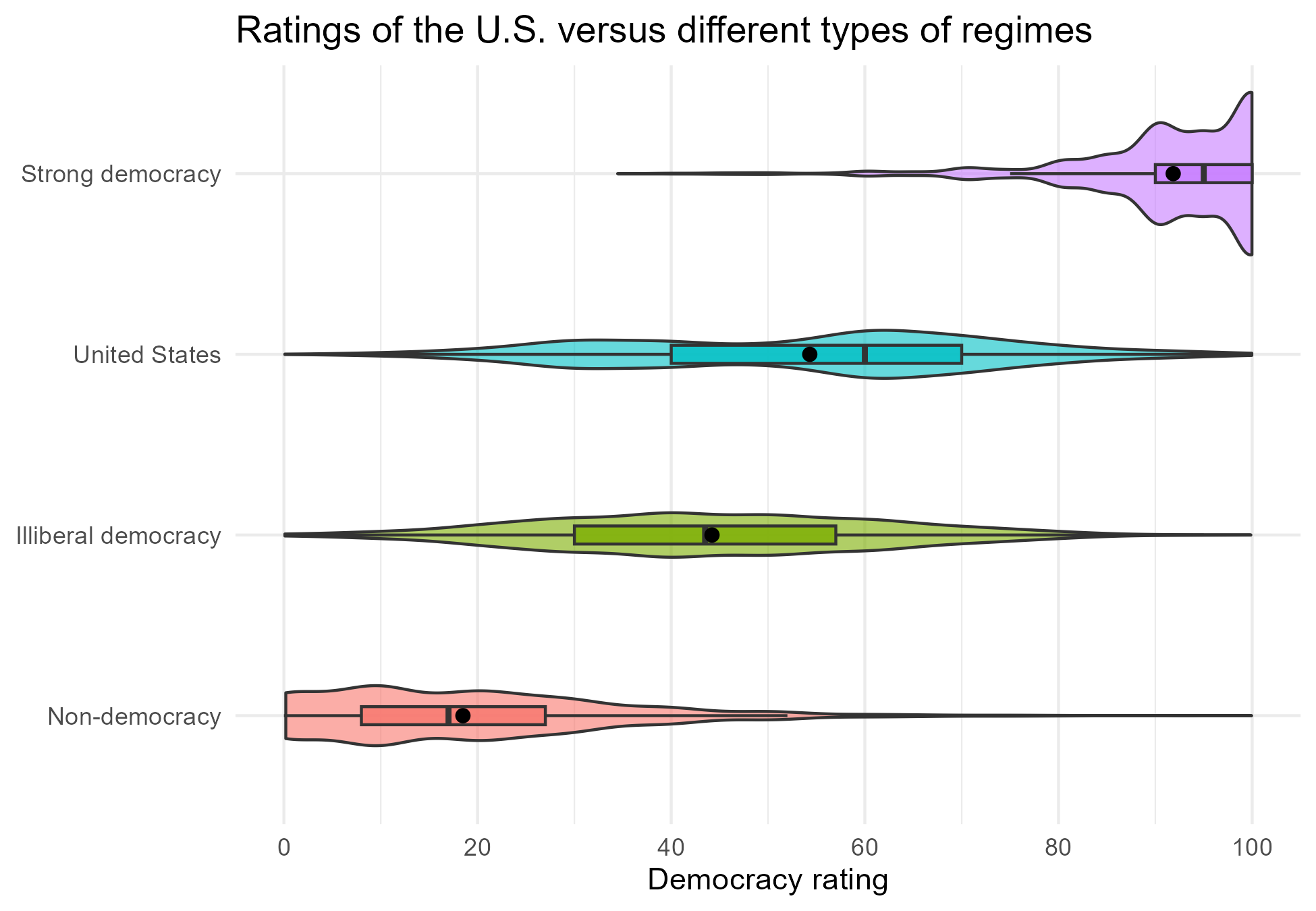
Notably, variation in ratings is greater for the United States than the hypothetical illiberal democracy, which could represent genuine heterogeneity in democratic performance for the U.S. (discussed further below) or could suggest that evaluating a real country generates greater polarization among experts than a hypothetical one.
When asked how they expect to rate U.S. democracy in 2027, experts continue to forecast a decline to 47, which would be its lowest point in our data. In contrast, the public expects slight improvements in American democracy in two years — to 49 for the public overall and to 41 and 60 for Democrats and Republicans, respectively. These forecasts of future ratings are statistically unchanged among experts, the public, and Democrats and Republicans in the public since our April survey (see graph in the appendix).
Assessing U.S. performance on specific democratic principles
As in past surveys, we asked expert and public respondents to rate the extent to which specific democratic principles are currently upheld in the U.S., including four new items on the neutrality and political exploitation of the military and law enforcement. The full list of all 35 principles measured is provided in the appendix. Experts were asked about a random subset of nine principles; the public was asked about seven.
The figure below shows the percentage of respondents who regard the U.S. as fully or mostly meeting each standard (as opposed to meeting it partly or not at all) among political science experts (green) as well as Democrats (blue) and Republicans (red) from our public sample. The dark markers and confidence intervals represent estimates from September 2025; the light versions represent April 2025 estimates. Asterisks indicate statistical significance at the p<.05 level. (A version of this graph that presents assessments from the experts juxtaposed with those of Democrats and Republicans is provided in the appendix.)
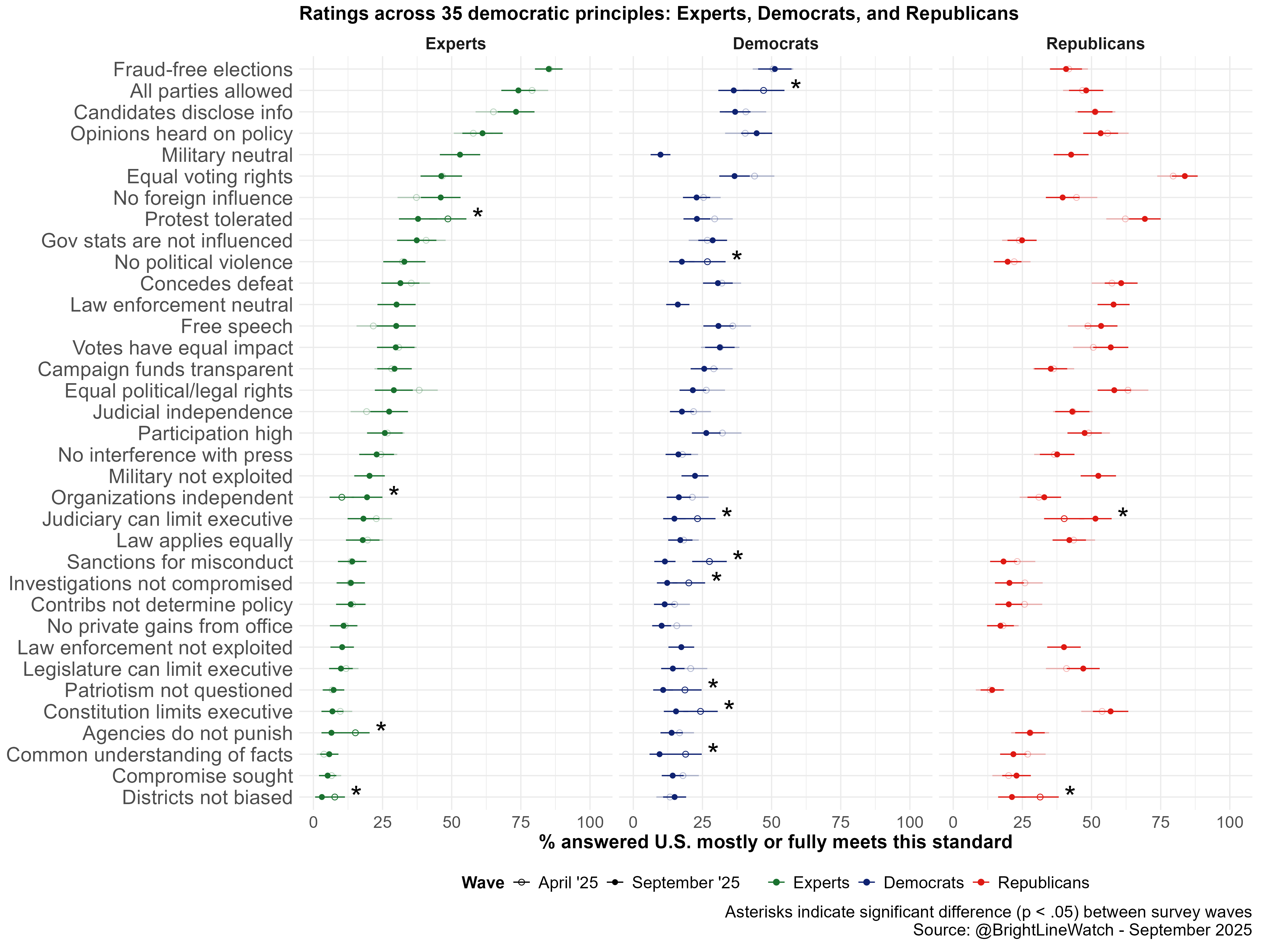
Perceptions of democratic performance in specific areas of concern were relatively stable among experts; ratings of performance on 27 of the 31 principles included in the April and September surveys did not change significantly.
Three of the four changes we observe in expert ratings since April are declines in performance in the following areas: toleration of peaceful protest (from 49% in April 2025 to 38% in September 2025), not using government agencies to punish political opponents (from 15% to 7%), and unbiased election district boundaries (from 8% to 3%). These changes are especially notable considering that the latter two principles had little room to decline further from their previous levels.
By contrast, experts rated democratic performance as improving since April on one democratic principle: organizations such as universities and businesses operating independently of government pressure (from 10% in April to 20% in September). This change may reflect Harvard’s success in resisting pressure from the Trump administration; the April survey took place just after Harvard filed suit against the administration and the September survey began just after a district court decision in its favor.

Though expert ratings have remained largely stable since April, it is important to note the longer-term decline in expert evaluations of democratic performance we have seen compared to post-election ratings from November 2024. As the figure below demonstrates, expert ratings have declined significantly on 20 of the 31 ratings we have measured across that time period (at the p<.01 level), including government agencies not being used to punish political opponents (from 68% in November 2024 to 7% in September 2025), not interfering with the press (from 76% to 23%), and respecting the right to free speech and expression (from 81% to 30%).
Performance ratings were also largely stable since April among Democrats and Republicans on the 31 democratic principles tracked in both surveys. Democrats were more likely to perceive declines in performance; eight such declines were statistically significant at the p<.05 level, including, for example, sanctions for misconduct and constitutional limits on the executive branch. Republicans only perceived a significant decrease in performance on district boundaries not being biased and actually reported improved performance on judicial limits on the executive (perhaps reflecting the cases where court orders have blocked Trump administration actions).
The aftermath of the killing of Charlie Kirk
The conservative commentator and activist Charlie Kirk, who directed the group Turning Point USA, was shot and killed in an apparent act of political violence during an event at Utah Valley University on September 10. The event attracted enormous political and media attention given Kirk’s fame and the public nature of his murder, which was captured on videos that circulated widely on social media. President Trump and his allies called for retribution against left-wing groups they blamed for the shooting despite a lack of credible evidence to support these claims. The event’s aftermath also featured a backlash against reactions to Kirk’s death that were seen as inappropriate. Numerous people were fired from their jobs or sanctioned by their employers, including teachers and professors as well as ABC late night host Jimmy Kimmel, whose show was temporarily suspended amidst pressure from Brendan Carr, the Trump appointee who chairs the Federal Communications Commission.
Our expert and public surveys were collecting data at the time of the shooting. As discussed below, 85% of experts rated Kirk’s shooting as a threat to democracy, including 57% who called it an extraordinary or serious threat.
In the figure below, we separately measure overall expert and public ratings of U.S. democracy as well as evaluations of performance on the democratic principle that “Government effectively prevents private actors from engaging in politically-motivated violence or intimidation” for responses received in the days before the shooting and those received afterward. (We exclude the day of the shooting given the ambiguity of when people learned about the news.)

None of the changes in ratings of U.S. democracy overall reach conventional levels of statistical significance for any group (experts, the public, and Democrats and Republicans in the public). However, the percentage of experts who say the country is fully or mostly meeting the standard of the government effectively preventing political violence or intimidation did fall significantly, declining from 52% to 29% (no changes were significant among the public or partisan subgroups). We observe no statistically significant difference after the shooting among any group in perceived performance at protecting unpopular speech, using law enforcement to advance political agendas, or using government agencies to punish political opponents.
Our survey measures of approval of the Kirk shooting were especially concerning. Prior surveys by Bright Line Watch and others show that support for hypothetical acts of political violence is typically very low once inattentive respondents are excluded and terms like “violence” are defined more precisely. In February 2025, for instance, we found that only 3% of Democrats and 2% of Republicans endorse violent felonies to advance their political goals. New data collected after the Kirk shooting by the Polarization Research Lab (PRL) shows that only 1% of Americans explicitly endorse partisan murder in a hypothetical scenario (down from 3% previously).
However, the PRL data shows that 3.3% of Americans said it is always acceptable for a person to be happy about the murder of a public figure they oppose and another 8.1% said it was usually acceptable. Among Democrats, 4.3% said it was always acceptable to be happy and 14.9% said it was usually acceptable.
In our public survey data, we asked respondents a more direct question — whether they approved or disapproved of various recent events, including that “Conservative commentator Charlie Kirk shot and killed while speaking at a college campus in Utah” (added to our survey on the evening of the shooting). For these estimates, we follow best practices from past research and exclude survey respondents who failed a survey attention check or who admit to providing humorous or insincere responses. Overall, Americans overwhelmingly indicated that they disapprove of Kirk’s killing, including 88% of Democrats and 95% of Republicans. However, 12% of Democrats approved — an estimate that is distressingly high for a real-world event. These results suggest that more people may approve of or at least tolerate violence against specific disfavored figures after the fact than are explicitly willing to endorse political violence in the abstract, especially when the figure in question previously made statements that partisans find offensive.
Fighting fire with fire? Redistricting and responses to democratic norm violations
With Republican prospects in the 2026 U.S. House of Representatives elections looking unfavorable, Texas Republicans redrew the district boundaries in their state in an unusual mid-decade redistricting intended to gain five seats for the party. A similar plan was enacted in Missouri to yield another Republican seat, though an effort is underway to force it to be approved through a referendum first. In response to the Texas move, Democrats in California enacted a plan to put an initiative up for a special election that would redistrict their state to yield five additional seats for Democrats. Other states may soon enter the fray.
We surveyed both experts and the public to understand how they evaluated these actions. We consider first the actions taken by Texas and California, which were the most widely publicized, before discussing the more general scenario of tit-for-tat redistricting and measuring how different groups evaluate violating democratic norms in response to perceived norm violations.
The experts are concerned about Texas Republicans redrawing their state’s congressional map before the 2026 election — in total, 92% rate it as a threat to democracy — but are divided on the California plan to redraw their districts. California Democrats describe their actions as a response to the Texas plan, but only 32% of experts see the California redistricting proposal as a benefit to democracy, whereas 38% see it as a threat. One possible interpretation of these findings is that experts are concerned about the prospect of a spiral of escalation between the parties.
To estimate the extent of the perceived harm, we asked both expert and public respondents to provide the ratings on a 0–100 scale that they expect to give U.S. democracy in 2027 under two scenarios: (1) Texas redraws its congressional map boundaries and California does not versus (2) California and Texas both redistrict. These ratings are plotted below for experts, the public overall, and Democrats and Republicans in the public sample.
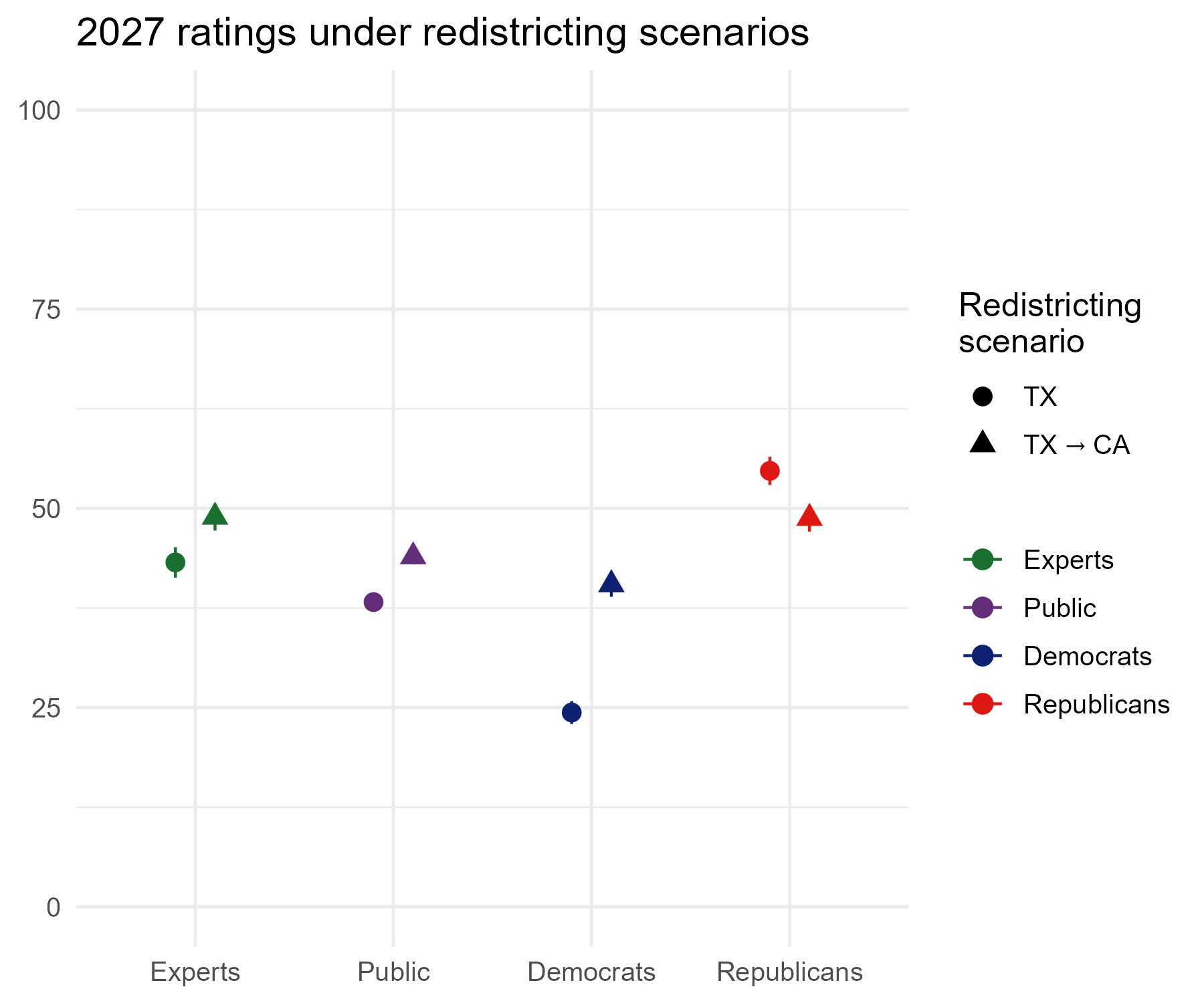
Experts, who indicated earlier in the survey, on average, that they expected to rate U.S. democracy as 47 in 2027, expected to rate U.S. democracy as 43 on average in 2027 if only Texas redistricts, a significant decline. However, conditional on California responding with its own redistricting, their expected ratings rebound somewhat to 49, a significant improvement versus the Texas-only scenario. We observe similar patterns of higher ratings for the offsetting redistricting scenario among the public overall (38 versus 44) and among Democrats (24 versus 40), whereas Republicans expect to rate U.S. democracy somewhat lower if both states redistrict (49) than if Texas redistricts unilaterally (55).
As the figure below illustrates, this pattern of differential approval of redistricting among Republicans largely persists when we asked respondents about randomized variations of a scenario in which one party redistricts in one unspecified state and the other party redistricts in another.
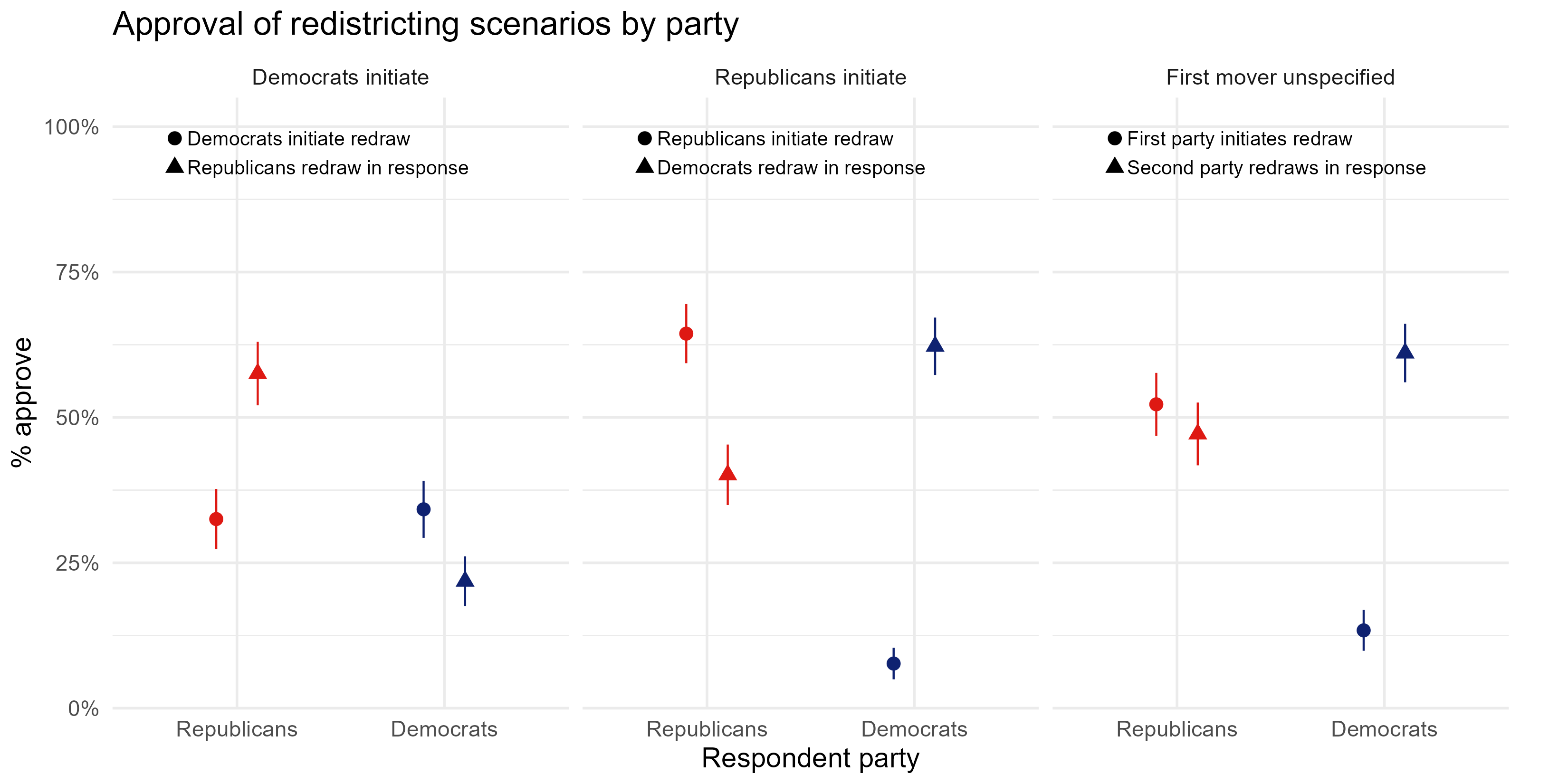
As in the specific Texas/California case above, Republicans largely approve (64%) of the GOP redistricting first in one state and disapprove (40% approval) when Democrats redistrict in response. Democrats, unsurprisingly, disapprove of Republicans redistricting first (just 8% approve) but they approve (62%) of Democrats redistricting in another state in response.
However, Republicans tend to be more supportive of redistricting overall. For instance, when Democrats move first, most party members do not approve. In total, only 34% of Democrats approve of their party redistricting unilaterally, which is not measurably different than the 33% approval we observe among Republicans in the same scenario. By contrast, a majority of Republicans (64%) approve of their party moving first.
We also asked a random subset of respondents to consider a more abstract scenario in which the political parties are not named. They were instead just told about “one party” initiating redistricting and the “other party” responding. Here again, a majority of Republicans (52%) approves of the party initiating the process and a near-majority approves the second party responding in kind (47%). Democrats, by contrast, overwhelmingly disapprove initiating a redraw (just 13% approve) but, conditional on one party having started the process, they typically approve of the second party responding (61%).
Finally, we consider the principle of “fighting fire with fire” in response to perceived democratic norm violations (as California Governor Gavin Newsom and other Democrats have put it). We asked members of the public the following question: “When politicians from {the Democratic Party, the Republican Party, one party} violate democratic norms to gain advantage, is it acceptable for the {Republican Party, Democratic Party, other party} to violate democratic norms in response?” Respondents could answer by saying “Always acceptable — you have to fight fire with fire,” “Sometimes acceptable — only to restore balance,” or “Never acceptable — two wrongs don’t make a right.”
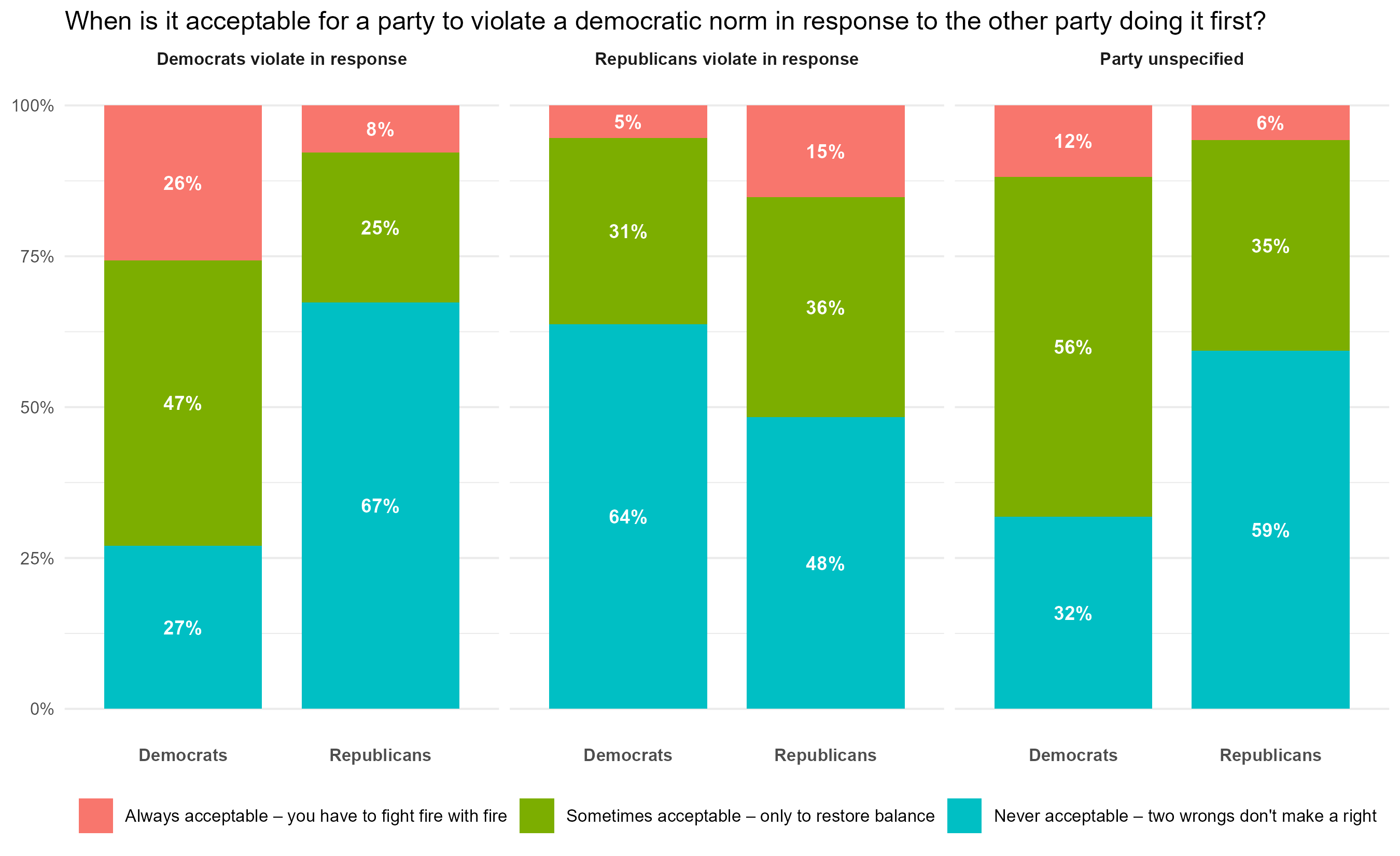
We observe notable differences in support for responding to democratic norm violations with a democratic norm violation. In a scenario where the other party is described as committing the first norm violation, 67% of Republicans and 64% of Democrats say it is never acceptable for the other party to violate norms in response. In the opposite scenario, however, 52% of Republicans and 73% of Democrats say it is always or sometimes acceptable for their party to violate norms in response to a norm violation by the other party. The greater endorsement among Democrats may reflect their status as the party out of power or the sequencing of the Texas and California redistricting initiatives. (Partisan responses to the generic “one party”/“other party” scenario fall somewhere in between these two extremes.)
Experts were only asked the “one party”/“other party” question variant. Seven in ten said violating norms in response to a norm violation is sometimes acceptable to restore balance compared to 23% who said it is never acceptable and 6% who said it is always acceptable.
Actual and potential threats to democracy
We asked our experts to assess the impact of a list of recent events (including the Kirk shooting) and potential future events on American democracy. The set of recent events that experts were asked to consider was the following (each rated a random subset of 8 from the full list):
Full list of recent events
- After its federal research grants were frozen, Columbia University pays a $200 million fine to settle allegations from the Trump administration that it failed to do enough to stop the harassment of Jewish students.
- The Trump administration freezes federal research grants to UCLA and demands a $1 billion settlement over alleged civil rights violations.
- President Trump tries to fire Federal Reserve Governor Lisa Cook after his administration accuses her of mortgage fraud
- Federal Reserve Governor Lisa Cook sues the Trump administration after he tries to fire her for alleged mortgage fraud.
- Texas Republicans redraw their state’s congressional map before the 2026 election to be more favorable to Republicans.
- In response to Texas GOP redistricting, California Democrats schedule a special election on a ballot measure to redraw their state’s congressional maps before the 2026 election to be more favorable to Democrats.
- The Trump administration deploys over 800 National Guard troops to Washington, D.C.
- Over 1,100 National Guard troops from Republican-led states are deployed to Washington, D.C., at the request of the Trump administration.
- President Trump fires Bureau of Labor Statistics Commissioner Erika McEntarfer after accusing her of misrepresenting jobs data.
- President Trump issues an executive order requiring political appointees to approve federal research grants which were previously managed by career scientists and civil servants.
- The Trump administration announces an investigation into New York Attorney General Letitia James for alleged mortgage fraud.
- U.S. Immigration and Customs Enforcement (ICE) dramatically expands its enforcement and detention capacity.
- CBS parent company Paramount agrees to $16M settlement of Trump lawsuit over a Kamala Harris interview on “60 Minutes.”
- The Federal Communications Commission approves merger of CBS parent company Paramount after $16M settlement with Trump over a Kamala Harris interview on “60 Minutes.”
- The Supreme Court issues a decision that allows the Department of Homeland Security to deport noncitizens to third countries without notice while litigation proceeds.
- Columbia graduate Mahmoud Khalil is released from ICE detention by court order.
- The Supreme Court allows Trump to remove independent agency members without cause.
- After a scuffle outside an immigration detention facility, Newark Mayor Ras Baraka is arrested for trespassing and Congresswoman LaMonica McIver is charged with assaulting law enforcement officers.
- The United States accepts the donation of a Boeing 747‑8 jet from Qatar for use as Air Force One.
- A Supreme Court decision allows the Trump administration to proceed with sweeping layoffs of federal workers.
- The Trump administration deploys National Guard troops to Los Angeles in response to protests.
- The Supreme Court holds that federal courts cannot issue universal or nationwide injunctions.
- The administration ends direct federal funding to NPR and PBS.
- A gunman kills Minnesota state Rep. Melissa Hortman and her husband and wounds another lawmaker and their spouse in a politically motivated attack.
- FBI agents raid the home of former Trump adviser turned critic John Bolton.
- President Trump claims that he has the authority to use military force against suspected drug smugglers outside the U.S. as if they were wartime combatants.
- A federal judge orders the Trump administration to reverse its cuts of more than $2.6 billion in research funding for Harvard University.
- The District of Columbia sues to stop President Trump’s deployment of National Guard in Washington.
- President Trump directs the Secretary of Defense to create a standing National Guard quick reaction force.
- Conservative commentator Charlie Kirk is shot and killed while speaking at a college campus in Utah.
Experts were first asked whether each event would benefit, threaten, or not affect American democracy. Those who selected benefit or threat were then asked if the benefit or threat was little, moderate, serious, or extraordinary. The graph below is ordered by the percentage of experts who identify the event as a threat to democracy.
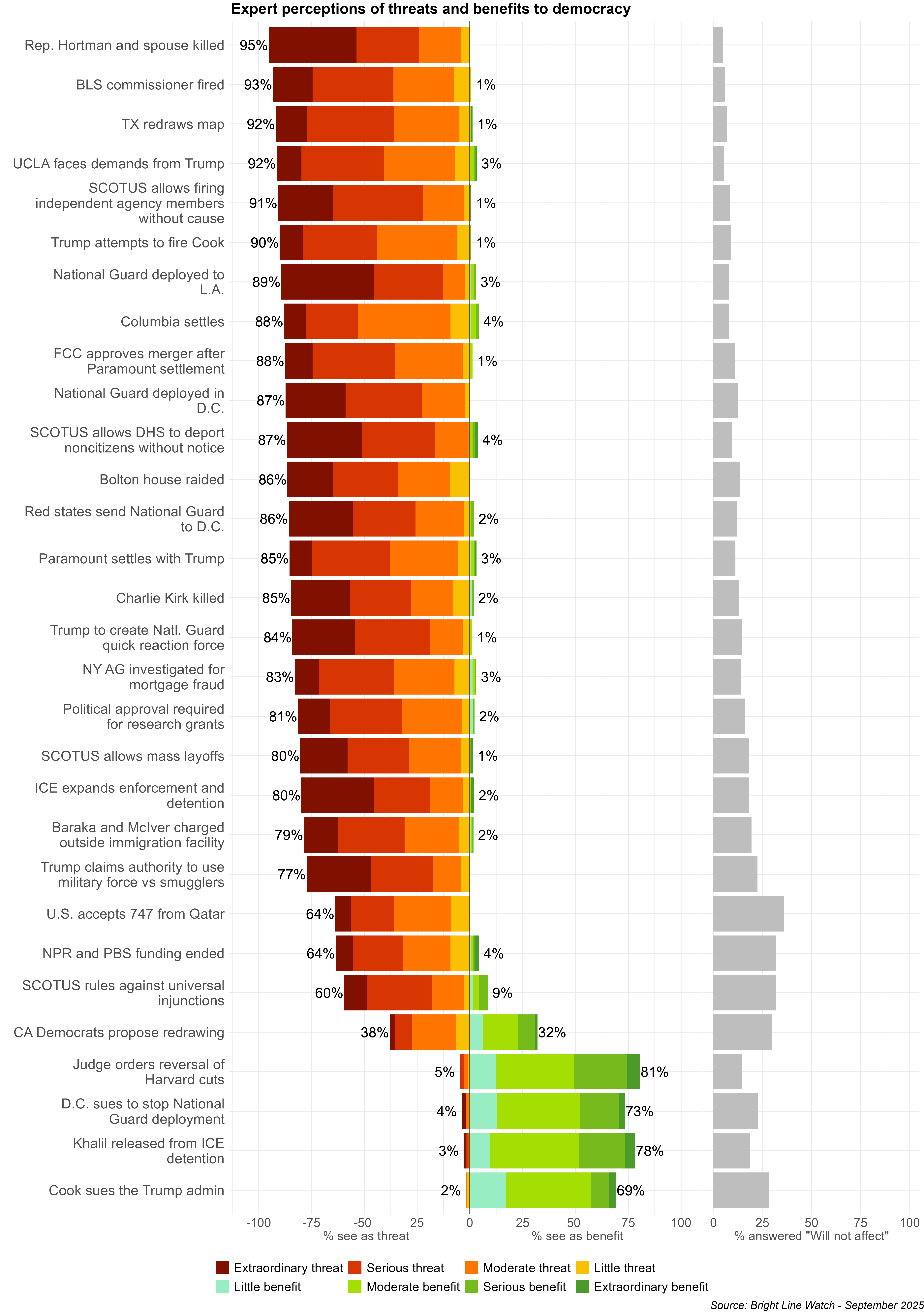
In total, twenty events were rated as a threat to democracy by 80% of experts or more, including the killing of Minnesota state legislator Melissa Hortman and her husband (95%), Trump’s firing of the Bureau of Labor Statistics commissioner Erika McEntarfer (93%), and Texas changing its congressional districts mid-decade to advantage Republicans in the 2026 election (92%). The events that were rated as extraordinary or serious threats by the greatest proportion of experts were the National Guard deployment to Los Angeles (77% extraordinary/serious), the Supreme Court allowing the Department of Homeland Security to deport non-citizens without notice (70% extraordinary/serious), Trump directing the Department of Defense to create a National Guard quick reaction force (65% extraordinary/serious), and the dramatic expansion of the enforcement and detention capabilities of U.S. Immigration and Customs Enforcement (ICE; 61% extraordinary/serious). Six other events are rated as threats to democracy by 60% of experts or more. By contrast, four events are rated as benefits to democracy by 60% or more of experts, including the Harvard court decision ordering the reversal of government funding cuts (81% say it is a benefit) and Mahmoud Khalil being released from ICE detention (79%). Finally, experts are split over the California redistricting plan (as discussed above), with 38% rating it as a threat to democracy, 32% saying a benefit, and 30% saying it will not affect democracy.
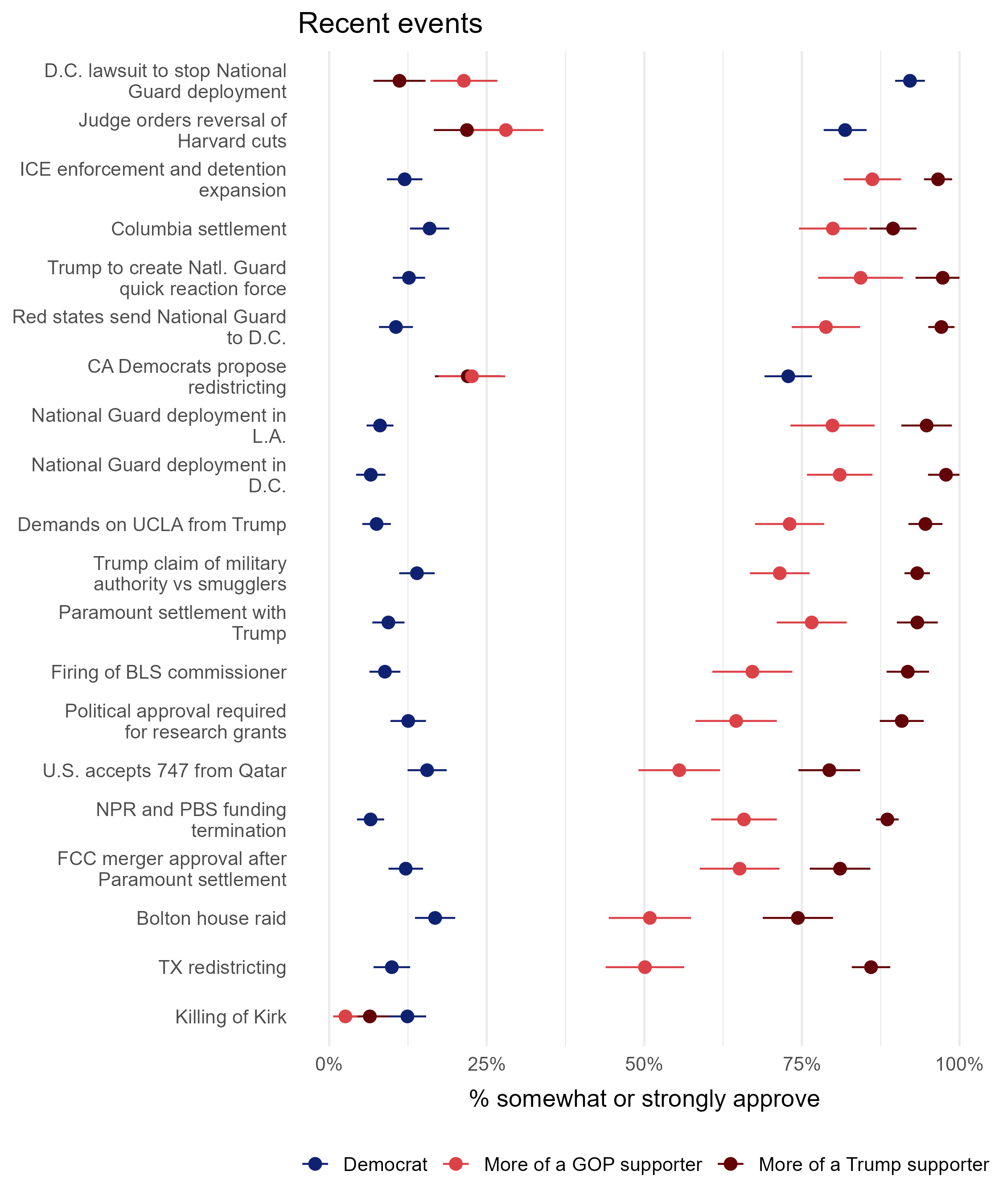
To see how the public views these events, we asked members of the public whether they approved of them or not. The figure below presents approval among Democratic and Republican members of the public (including leaners).
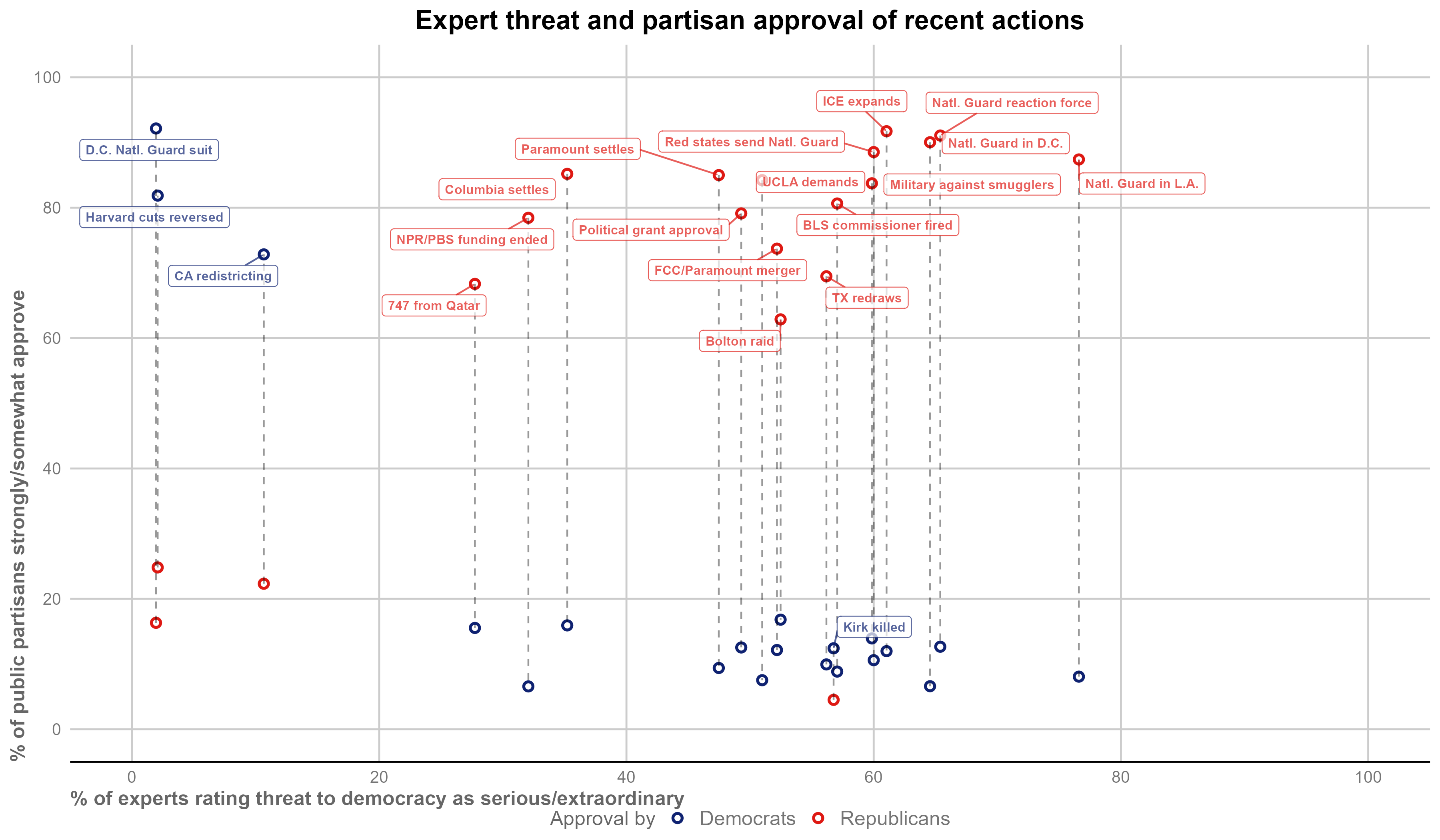
As the figure indicates, numerous recent events that a majority of experts rate as extraordinary or serious threats to democracy receive widespread support from Republicans. For instance, 87% of Republicans approve of the National Guard deployment to Los Angeles, which 77% of experts rated as an extraordinary or serious threat to democracy. Besides Charlie Kirk’s murder, only two events of this type attract support from fewer than 70% of Republicans: the Texas redistricting (69%) and the FBI raid on the home of former Trump adviser turned critic John Bolton (63%).
In addition to these ratings of recent events, experts were also asked to rate whether the following possible future events would present a threat or benefit to American democracy:
Full list of future events
- Habeas corpus is suspended for any group of people within the United States before 2027.
- A federal, state, or local government denies or refuses to recognize the citizenship status of one or more U.S.-born children of non-citizen parents before 2027.
- U.S. authorities transfer a current or former U.S. citizen to a prison abroad before 2027.
- The U.S. government seeks a judicial order to revoke the citizenship of a naturalized American for conduct that occurred after naturalization before 2027.
- The U.S. president formally invokes the Insurrection Act before 2027.
- The President or another executive branch official directs federal law enforcement to refuse to enforce a federal court order before 2027.
- Senior DOJ leaders override normal procedures to open or accelerate a case against a high-profile opponent or critic of the president before 2027.
- Senior DOJ leaders overrule normal DOJ practices and procedures to block, stall, or close a case involving the President or his family, supporters, or allies before 2027.
- The Senate passes a reconciliation bill where Byrd Rule compliance is not determined with input from the Congressional Budget Office before 2027.
- The U.S. presidential administration alters or delays the public release of a major federal economic indicator before 2027.
- Federal prosecutors indict one or more Obama administration officials in connection with the Trump/Russia investigation before 2027.
- Citing concerns about crime, the President deploys National Guard troops to other cities besides Los Angeles and Washington, D.C., before 2027.
- The federal government conducts a new census before the regularly scheduled 2030 census.
- Citing concerns about voter fraud, the President deploys military forces or federal law enforcement outside polling places in the U.S. during the 2026 midterm elections.
- Harvard reaches an agreement with the Trump administration before 2027.
- The Supreme Court significantly limits key provisions of the Voting Rights Act before 2027.
- Trump attempts to stay in power beyond the end of his term in office in January 2029.
The figure below again shows expert ratings of these potential future events ranked by the percentage of experts who rate them as a threat to democracy.
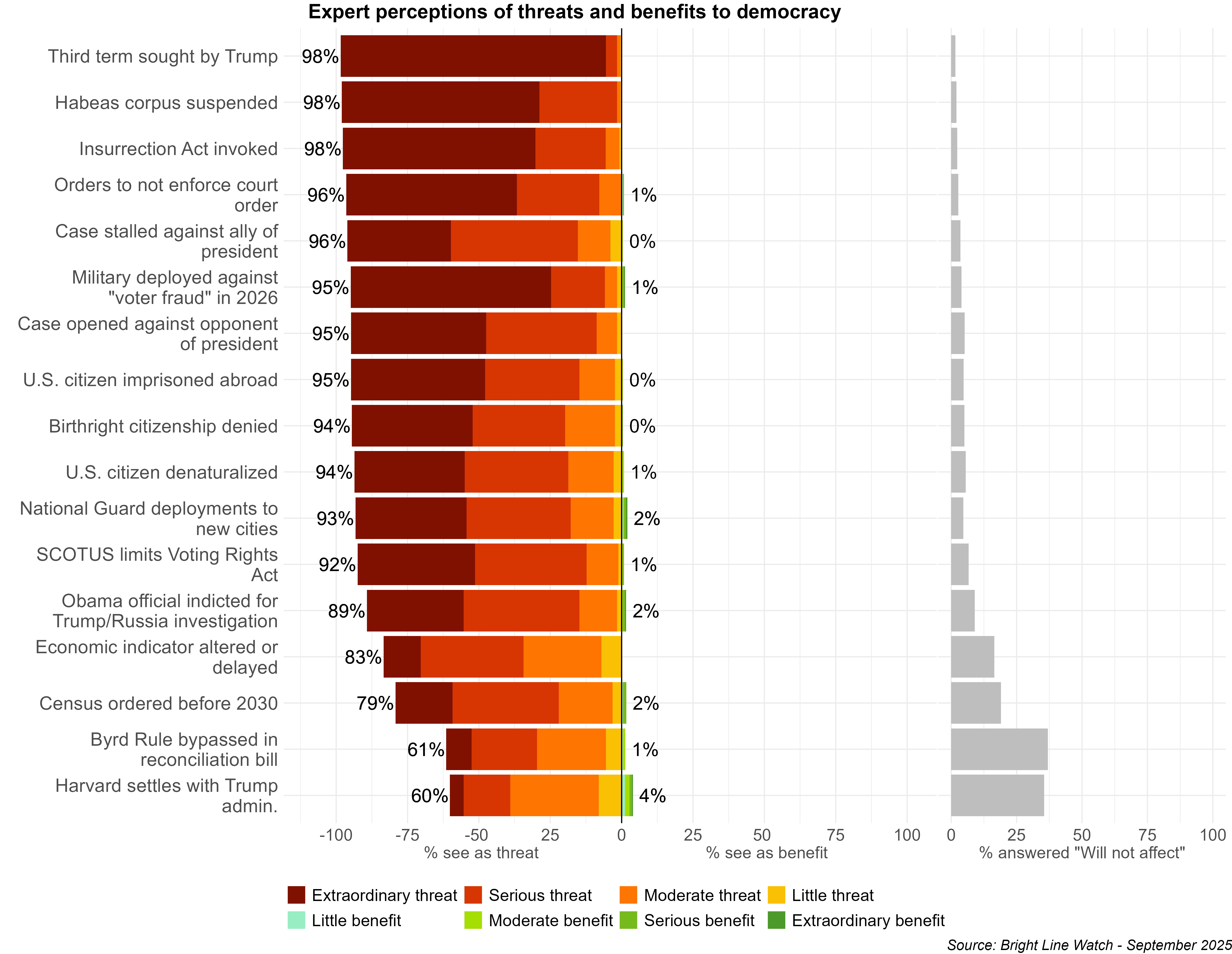
Experts are virtually unanimous on most of the 17 potential events surveyed. In total, 13 were rated as threats to democracy by 89% or more of experts, such as Trump seeking a third term in office in violation of the 22nd Amendment to the Constitution (98%, including 97% who rate it as an extraordinary or serious threat), the suspension of habeas corpus (98%; 96% extraordinary/serious), and invoking the Insurrection Act (98%; 92% extraordinary/serious).
With so many democracy-threatening events taking place or being contemplated as possibilities, it is important to consider the full scope of Trump’s second term. We therefore list the top 10 past events and the top 10 potential future events in the figure below that experts most often rated as posing extraordinary or serious threats to democracy (items from the most recent survey are represented in bold; others are drawn from the February and April surveys).
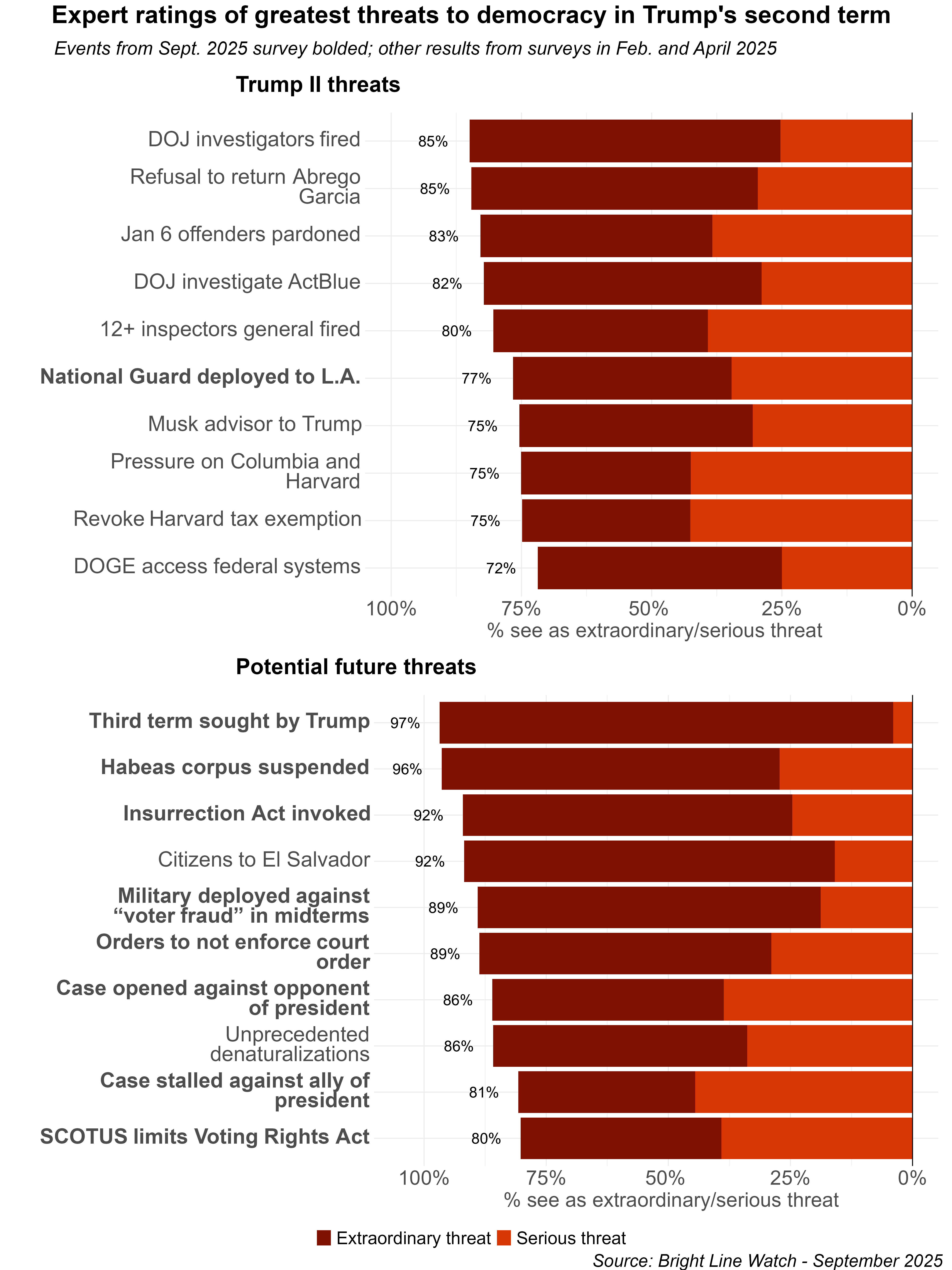
As the figure indicates, the National Guard deployment to Los Angeles is the only event since April 2025 that experts have rated among the top threats to democracy during Trump’s second term (though experts may have adjusted their standards as events have developed since January). However, experts rate eight potential events from the most recent survey as among the ten most significant potential threats to democracy since Trump took office for his second term, suggesting they are even more apprehensive about future developments.
Assessing the likelihood of future threats to democracy
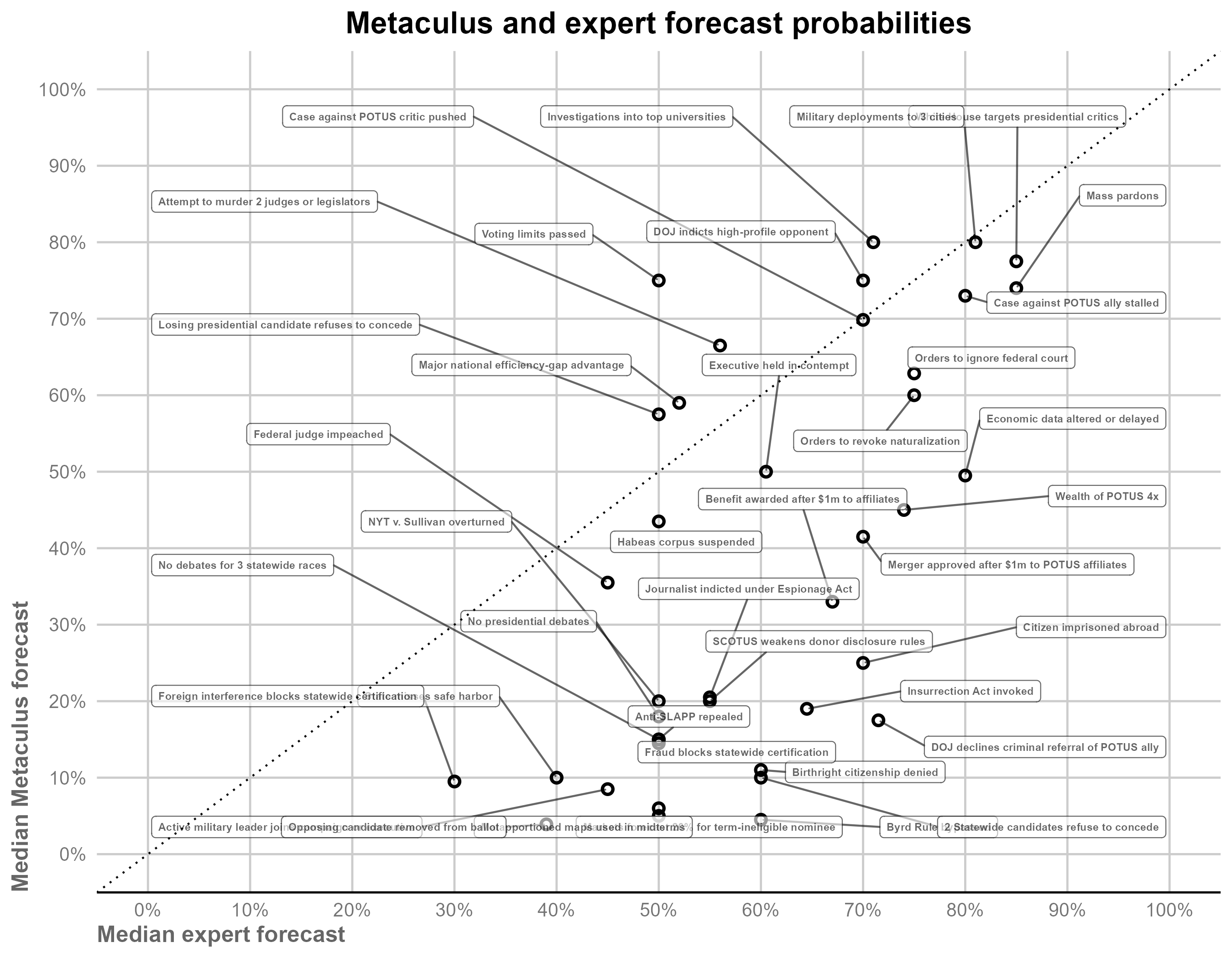
Assessing the likelihood of threats to democracy is a core task of Bright Line Watch. We have therefore asked experts to assess the likelihood of potential threats in our surveys since 2018 and have, since December 2024, adjusted those forecasts to account for an observed tendency toward pessimism (discussed below). To further address concerns about the accuracy of expert forecasts, we have partnered with the prediction platform Metaculus in recent months to generate comparison predictions from forecasters, which we will assess for accuracy in the future.
Following past surveys, we asked experts and forecasters to assign a probability to potential future events that are relevant to the state of democracy in the U.S. As part of our partnership with Metaculus, both groups provided forecasts for forty questions — the 39 questions in the new U.S. Democracy Threat Index that we developed with Metaculus (see overview here) plus one on future expert ratings of U.S. democracy measured by Bright Line Watch. The full list of questions and linked democratic principles is available here. (We focus in this report on forecasts for the 2025–2026 period; the U.S. Democracy Threat Index forecasts on Metaculus also include predictions for 2027–2028.)
Finally, to provide another point of comparison for our experts, we also solicited forecasts from Mantic, a new AI forecasting startup that recently placed eighth out of more than 550 human and AI entrants in a forecasting competition held by Metaculus. The platform described the performance of Mantic’s AI forecast bot as “the best rank a bot has ever achieved competing with human forecasters.”
In this report, we focus on the ten forecast questions concerning unambiguously negative events for democracy where experts rated the threat to democracy the event would pose. The full survey instrument administered to experts, which includes all the forecast questions, is provided here; the U.S. Democracy Threat Index is here. Figures reporting the full set of expert, forecaster, and AI forecasts are in the appendix.
Notably, we have found in past research with the political scientist Andrew Little that experts tend to overestimate the probability of negative events for democracy. We therefore apply the pessimism correction we developed with Little based on the observed incidence of events during the first Trump term to create adjusted forecast probabilities for each item, which are plotted below against the raw expert estimates.
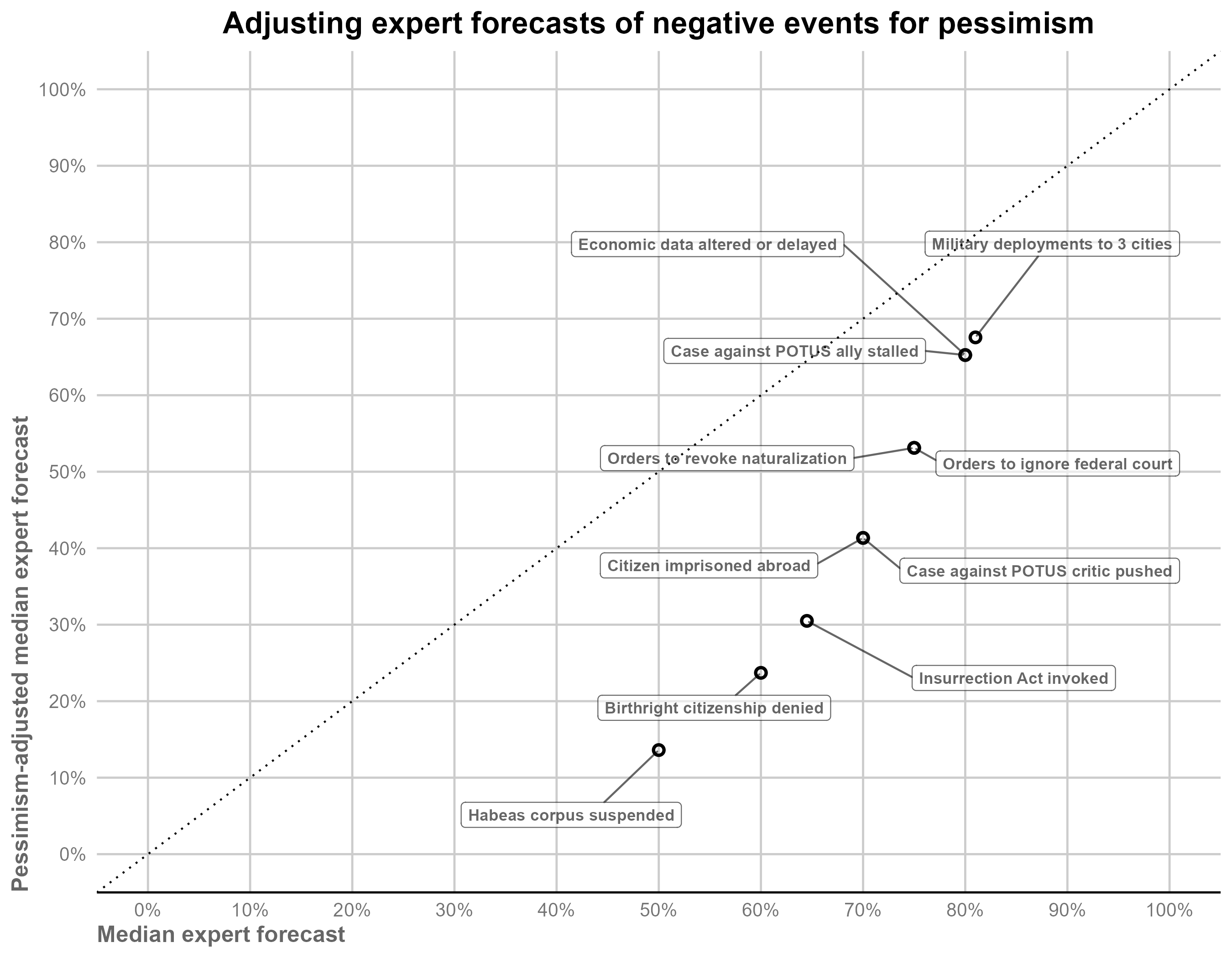
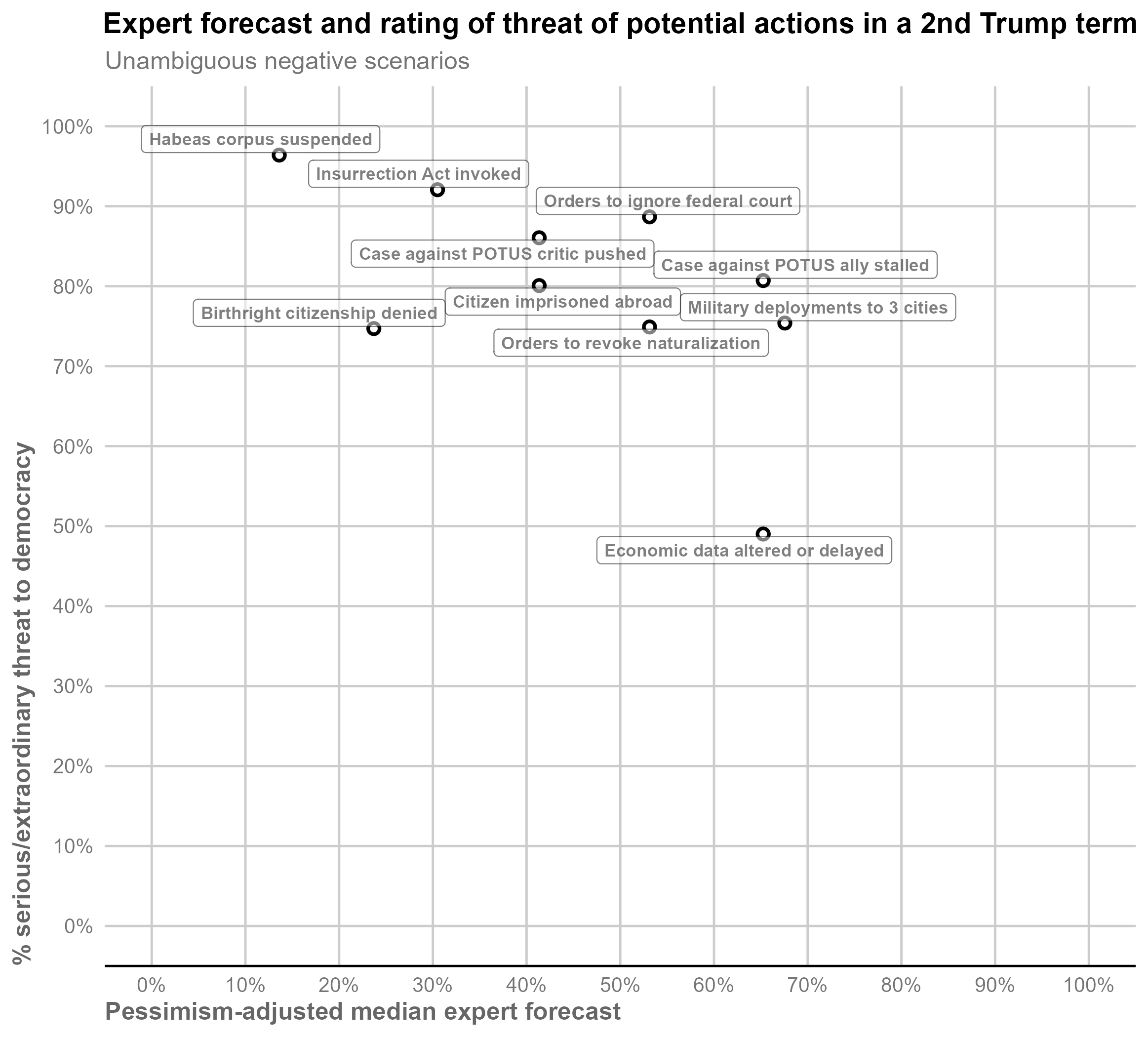
The pessimism adjustment most heavily downweights events around the middle of the probability scale. As a result, the suspension of habeas corpus, which experts rate as having a 50% chance of taking place, has an adjusted forecast probability of 14%. We similarly see substantial decreases in the probability of Trump invoking the Insurrection Act (from 65% to 30%) and imprisoning U.S. citizens abroad (70% to 41%). The adjustment is smaller for events seen as most likely; for instance, experts estimate the probability of economic data being altered or delayed to be 80% compared with 65% after the adjustment.
The figure below then compares our pessimism-adjusted expert forecasts for these potential events with human forecasters on Metaculus.
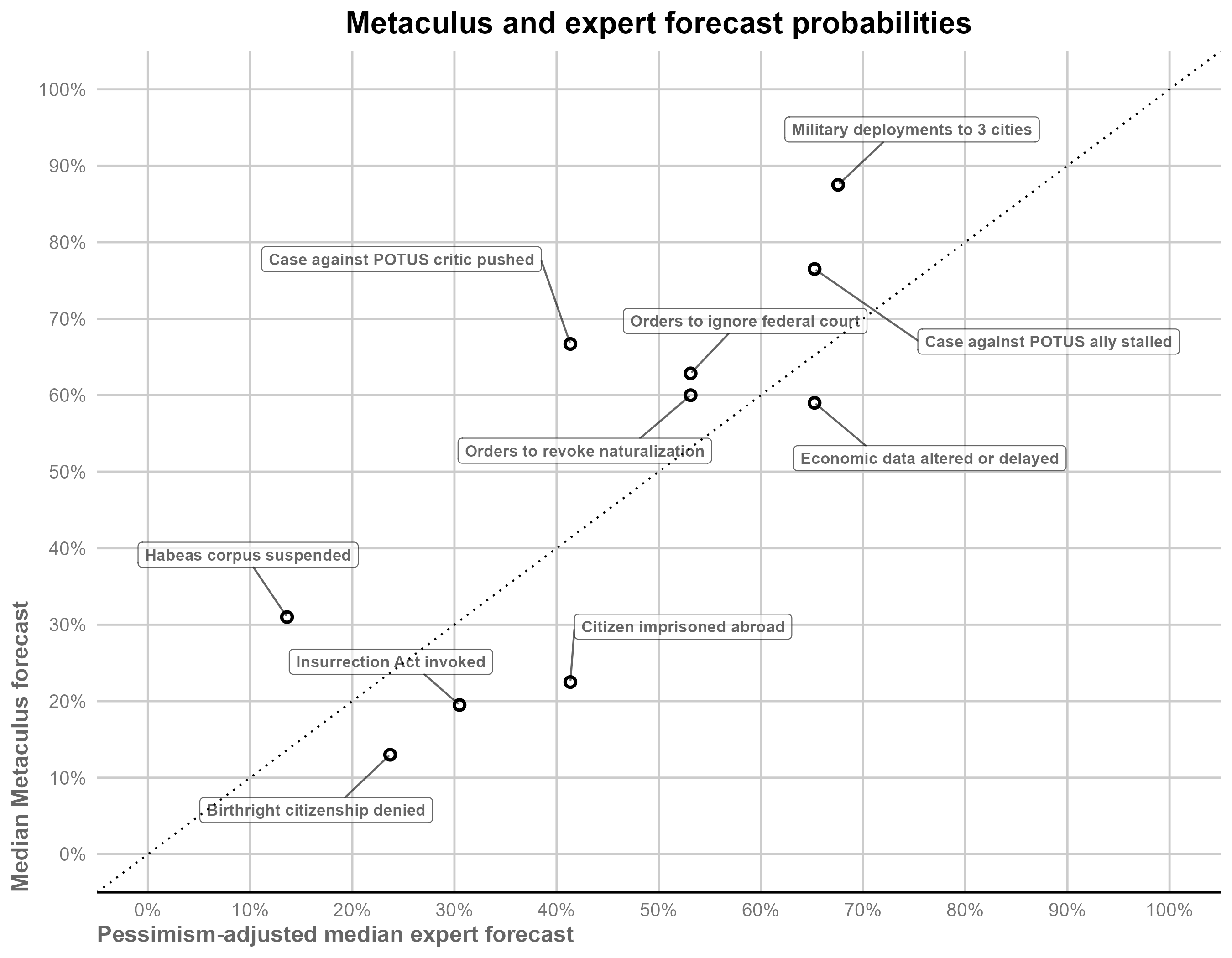
The human forecasters and experts are closely aligned after the pessimism adjustment to the expert forecasts; the median difference in forecasts is 9 percentage points. Alignment is especially close for the Trump administration revoking naturalization for subsequent conduct (53% experts, 60% Metaculus), ordering government officials to disregard court orders (53% experts, 63% Metaculus), and the government altering or delaying economic data (65% experts, 59% Metaculus). Metaculus forecasters see a much greater likelihood than experts of normal procedures being overridden in a case against a critic or opponent of the president (41% experts, 67% Metaculus) but are more skeptical about the chances of a U.S. citizen being imprisoned abroad (41% experts, 23% Metaculus). Notably, however, experts are not always more pessimistic after the adjustment; Metaculus forecasters rate the probability of six of the ten events higher than do experts.
The figure below instead compares expert forecasts (with the pessimism adjustment) to the AI forecasts from Mantic. (A graph comparing Metaculus human forecasts and Mantic AI forecasts is provided in the appendix.)
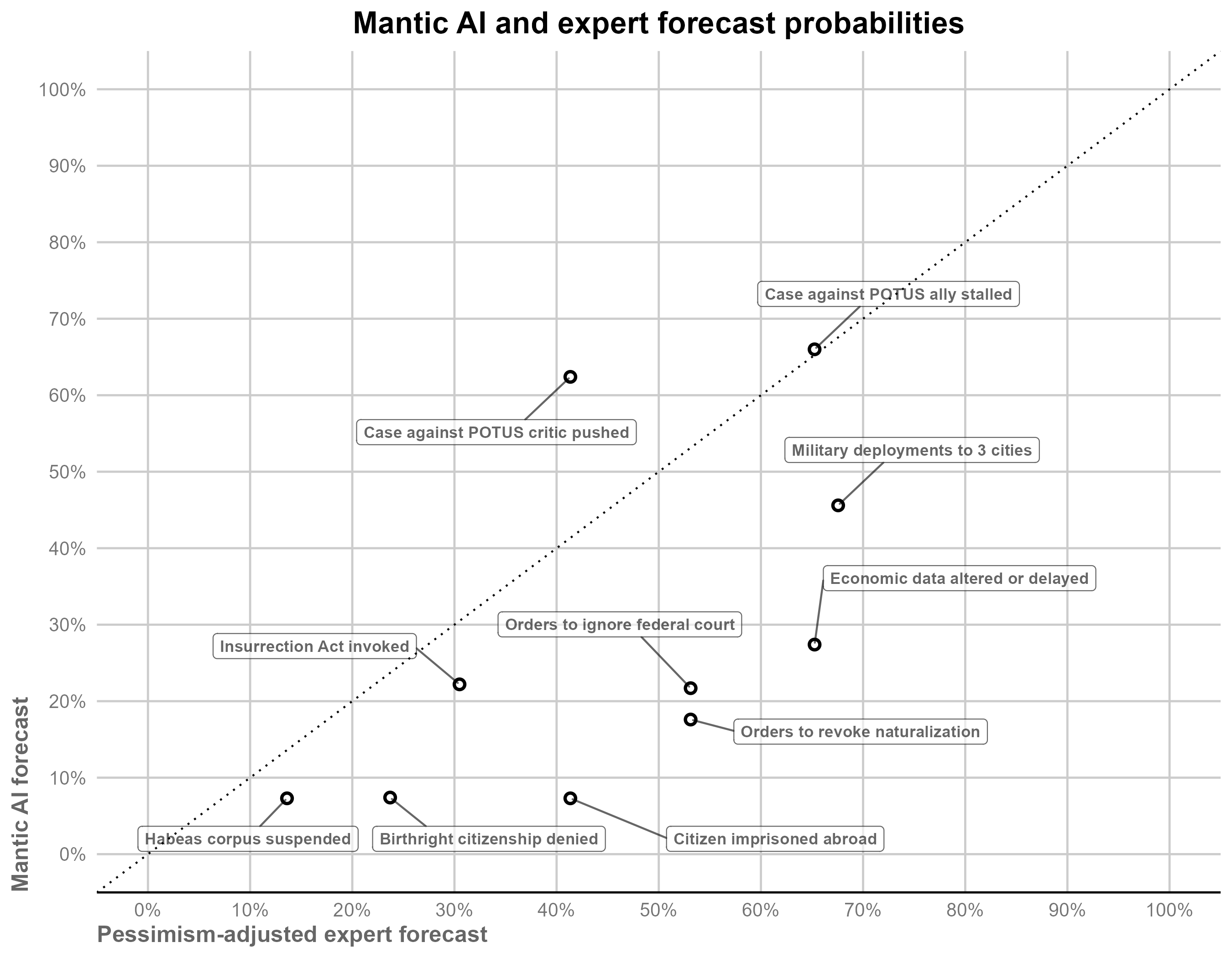
As the figure indicates, experts thought the events in question were more likely to occur than the AI forecasts from Mantic even after the pessimism adjustment. Divergences were especially wide for a U.S. citizen being imprisoned abroad (41% experts, 7% Mantic) and naturalization being revoked for subsequent conduct (53% experts, 18% Mantic). This gap may reflect the emphasis in forecasting (both human and AI) on prior probabilities of outcomes taking place (“base rates”), which are typically low in the U.S. given its relatively high levels of democratic performance and adherence to the rule of law in recent decades. The reasoning that Mantic’s AI provides for its estimates repeatedly describes historical precedents and event frequencies.
Finally, the figure plots the three event probability forecasts — experts, prediction platform forecasters, and the AI forecasts from Mantic — against the percentage of experts who view the potential event as posing an extraordinary or serious threat to democracy.
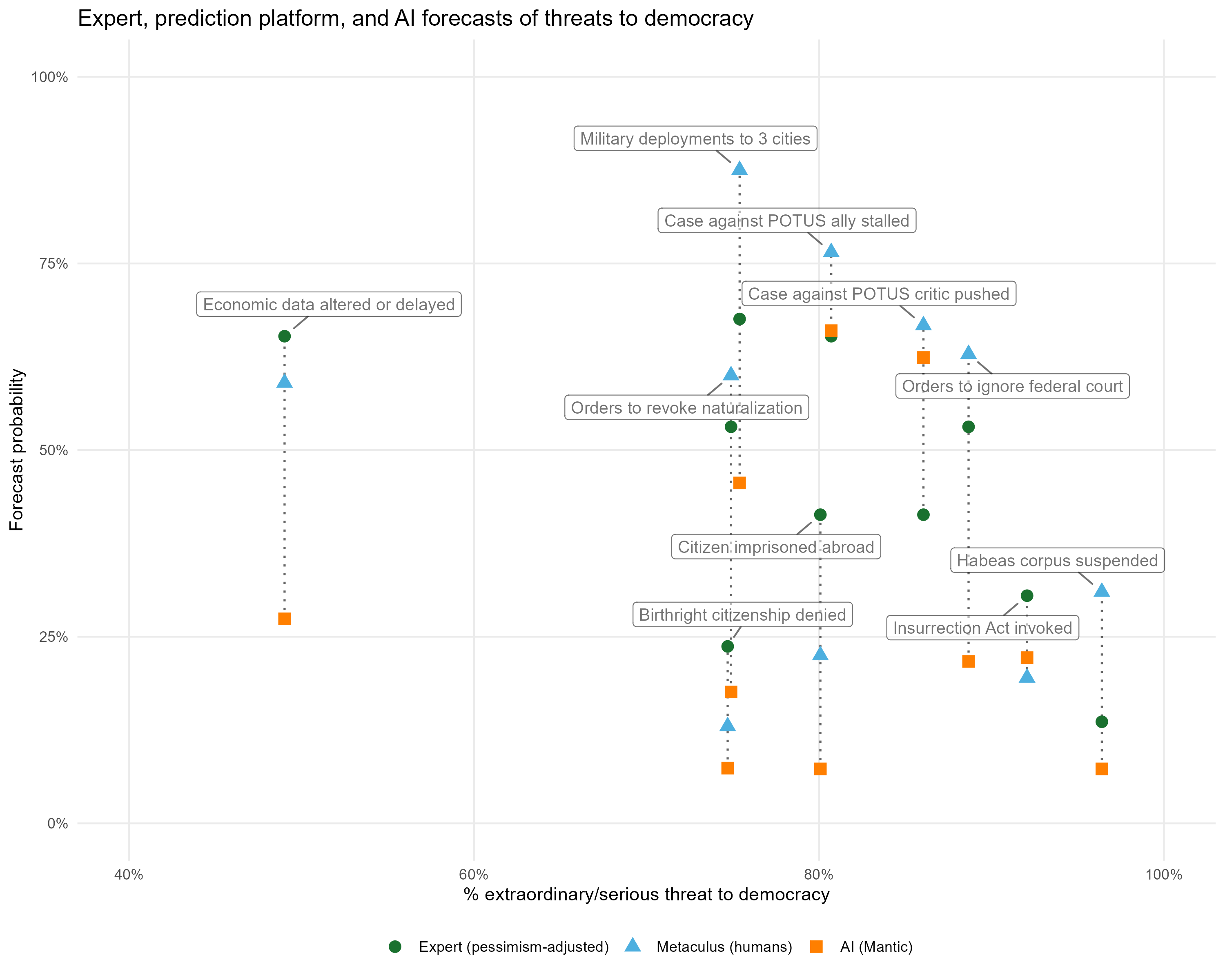
Among the events rated by most experts as an extraordinary or serious threat to democracy (all but the manipulation of economic data), the median forecast among experts, prediction platform forecasts, and Mantic’s AI forecast for 2025–2026 is a 50% or greater likelihood of normal procedures being overridden in legal cases concerning presidential allies and opponents (66% and 62%, respectively), a military deployment to a third metro area besides Los Angeles and Washington, D.C. (68%), an order revoking naturalization based on subsequent conduct (53%), and an order directing law enforcement not to enforce a court order (53%). Forecast probabilities are lower for other events rated as very serious threats to democracy: invoking the Insurrection Act (median forecast: 22%), imprisoning a U.S. citizen abroad (23%), denying birthright citizenship (13%), and suspending habeas corpus (14%).
Support for antidemocratic actions
Participants were asked about their support for practices that undermine the public good and could damage democracy using a scale drawn from prior research. Specifically, we asked whether they agree or disagree that their co-partisans should take the following set of actions:
- should do everything they can to hurt the [other party], even if it is at the short-term expense of the country;
- should do everything in their power within the law to make it as difficult as possible for [the other party] to run the government effectively;
- should redraw districts to maximize their potential to win more seats in federal elections, even if it may be technically illegal;
- should use the Federal Communications Commission to heavily restrict or shut down Fox News [shown to Democrats] / MSNBC [shown to Republicans] to stop the spread of fake news
- it’s OK to sacrifice U.S. economic prosperity in the short-term in order to hurt [the other party’s] chances in future elections.
We previously measured support for these antidemocratic actions in our November 2021 survey; we revisit them now to assess whether support levels have changed nearly four years later with a switch in party control of the White House and President Trump taking many actions that experts perceive as threatening democracy. The results are presented in the figure below.
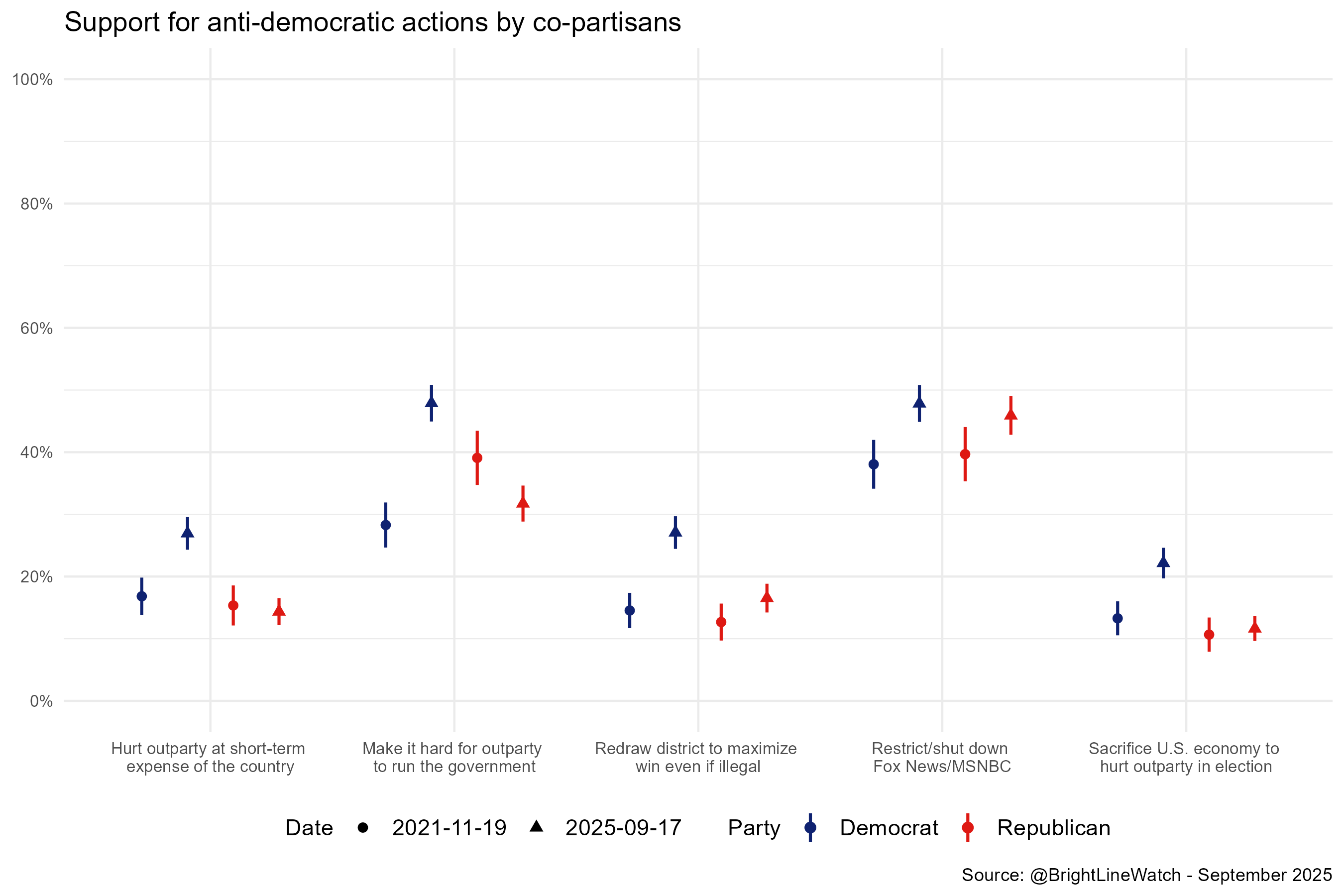
Democrats controlled the White House and both chambers of Congress in 2021 but now control none of these, plus they have very negative expectations about the future of American democracy. Accordingly, they are more supportive of each of these norm-violating tactics than they were nearly four years ago, though none receives majority support from Democratic partisans. It is important to note that the interpretation of some items may differ in the current context versus 2021 (e.g., the appropriateness of “do[ing] everything in their power within the law to make it as difficult as possible for [the other party] to run the government effectively”). However, Democratic approval increased even for “technically illegal” redistricting (from 12% in 2021 to 27% in 2025) and for restricting or shutting down Fox News (from 37% to 50%). Republican support for these actions is lower or unchanged except for redistricting (from 10% to 16%), possibly reflecting support for the Texas plan, and restricting or shutting down MSNBC (an increase from 38% to 47%), potentially in response to President Trump repeatedly calling for government actions against television networks.
Appendix
Bright Line Watch conducted its twenty-sixth survey of academic experts and its twenty-third survey of the general public from September 5–17 and September 5–16, respectively. Our public sample consisted of 2750 participants from the YouGov panel who were selected and weighted to be representative of the U.S. adult population. We also surveyed 703 political science experts across a diverse range of subfields. Our email list was constructed from the faculty list of U.S. institutions represented in the online program of the 2024 American Political Science Association conference.All estimates shown in the report used weights provided by YouGov. Our expert sample is unweighted because we do not collect demographic data to protect anonymity. Error bars in our graphs represent 95% confidence intervals. Data are available here.
35 democratic principles
- Government officials are legally sanctioned for misconduct
- Government officials do not use public office for private gain
- Government agencies are not used to monitor, attack, or punish political opponents
- All adult citizens enjoy the same legal and political rights
- Government does not interfere with journalists or news organizations
- Government effectively prevents private actors from engaging in politically-motivated violence or intimidation
- Government protects individuals’ right to engage in unpopular speech or expression
- Political competition occurs without criticism of opponents’ loyalty or patriotism
- Elections are free from foreign influence
- Parties and candidates are not barred due to their political beliefs and ideologies
- All adult citizens have equal opportunity to vote
- All votes have equal impact on election outcomes
- Elections are conducted, ballots counted, and winners determined without pervasive fraud or manipulation
- Executive authority cannot be expanded beyond constitutional limits
- The legislature is able to effectively limit executive power
- The judiciary is able to effectively limit executive power
- The elected branches respect judicial independence
- Voter participation in elections is generally high
- Information about the sources of campaign funding is available to the public
- Public policy is not determined by large campaign contributions
- Citizens can make their opinions heard in open debate about policies that are under consideration
- The geographic boundaries of electoral districts do not systematically advantage any particular political party
- Even when there are disagreements about ideology or policy, political leaders generally share a common understanding of relevant facts
- Elected officials seek compromise with political opponents
- Citizens have access to information about candidates that is relevant to how they would govern
- Government protects individuals’ right to engage in peaceful protest
- Law enforcement investigations of public officials or their associates are free from political influence or interference
- Government statistics and data are produced by experts who are not influenced by political considerations
- The law is enforced equally for all persons
- Incumbent politicians who lose elections publicly concede defeat
- Universities, businesses, and professional organizations operate independently of government pressure
- Military leadership remains politically neutral and does not favor or support any political party or candidate
- Officeholders do not use the military to advance political agendas or intimidate political opponents
- Law enforcement remains politically neutral and does not favor or support any political party or candidate
- Officeholders do not use law enforcement to advance political agendas or intimidate political opponents
Approval of recent and future events
Approval of future events and future threat to democracy

Political systems
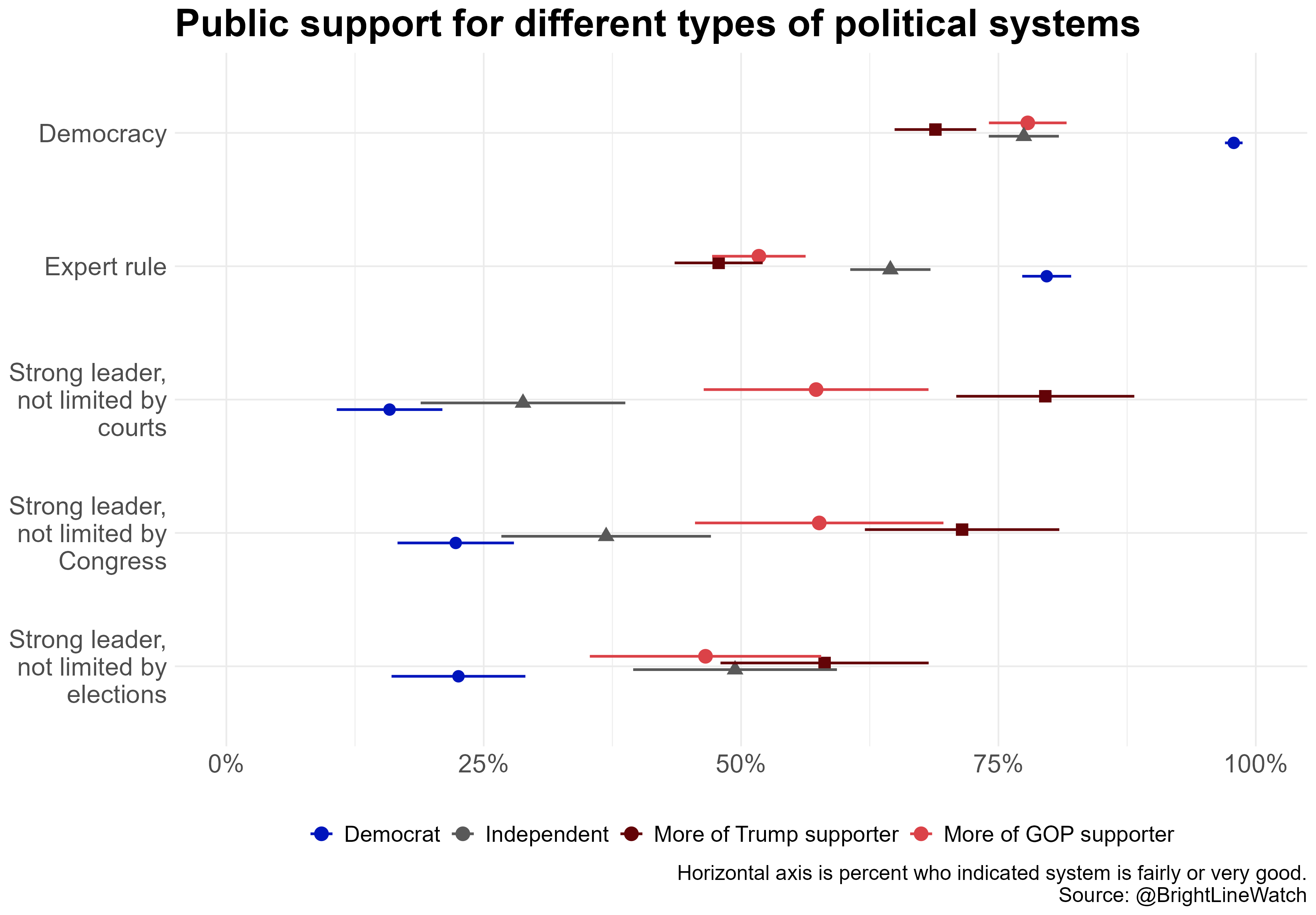
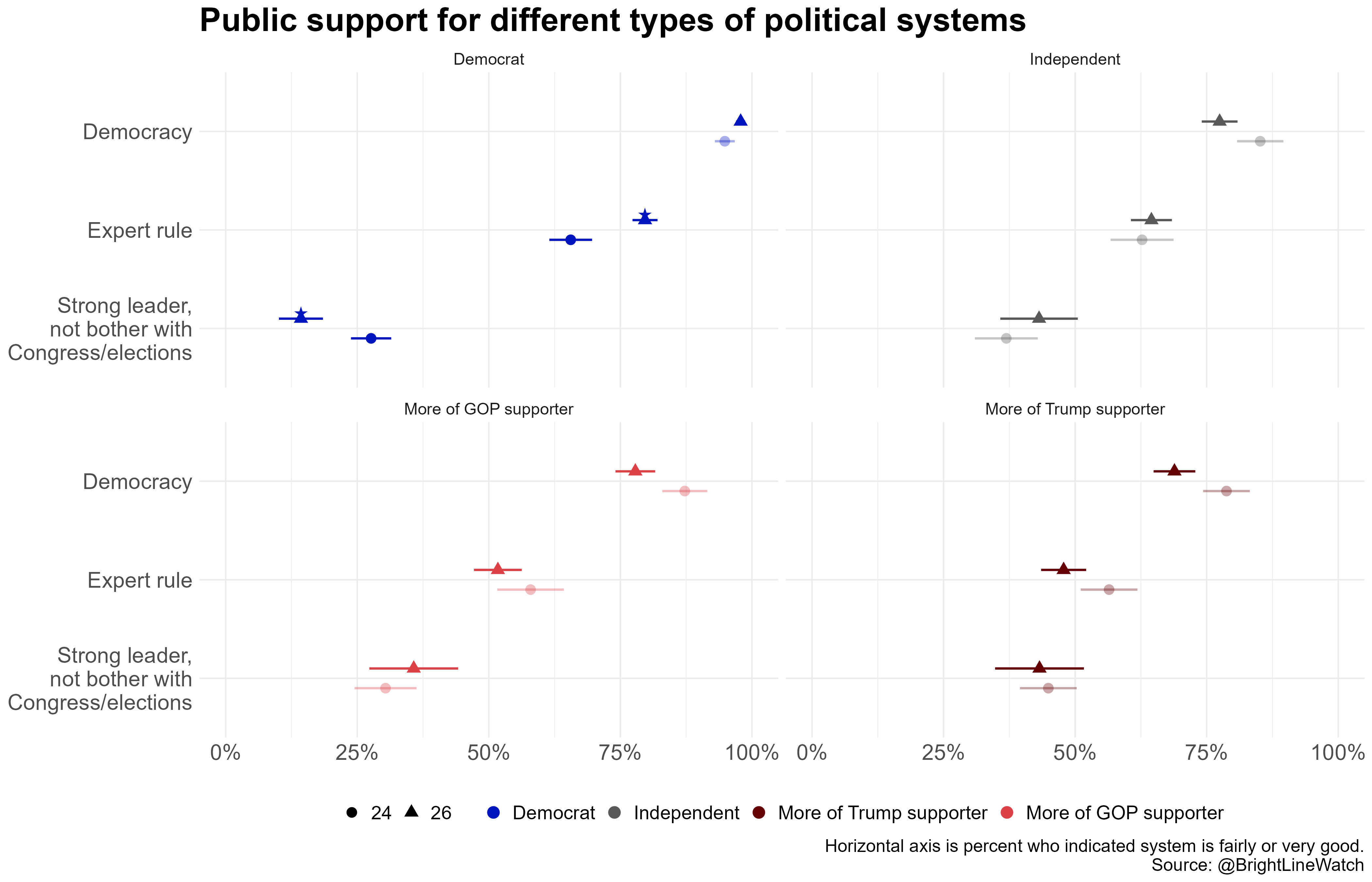
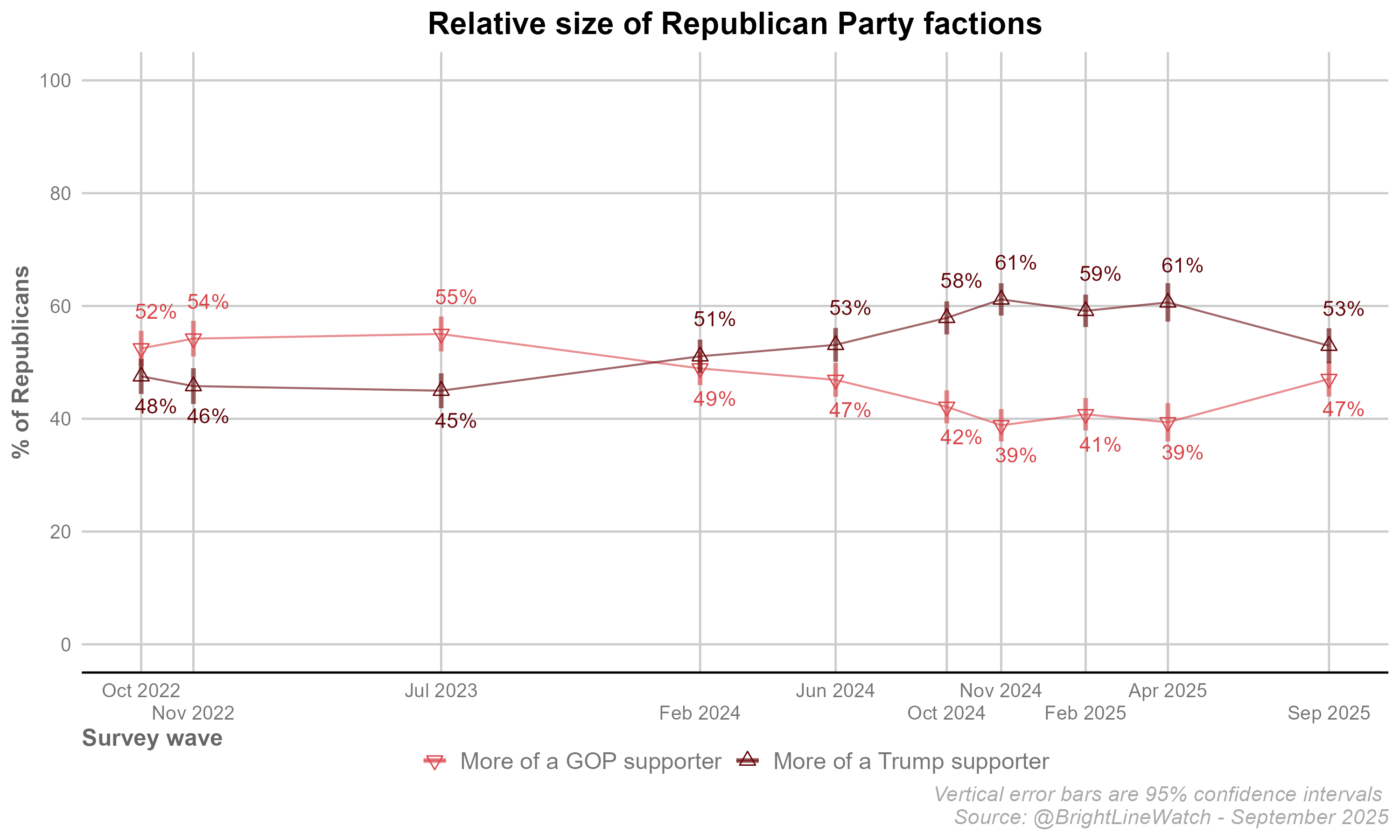
Trump / GOP supporter?
Since late 2022, we have asked each respondent who identifies as a Republican (or leans toward that party) whether they regard themselves as more a supporter of the Republican Party or more a supporter of Donald Trump. Through the summer of 2023, more identified primarily with the party. By early 2024, when Trump had locked up the party’s presidential nomination, a narrow majority identified primarily with Trump, and the share of Trump-over-party Republican respondents grew further, stabilizing at about 60% of Republican respondents across four surveys through late 2024 and early 2025. In September 2025, the share dropped to 53% more Trump to 47% more GOP.
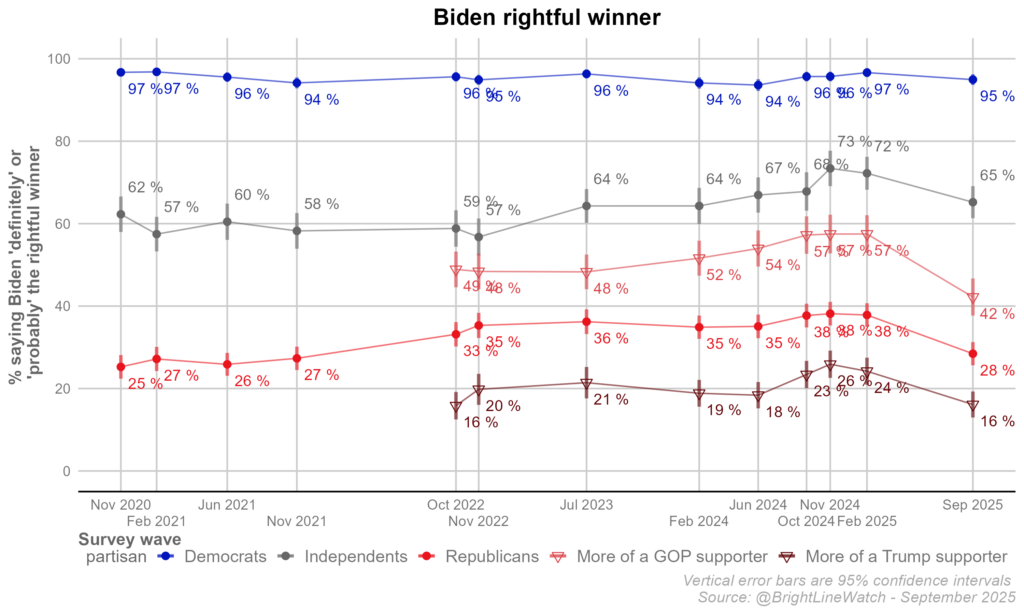
Biden rightful winner
Forecasting future events
The full list and wording of forecast questions are available in the survey instrument. All Mantic AI forecasts are available here.
Adjusted expert forecasts of future threats to democracy
Evaluations of U.S. democratic performance