The Persistence of Diminished Democracy in a Second Trump Presidency
Bright Line Watch December 2025–January 2026 and February–March 2026 surveys
Bright Line Watch fielded two recent surveys of political science faculty at American colleges and universities (whom we refer to as “experts” below) and representative samples of Americans (whom we refer to as “the public” below).
The first survey, which was fielded in late December 2025 and early January 2026, overlapped with the January 3 military strike in Venezuela and the January 6 deployment of up to 2,000 additional Department of Homeland Security personnel to Operation Metro Surge in Minnesota. Both seemed potentially consequential for perceptions of U.S. democratic performance. We therefore chose to conduct a second survey in February–March 2026 and report the results of both surveys here rather than release potentially outdated results from the previous survey.
The first survey was fielded from December 22, 2025–January 7, 2026 among experts (564 responses) and from December 22, 2025–January 6, 2026 among the public (2,750 responses). The second was fielded from February 19–March 10, 2026 among experts (621 responses) and from February 24–March 6, 2026 among the public (2,750 responses).
We collected expert survey data in partnership with Luth Research, which managed survey invitations to preserve participant anonymity. Panel management and data collection for the public surveys were conducted by YouGov. All public survey results reported below incorporate the post-stratification weights provided by YouGov.
Executive summary
-
Expert ratings of U.S. democracy have largely stabilized at lower levels than any prior period since our data begin in 2017. During Donald Trump’s first term and Joe Biden’s presidency, ratings among experts never fell below 60 or exceeded 70 on a 0–100 scale. However, they fell sharply in the first months of Trump’s second presidency, reaching a new low of 53 in April 2025. They remained statistically unchanged at 54 in September 2025 before increasing to 60 in the initial expert ratings collected in our December 2025–January 2026 survey. This rating, which exceeded previous forecasts, may have reflected the effective contestation of off-year elections in November 2025.
-
However, data collected during the December 2025–January 2026 survey show that expert ratings of U.S. democracy declined after the capture of Nicolás Maduro, reverting toward prior levels (56). Those assessments remained consistent in our February–March 2026 survey (57). Expert forecasts for 2027 are stable at 56 before an expected rise to 60 in 2032.
-
The sharp and persistent decline in expert ratings of U.S. democracy that we have observed corresponds with the declines reported for 2025 in annual ratings released last week by The V‑Dem Institute and Freedom House. However, our more frequent expert surveys show that this decline was concentrated in the early months of last year and that ratings of democratic performance have largely stabilized in the period since.
-
Ratings of democracy among the public also declined to a new low during Trump’s second presidency and stabilized there with only modest improvements. However, these average ratings mask a deepening partisan divide on democratic performance, which has now reached record levels, exceeding the gaps observed during Trump’s first term and Biden’s presidency. The increased gap in the February–March 2026 survey is driven by Republicans, whose evaluations of U.S. democracy have reached their highest levels since our first public survey during Trump’s first year in office in 2017.
-
When provided with a description of three hypothetical governments and asked to rate them on the same 0–100 scale as the U.S., experts, Democrats, and Republicans all rate a hypothetical strong democracy above a hypothetical illiberal democracy and put a non-democracy lowest. However, experts and Democrats rate the U.S. closer to the hypothetical illiberal democracy than the hypothetical strong democracy. Republicans, by contrast, place the U.S. closer to the hypothetical strong democracy because they rate current U.S. democracy higher and the hypothetical strong democracy lower, on average, than do the other groups.
-
Expert ratings of U.S. performance on 35 democratic principles were largely unchanged since September 2025, though experts did see improvements in judicial checks on the executive and not using the military for political purposes, which may reflect the recent Supreme Court tariff decision and the end of domestic deployments of the National Guard.
-
We observe several troubling shifts in how important the public considers these principles to be — Democrats are less likely to say preventing political violence is important, while Republicans show significant declines in endorsing the protection of free speech, constitutional and judicial limits on the executive, and responsiveness to public opinion.
-
Experts identified a large number of recent events as threats to democracy. The consensus on the threat was near-unanimous for several events related to the rule of law (96% for Trump directing Attorney General Pam Bondi to prosecute his political enemies); elections (93% for Trump’s call to “nationalize” voting), and speech (93% for Trump’s claim that Democratic lawmakers committed sedition by saying the military should refuse unlawful orders).
-
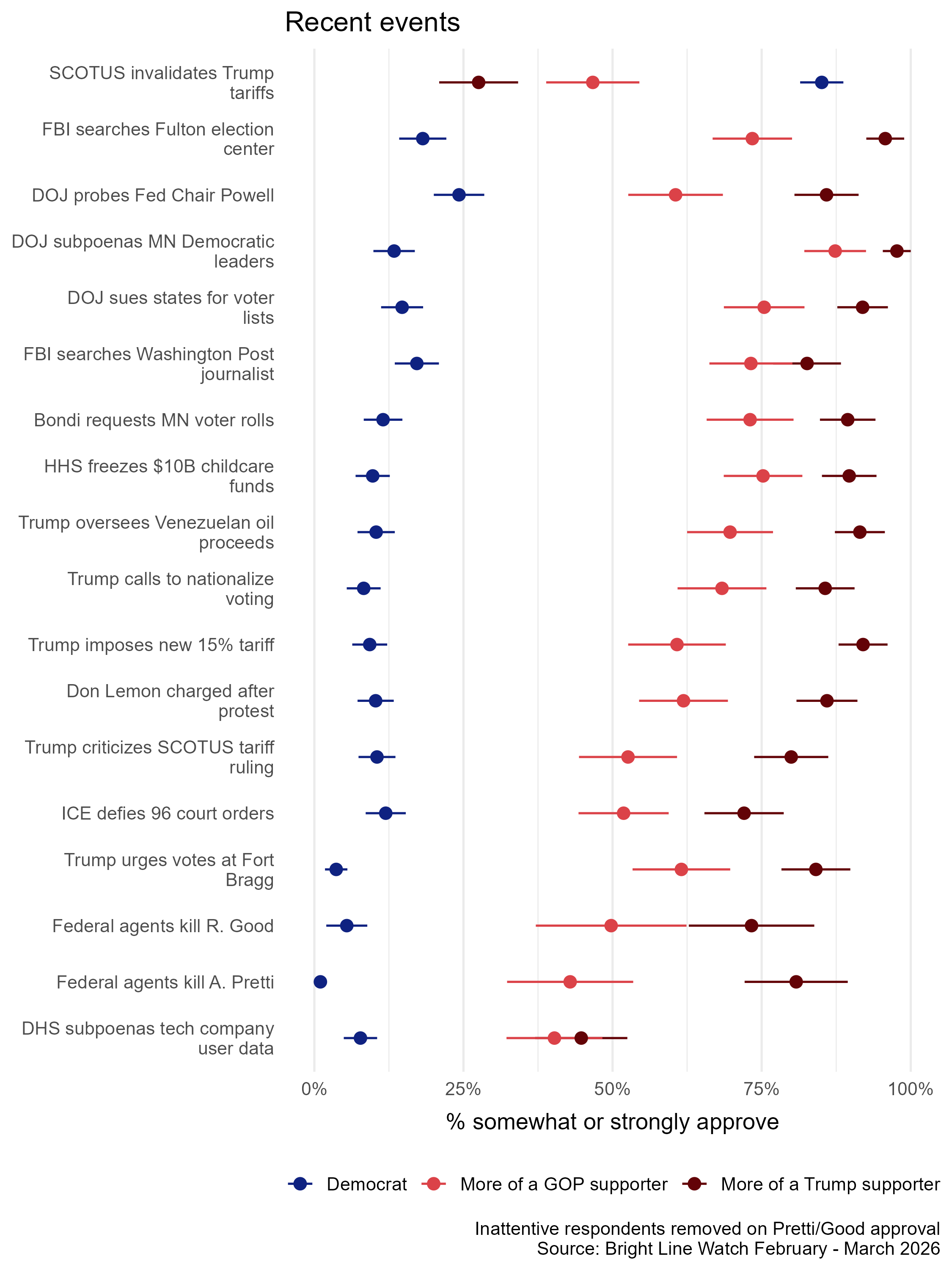
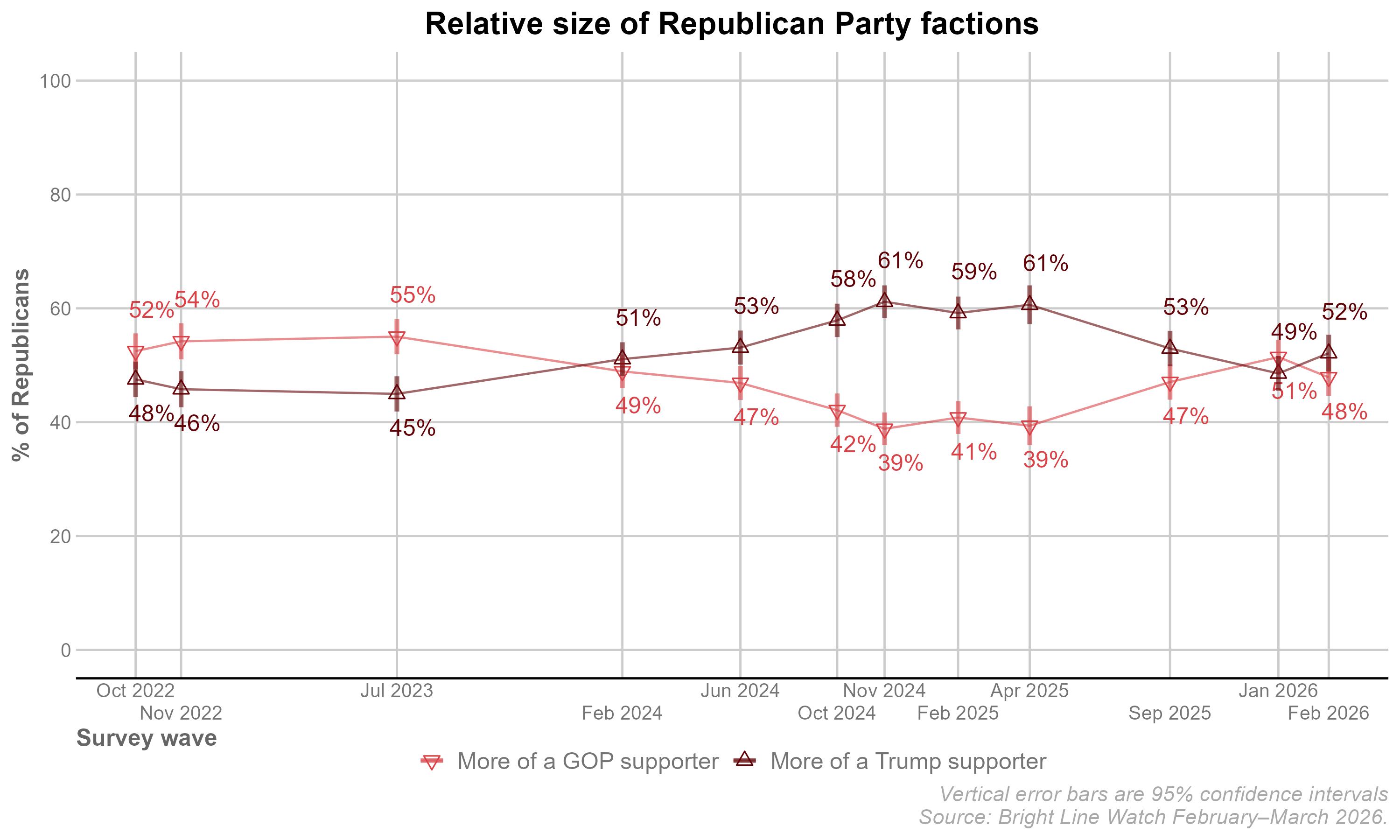
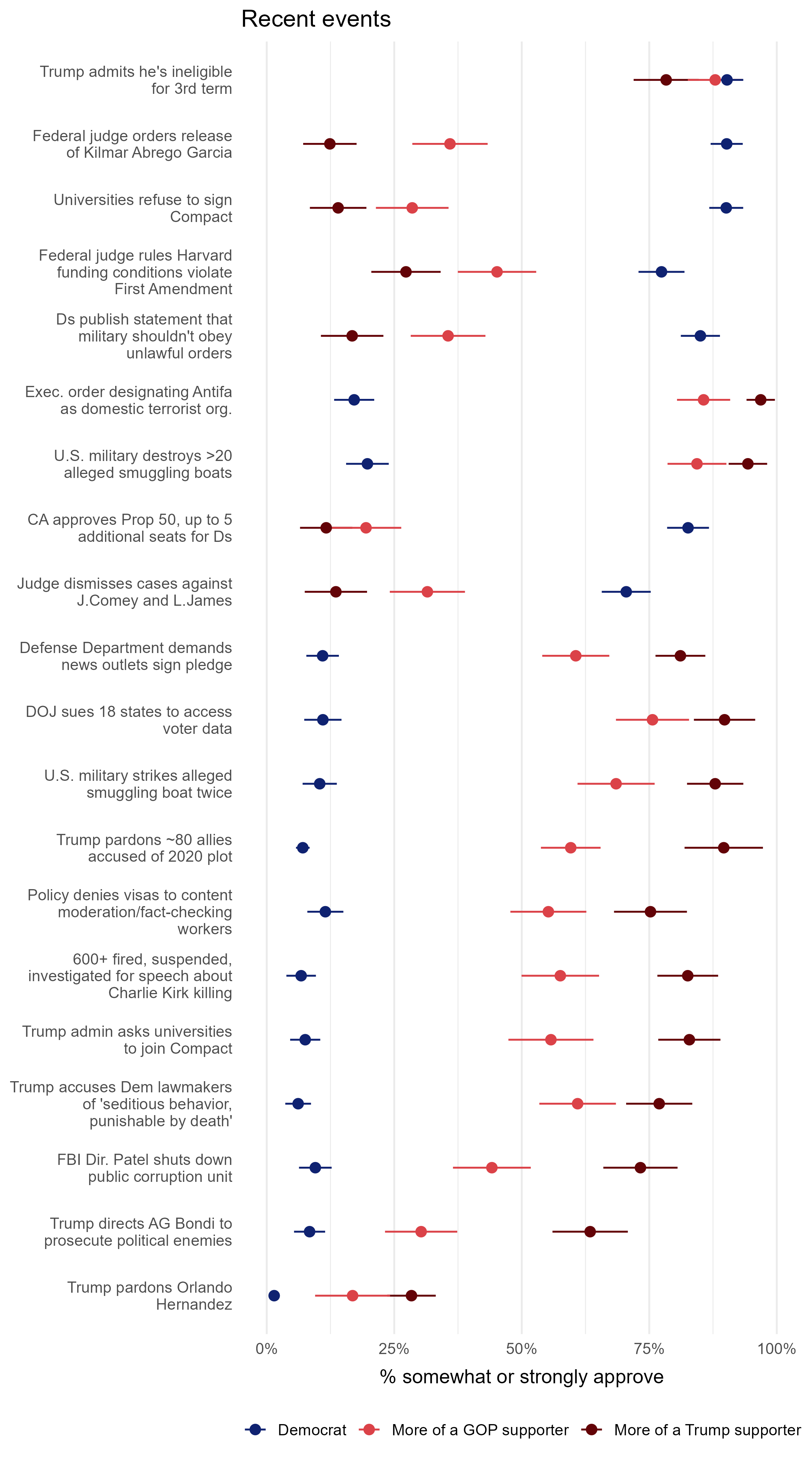
Among the public, approval of these events was widespread among Republicans, particularly those who identify as supporters of President Trump rather than the Republican Party.
-
Despite Trump and his allies again raising unfounded questions about election integrity, public confidence in the voting system is comparable to before the 2020 election and less polarized than it was before the 2022 and 2024 elections.
Overall evaluations of American democracy
Since 2017, Bright Line Watch has asked experts and the public to rate U.S. democracy on a 0–100 scale. We report these measures in the figure below along with expected ratings of future performance in 2027 and 2032.
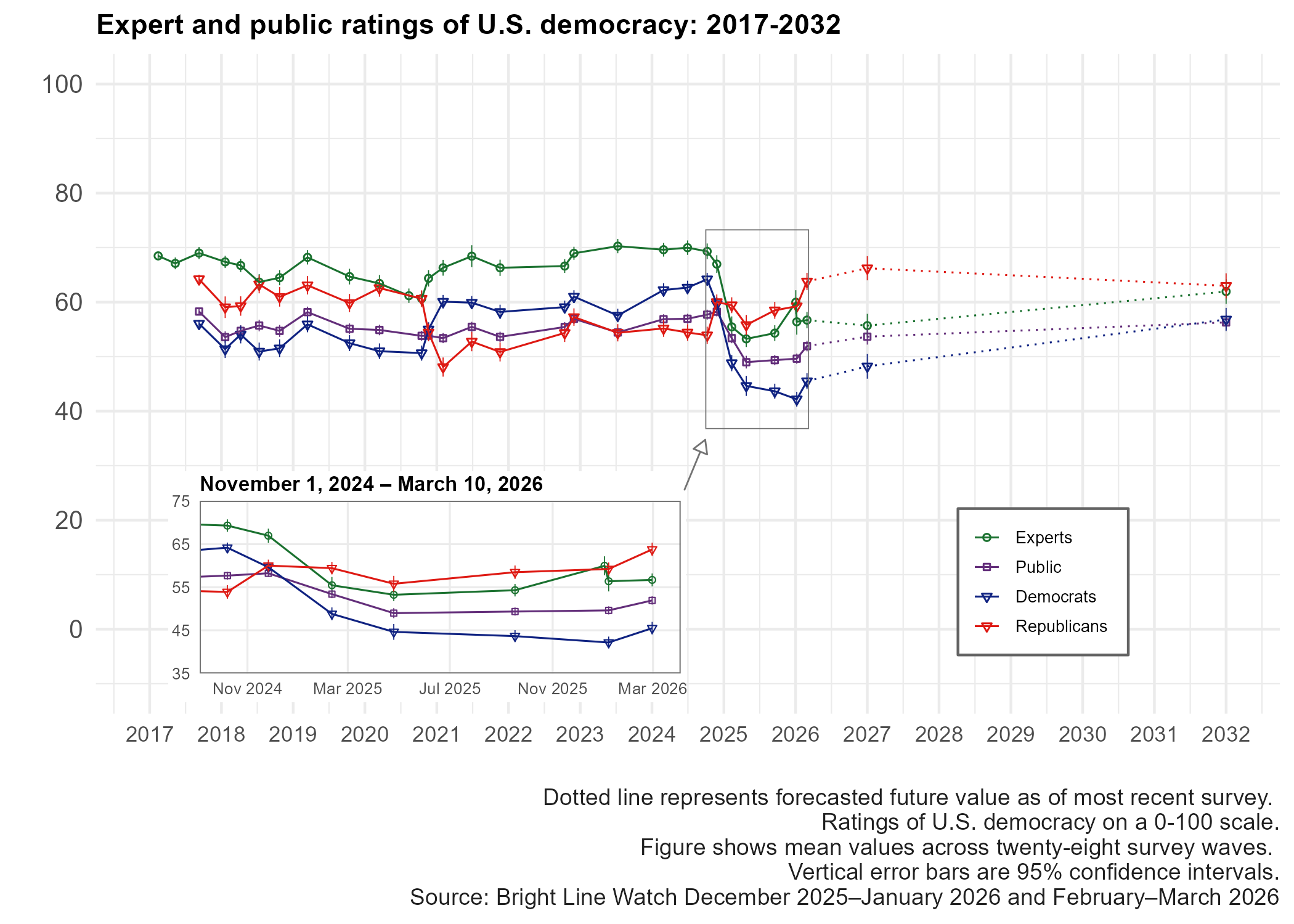
Across 23 previous surveys administered during Trump’s first term and Biden’s presidency, ratings among experts were relatively stable, never falling below 60 or exceeding 70. The first months of Trump’s second presidency brought a precipitous drop to 53 by April 2025. Ratings stabilized there, remaining statistically unchanged at 54 in September 2025.
By the time of our next data collection, however, experts rated American democracy more favorably — perhaps because of the defeats Republicans faced at the polls in off-year elections in 2025, which showed that the playing field had not been tilted against the opposition and that free and fair elections were still possible. Experts who were surveyed in late December 2025 and early January 2026 before the U.S. raid in Venezuela (discussed further below) rated U.S. democracy at 60, its highest point since Trump’s return to the presidency. These ratings are substantially higher than expected for the end of 2025 according to both human forecasters on the prediction platform Metaculus (50) and the AI forecaster Mantic (52).
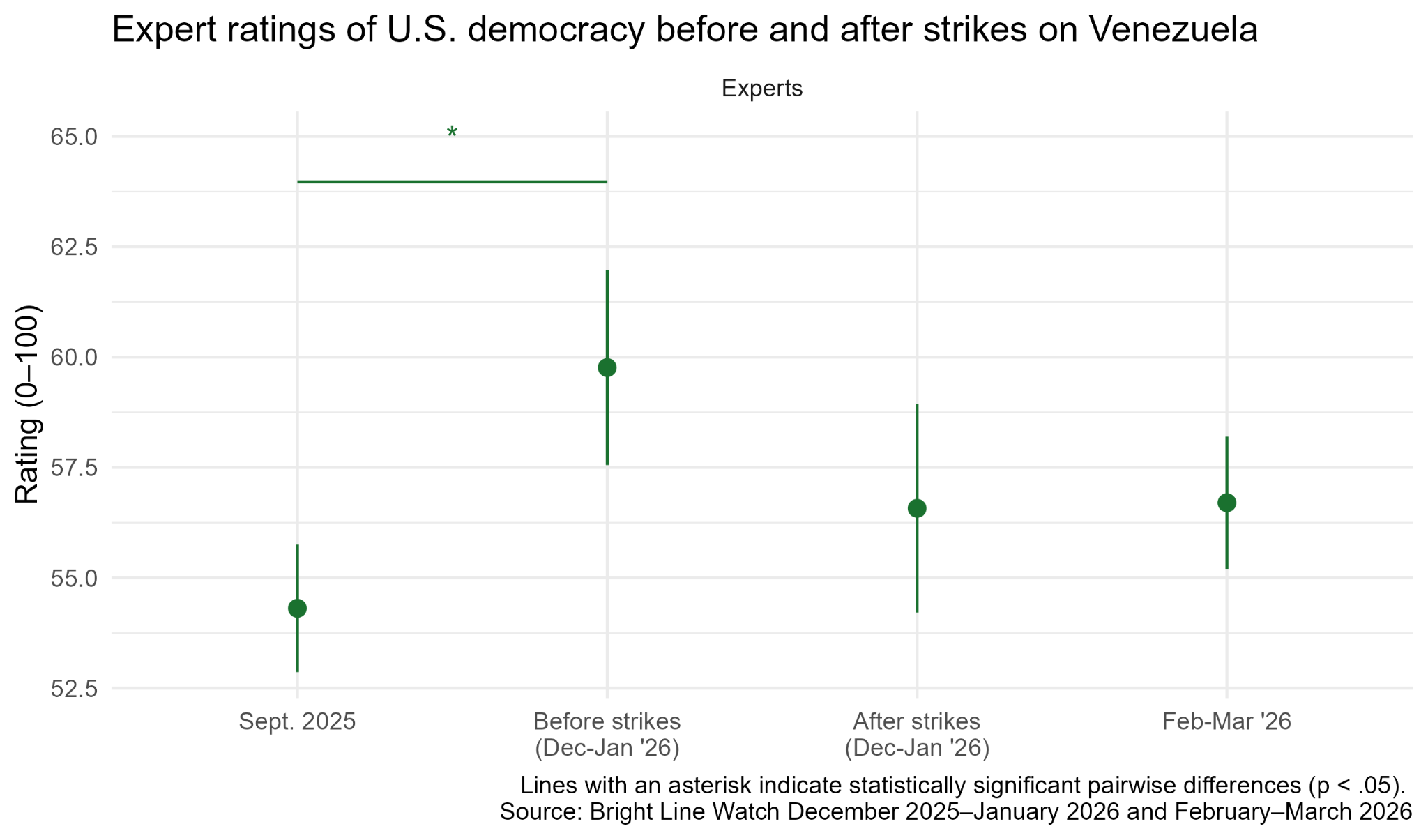
However, expert ratings of democracy reverted nearly to September 2025 levels (56) after Operation Absolute Resolve, a military operation conducted on January 3, 2026 without congressional approval in which Venezuelan president Nicolás Maduro was captured and removed to the U.S. One possible interpretation of this shift is that the Maduro raid reinforced concerns about the lack of constraints on Trump’s use of executive power, though, as discussed below, experts rated the raid as a less serious threat to democracy than many other recent events.
Most recently, ratings of U.S. democracy among experts remained at approximately the same level in our February–March 2026 survey (57) as immediately after the Maduro raid (56). These ratings continue to place U.S. democracy between recent expert ratings of Israel (49) and Mexico (60) and far from countries previously considered to be peer democracies such as Great Britain (83) and Canada (88).
The sharp and persistent decline in expert ratings of U.S. democracy that we have observed during Trump’s second presidency corresponds with the declines reported for 2025 in annual ratings released last week by The V‑Dem Institute and Freedom House. As described above, however, our more frequent expert surveys show that this decline was concentrated in the early months of last year and that ratings of democratic performance have largely stabilized in the period since. We also note that expert forecasts of ratings for U.S. democracy are stable for 2027 at 56 and more optimistic in the longer term, rising to 60 for 2032.
Ratings of U.S. democracy among the public tend to be lower than among experts, but they have followed a similar trend over time. As with the experts, their rating on our 0–100 scale remained within a relatively narrow range during Trump’s first term and Biden’s presidency (52–58) before dropping to a low of 49 by April 2025. Public ratings have trended slightly higher since, reaching 52 in February–March 2026.
However, the recent stability we observe in public ratings of U.S. democracy masks a deepening partisan divide on democratic performance. Since 2017, supporters of both parties have rated democracy more favorably when their party controls the White House, but the partisan gap in mean democracy ratings by party ranged from 0–12 points during the first Trump presidency and Biden’s term in office. During the second Trump presidency, the divide has widened, reaching 18 points in the February–March 2026 survey, the largest gap we have measured.
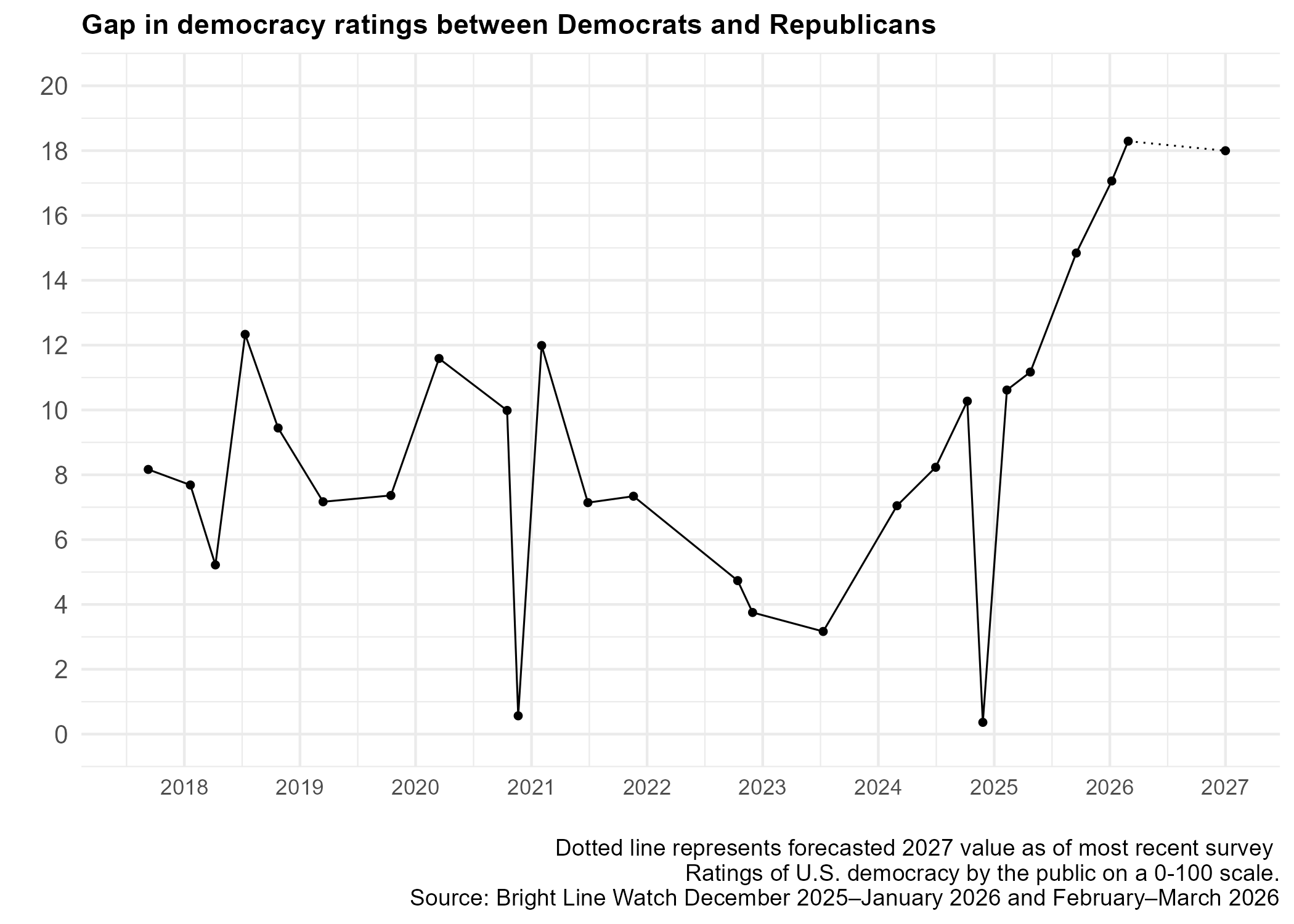
Notably, evaluations increased from December 2025–January 2026 to February–March 2026 among both Democrats and Republicans, but the increase among Republicans was larger (59 to 64 versus 42 to 45 among Democrats), pushing GOP supporters to the most favorable evaluations recorded since our first public survey in October 2017.
The public’s expectations for the future of U.S. democracy show some mild optimism, with forecast values rising to 54 for 2027 and 56 for 2032. Notably, both Republicans and Democrats expect improvements in democratic performance in 2027 (from 64 to 66 and 45 to 48, respectively). Republican expectations are similar for 2032 (to 63) whereas Democrats foresee further improvement (to 57).
Institutional differences across regime types
In September 2025, we asked experts to use the same 0–100 scale described above to evaluate the state of democracy in three hypothetical countries described in the dropdown table below — a prototypical strong democracy, an illiberal democracy in which independent checks on power are partially compromised, and a non-democracy.
Regime types
| Country A [strong democracy] | Country B [illiberal democracy] | Country C [non-democracy] | |
| Elections | Elections are regular and competitive; opposition campaigns have equal access to venues and media; incumbent use of state resources for campaigns is prohibited and enforced. | Elections are regular but not fully competitive; opposition campaigns face disadvantages in access to venues and media; incumbent use of state resources for campaigns is prohibited but weakly enforced. | Elections are regular but not competitive; opposition campaigns face severe restrictions on access to venues and media; incumbent use of state resources for campaigns is pervasive and unconstrained. |
| Courts | Judges are appointed through pluralistic, merit-based procedures; the judiciary is independent; courts regularly review and annul executive acts. | Judges are appointed through mixed procedures with executive influence; the judiciary is partly independent; courts infrequently review or annul executive acts. | Judges are appointed from ruling-party lists; the judiciary is not independent; courts do not review or annul executive acts. |
| Law enforcement | Prosecutors are legally independent; charging decisions are insulated from political direction; high-profile cases against opposition figures are not announced near elections. | Prosecutors are subordinate to the executive; charging decisions are exposed to political influence; high-profile cases against opposition figures are rarely announced near elections. | Prosecutors are directed by the prime minister’s office; charging decisions follow political directives; high-profile cases against opposition figures are frequently announced near elections. |
| Media | Media regulation protects editorial independence; national broadcasters follow independence codes; accreditation and access rules are viewpoint-neutral. | Media regulation nominally protects editorial independence; national broadcasters face administrative pressure; accreditation and access rules are selectively applied. | Media regulation permits executive control; national broadcasters face severe pressure to conform; accreditation and access rules exclude critical outlets. |
| Government data | Official statistics and the national audit institution are legally independent; release calendars and methods are set without political input and reports are published without pre-clearance. | Official statistics and the national audit institution are subordinate to line ministries; release calendars and methods are shaped by input from political leaders; reports are sometimes reviewed before publication. | Official statistics and the national audit institution are controlled by the executive branch; release calendars and methods are directed by political leaders; reports are frequently delayed, altered, or withheld. |
| Civil service | Senior civil service appointments are made by open, merit-based competition; political appointments are limited by law; vacancies are publicly advertised. | Senior civil service appointments are governed by merit rules with wide discretion for political appointments; political criteria affect career progression; vacancies are unevenly advertised. | Senior civil service appointments are made at the government’s discretion without competitive merit procedures; political appointments are standard; vacancies are not publicly advertised. |
In our December 2025–January 2026 survey, we asked the public to rate these same hypothetical countries in addition to the experts. The results for both groups are reported below.
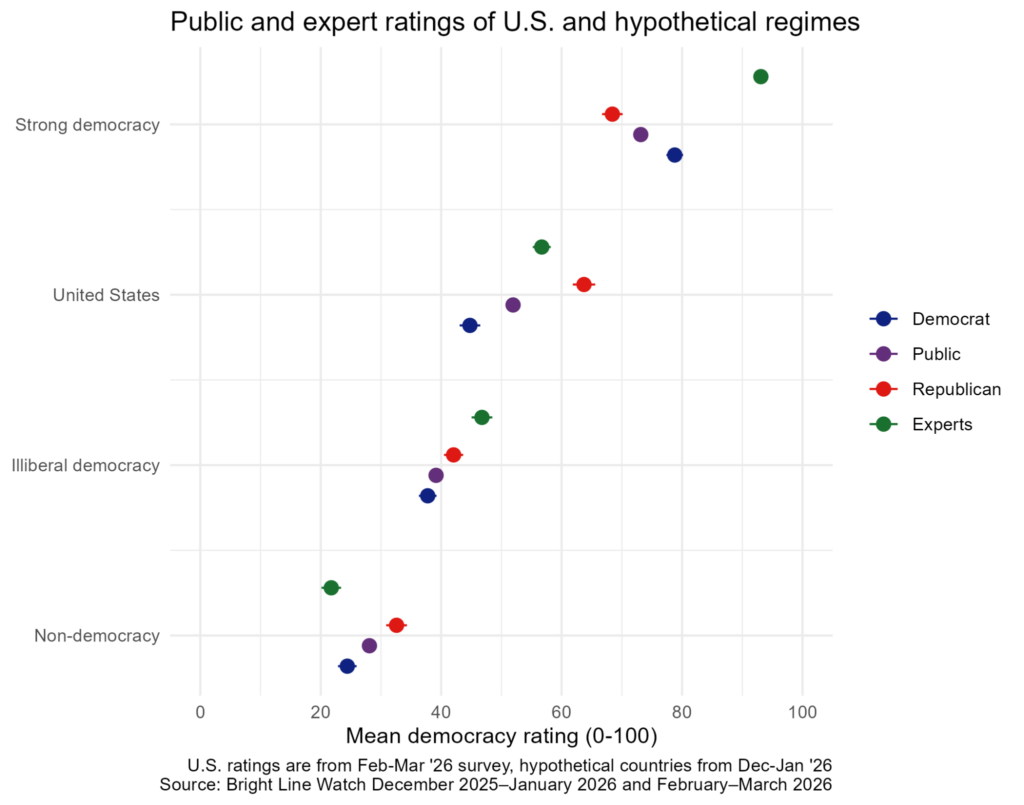
Each group rated the hypothetical strong democracy highest on the 0–100 scale, followed by the U.S., the hypothetical illiberal democracy, and the hypothetical non-democracy. However, the relative gaps between U.S. democracy and the other regime types vary by group. Among experts, the average rating of the U.S. (57) is closer to that of the hypothetical illiberal democracy (47) than to the hypothetical strong democracy (93). The same pattern holds for the public overall (52, 39, and 73, respectively) and for Democrats (45, 38, and 79, respectively). By contrast, Republicans place the United States closer to the hypothetical strong democracy than do other groups, both because they rate current U.S. democracy higher (64), and the hypothetical strong democracy lower, on average, than the other groups do (68).
Assessing performance on specific democratic principles
We asked experts and the public to evaluate U.S. performance on 35 democratic principles listed in the dropdown below.
35 democratic principles
- Government officials are legally sanctioned for misconduct
- Government officials do not use public office for private gain
- Government agencies are not used to monitor, attack, or punish political opponents
- All adult citizens enjoy the same legal and political rights
- Government does not interfere with journalists or news organizations
- Government effectively prevents private actors from engaging in politically-motivated violence or intimidation
- Government protects individuals’ right to engage in unpopular speech or expression
- Political competition occurs without criticism of opponents’ loyalty or patriotism
- Elections are free from foreign influence
- Parties and candidates are not barred due to their political beliefs and ideologies
- All adult citizens have equal opportunity to vote
- All votes have equal impact on election outcomes
- Elections are conducted, ballots counted, and winners determined without pervasive fraud or manipulation
- Executive authority cannot be expanded beyond constitutional limits
- The legislature is able to effectively limit executive power
- The judiciary is able to effectively limit executive power
- The elected branches respect judicial independence
- Voter participation in elections is generally high
- Information about the sources of campaign funding is available to the public
- Public policy is not determined by large campaign contributions
- Citizens can make their opinions heard in open debate about policies that are under consideration
- The geographic boundaries of electoral districts do not systematically advantage any particular political party
- Even when there are disagreements about ideology or policy, political leaders generally share a common understanding of relevant facts
- Elected officials seek compromise with political opponents
- Citizens have access to information about candidates that is relevant to how they would govern
- Government protects individuals’ right to engage in peaceful protest
- Law enforcement investigations of public officials or their associates are free from political influence or interference
- Government statistics and data are produced by experts who are not influenced by political considerations
- The law is enforced equally for all persons
- Incumbent politicians who lose elections publicly concede defeat
- Universities, businesses, and professional organizations operate independently of government pressure
- Military leadership remains politically neutral and does not favor or support any political party or candidate
- Officeholders do not use the military to advance political agendas or intimidate political opponents
- Law enforcement remains politically neutral and does not favor or support any political party or candidate
- Officeholders do not use law enforcement to advance political agendas or intimidate political opponents
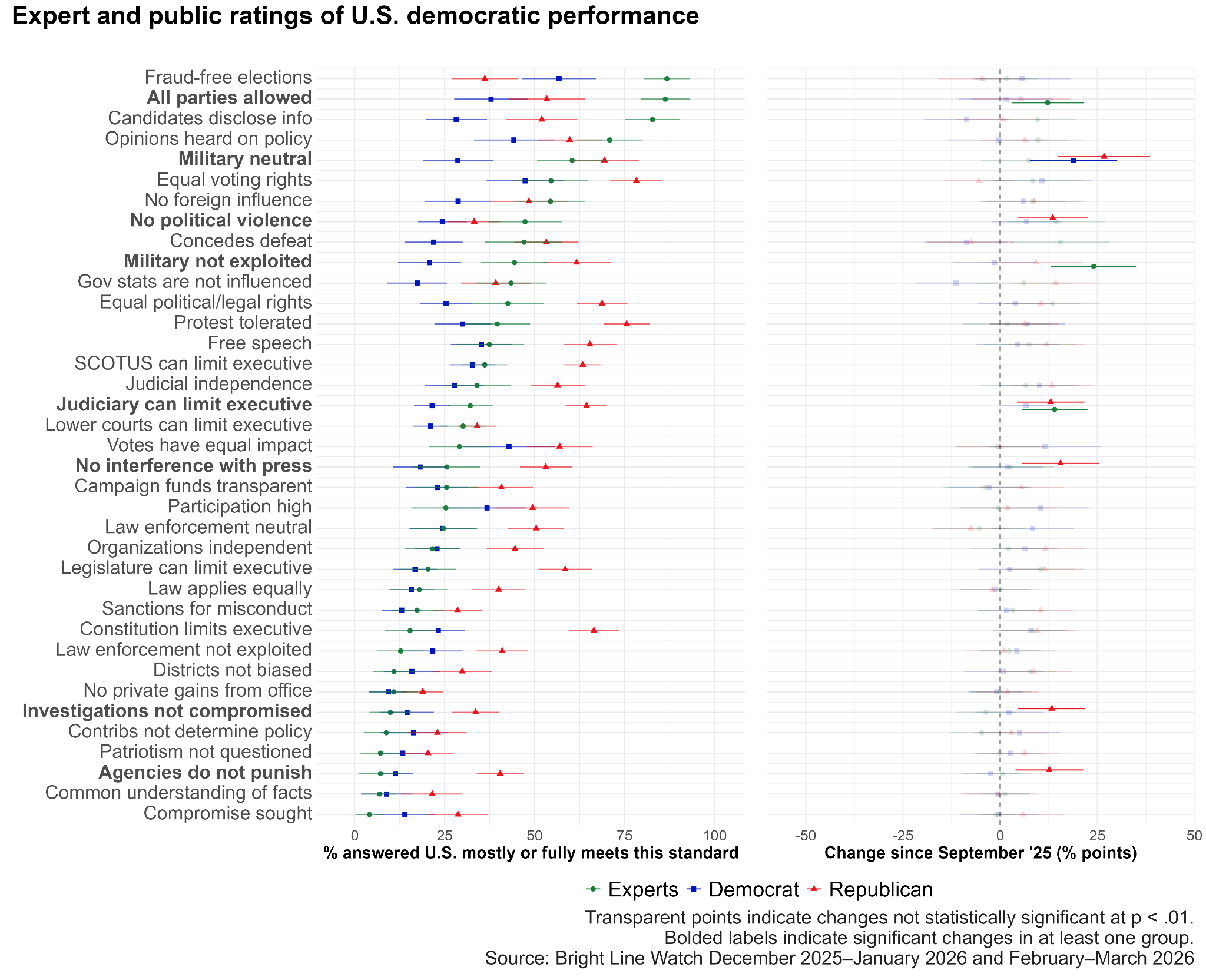
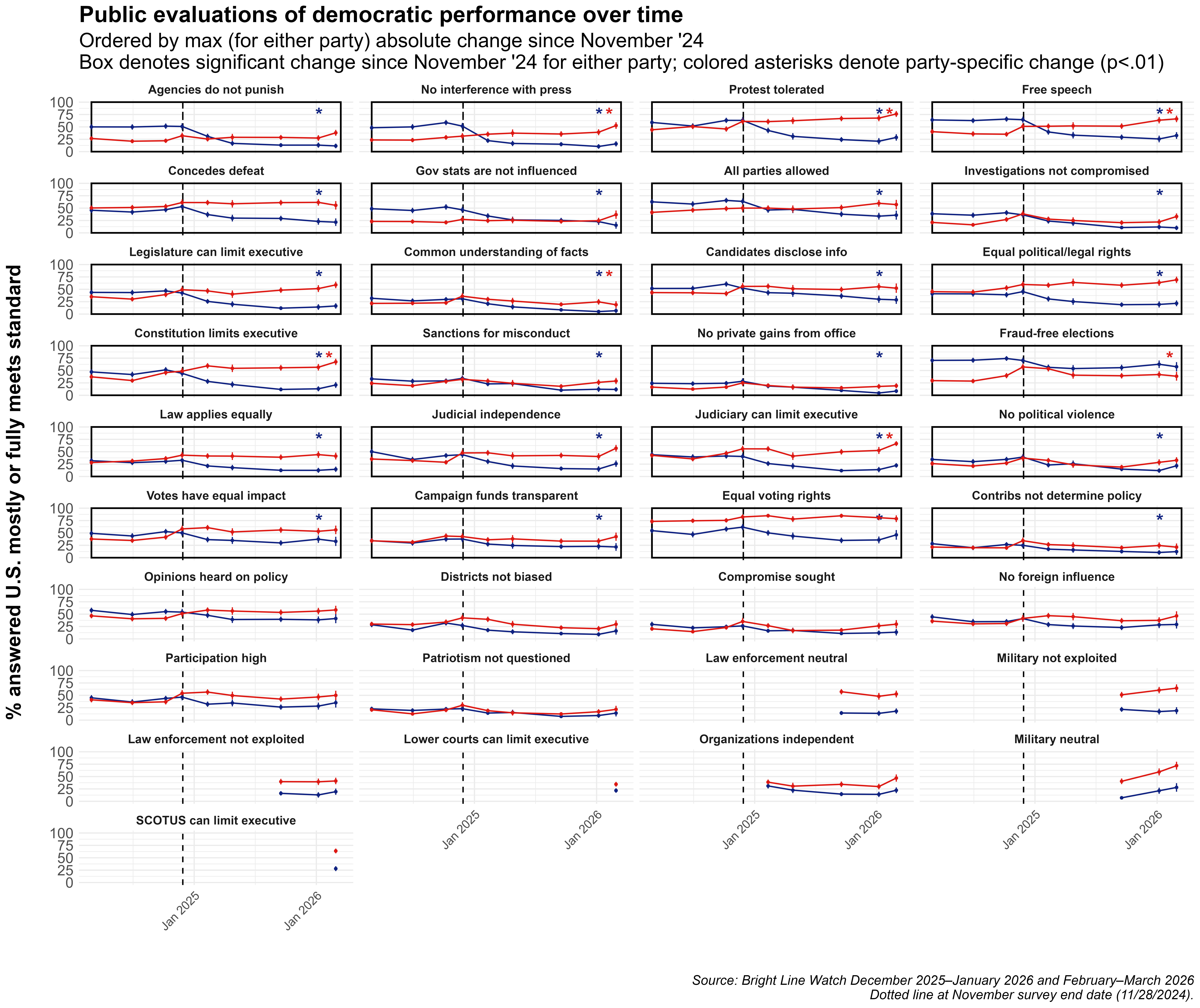
Notably, expert ratings changed significantly (p<.01) for just two principles between September 2025 and February–March 2026 — more experts said that the judiciary effectively limits the executive (18% in September versus 32% in February–March) and that the military is not exploited to advance political agendas or intimidate political opponents (20% in September versus 45% in February–March). These shifts may reflect the Supreme Court ruling against Trump on tariffs (an event that 87% of experts view as a benefit to democracy; see below) and the withdrawal of National Guard deployments from several cities in January 2026 (77% previously rated Trump’s deployment of the National Guard to Los Angeles as a serious or extraordinary threat to democracy).
Among the public, performance ratings only changed significantly since September 2025 for Democrats on one principle — an improvement in the neutrality of military leadership. Republicans perceive significant improvements on that principle as well as the prevention of political violence, judicial checks on the executive, government interference with the press, independent law enforcement investigations of public officials, and not using agencies against political opponents.
We also asked experts and the public to rate the importance of these principles to democracy.
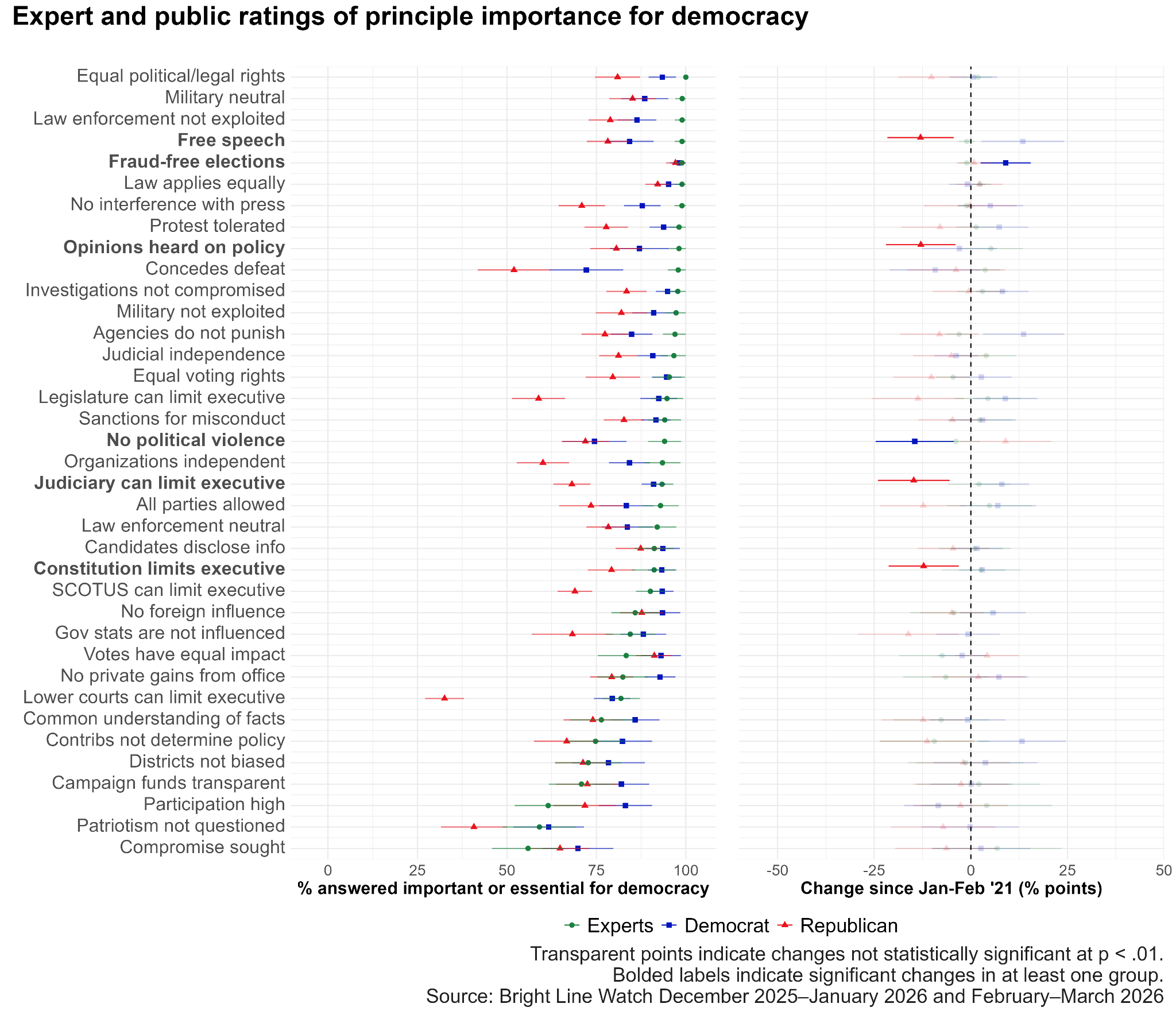
We observe no significant change among experts. Public ratings were also largely stable. However, we observe several troubling changes — a significant decrease in the percentage of Democrats saying preventing political violence is important as well as significant declines in the share of Republicans endorsing the protection of free speech, constitutional and judicial limits on the executive, and responsiveness to public opinion.
Actual and potential threats to democracy
Bright Line Watch asks experts to evaluate whether and to what extent recent actions or events pose a threat or benefit to U.S. democracy. The full list of events asked of experts in the December 2025–January 2026 and February–March 2026 surveys is listed in the dropdown below.
Events (December 2025–January 2026 survey)
- Trump pardons Juan Orlando Hernandez, the former president of Honduras, who was serving 45 years in prison for helping drug traffickers import cocaine to the U.S.
- Trump directs Attorney General Pam Bondi to prosecute his political enemies in a Truth Social message.
- The Defense Department demands news outlets sign a pledge not to gather any information that hasn’t been authorized for release.
- Trump administration asks universities to join its Compact for Academic Excellence in Higher Education, which would increase federal control of university policies.
- Universities refuse to sign the Trump administration’s Compact for Academic Excellence in Higher Education, which would increase federal control of university policies.
- The U.S. military destroys more than twenty boats alleged to be carrying drugs.
- U.S. military kills two survivors of an initial military strike in a second strike on an alleged drug smuggling boat.
- Trump acknowledges that he is ineligible to run for a third term.
- Six Democratic lawmakers with military or intelligence backgrounds issue a video stating that military personnel should not obey unlawful orders.
- Trump accuses Democratic lawmakers of “seditious behavior, punishable by death” for releasing a video stating that military personnel should not obey unlawful orders.
- Federal judge dismisses federal criminal cases against former FBI Director James Comey and New York Attorney General Letitia James.
- Trump pardons his former attorney and chief of staff as well as nearly 80 other allies accused of plotting to overturn the 2020 election.
- The Department of Justice sues 18 states to access voter data.
- FBI Director Kash Patel shuts down the FBI’s public corruption investigation unit and fires agents who worked on investigations related to Trump.
- State Department issues policy to deny visas to applicants who have worked in content moderation, fact-checking, or combating misinformation.
- Federal judge rules Trump administration’s attempts to condition Harvard’s federal funding on policy changes violate the First Amendment.
- Federal judge orders release of Kilmar Abrego Garcia, finding the Trump administration misled the court and detained him without lawful authority.
- Estimated 7 million Americans participate in October “No Kings” protests across approximately 2,700 cities—the largest single-day demonstration in U.S. history.
- More than 600 people are fired, suspended, or investigated for their speech about the killing of Charlie Kirk.
- The U.S. carries out strikes against Venezuela and captures Venezuelan President Nicolás Maduro.
- Secretary of Defense Pete Hegseth announces proceedings aimed at reducing Senator Mark Kelly’s rank and retirement pay over his statements in a video asserting that military personnel should not obey unlawful orders.
Events (February–March 2026 survey)
- Donald Trump writes on Truth Social that a federal judge who ruled against him “should be IMPEACHED!!!”
- The Department of Justice begins a criminal investigation into Federal Reserve Chair Jerome Powell.
- Federal agents fatally shoot Renée Good during immigration operations in Minnesota.
- Federal agents fatally shoot Alex Pretti during immigration operations in Minnesota.
- Federal judges rule that Lindsey Halligan and Alina Habba were unlawfully appointed as U.S. Attorneys.
- The Trump administration issues executive orders that impose penalties on some major law firms.
- ICE disobeys 96 court orders in the District of Minnesota in January, according to Chief U.S. District Judge Patrick J. Schiltz.
- The journalist Don Lemon is charged with federal civil rights crimes after live-streaming a protest at a church in St. Paul, Minnesota.
- FBI agents search a Fulton County, Georgia election center for ballots from the 2020 election with the Director of National Intelligence present.
- U.S. attorneys’ offices ask job applicants to explain how they would advance President Trump’s policy priorities.
- President Trump calls for Republican officials to “nationalize” voting, which is administered at the state and local level.
- The Trump administration oversees Venezuelan oil sales and holds proceeds in offshore, U.S.-controlled accounts while directing how funds are spent.
- The Department of Health and Human Services freezes $10 billion in childcare funding for 5 Democratic-led states due to alleged fraud.
- An investment firm tied to the United Arab Emirates invests $500 million into the Trump family’s cryptocurrency company days before Trump’s inauguration.
- The DOJ issues subpoenas to five Minnesota Democratic leaders, including Governor Tim Walz and Minneapolis mayor Jacob Frey, investigating their response to federal immigration enforcement.
- Attorney General Pam Bondi asks Minnesota Governor Tim Walz for access to the state’s voter rolls.
- FBI agents search the home of a Washington Post journalist as part of a leak investigation.
- In a court filing, DOJ lawyers acknowledge that DOGE employees signed an agreement with a political advocacy group seeking to match Social Security data against voter rolls to “overturn election results in certain States”.
- President Trump creates a “Board of Peace” with himself as permanent chair and invites more than 30 countries to pay $1 billion for permanent membership.
- The DOJ sues 24 states for unredacted access to voter registration lists.
- The Trump administration finalizes a rule allowing for up to 50,000 federal career employees to lose job protections.
- The Supreme Court rules that the president has “absolute immunity from criminal prosecution for actions within his conclusive and preclusive constitutional authority” and “at least presumptive immunity from prosecution” for all official acts.
- Donald Trump says “You have to vote for us” during a speech to troops at Fort Bragg.
- The Department of Homeland Security sends administrative subpoenas to tech companies requesting personal information about users whose social media accounts track or criticize the agency.
- The Supreme Court rules that President Trump exceeded his authority to impose tariffs under existing law, invalidating many of the tariffs he imposed on foreign goods.
- After the U.S. Supreme Court strikes down his previous tariff program, President Trump imposes a new temporary tariff of 15% on imports.
- After the U.S. Supreme Court strikes down his previous tariff program, President Trump says “I am ashamed of certain Members of the Court” and says “[i]t is my opinion that the Court has been swayed by Foreign Interests.”
- The United States and Israel launch coordinated military strikes on Iran in late February 2026.
Expert ratings of whether these events pose a threat or benefit to democracy are provided in the figures below for assessments provided by experts in our December 2025–January 2026 and February–March 2026 surveys.
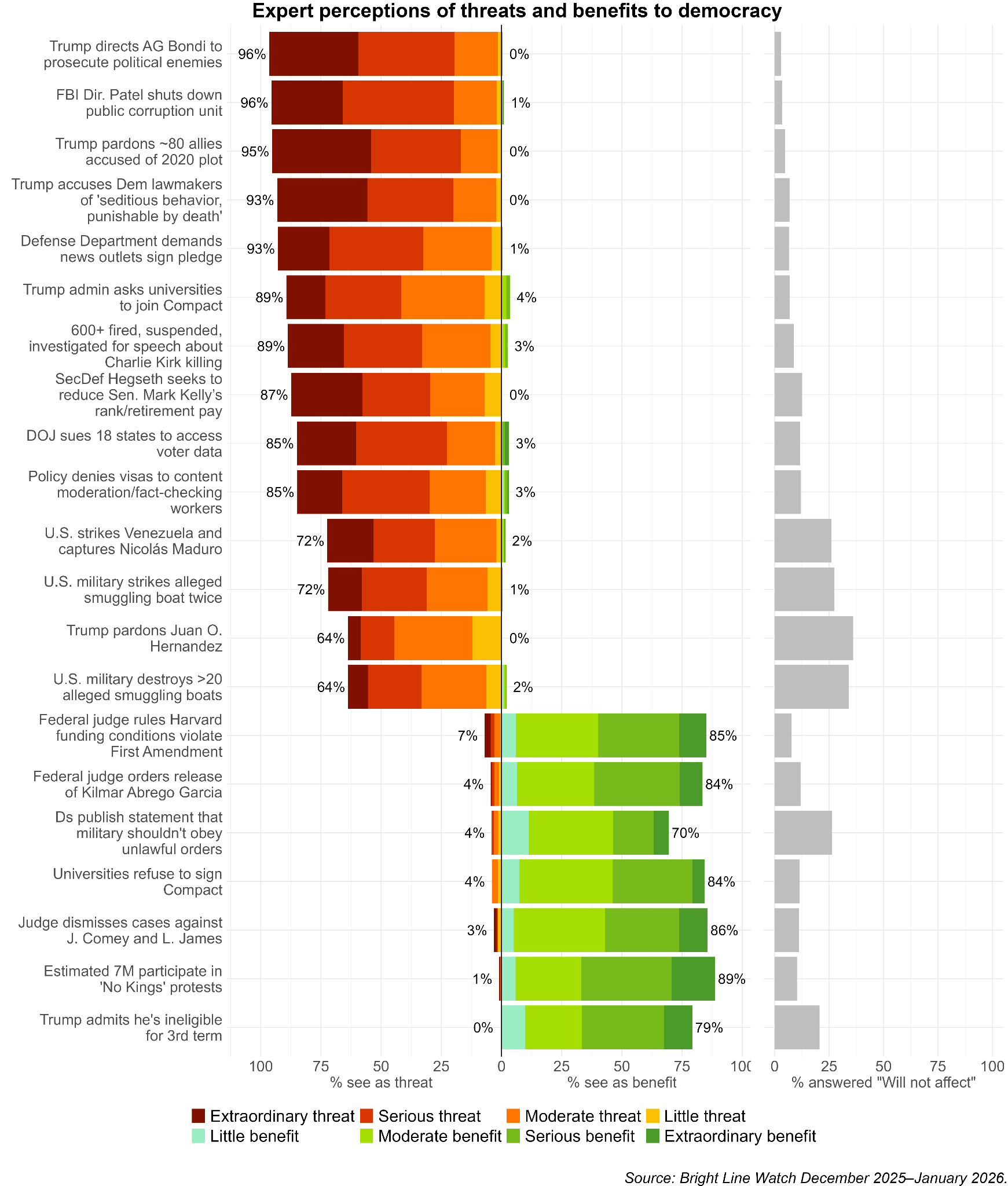
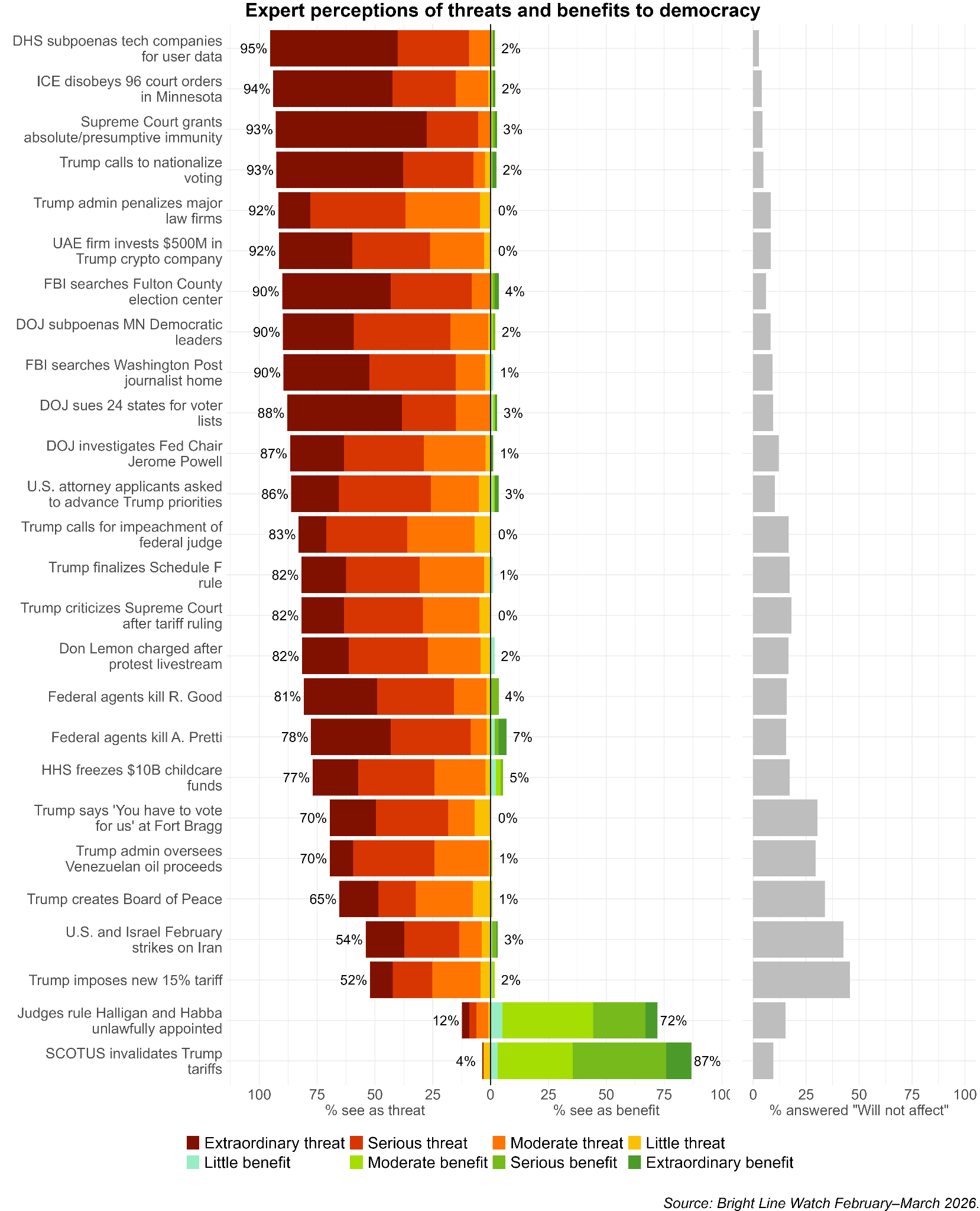
Several recent events related to the rule of law were rated as a threat to democracy by 90% or more of experts and as a serious or extraordinary threat by 50% or more:
- Trump directs Attorney General Pam Bondi to prosecute his political enemies in a Truth Social message (96% threat; 77% serious/extraordinary);
- FBI Director Kash Patel shuts down the FBI’s public corruption investigation unit and fires agents who worked on investigations related to Trump (96% threat; 76% serious/extraordinary);
- Trump pardons his former attorney and chief of staff as well as nearly 80 other allies accused of plotting to overturn the 2020 election (95% threat; 78% serious/extraordinary);
- ICE disobeys 96 court orders in the District of Minnesota in January, according to Chief U.S. District Judge Patrick J. Schiltz (94% threat; 79% serious/extraordinary);
- The DOJ issues subpoenas to five Minnesota Democratic leaders, including Governor Tim Walz and Minneapolis mayor Jacob Frey, investigating their response to federal immigration enforcement (90% threat; 72% serious or extraordinary).
We also asked experts to retrospectively assess the perceived threat to democracy from two past actions related to the rule of law. In total, 93% of experts said that the 2024 Supreme Court ruling that the president has “absolute immunity from criminal prosecution for actions within his conclusive and preclusive constitutional authority” and “at least presumptive immunity from prosecution” for all official acts is a threat to democracy, including 88% who said it was a serious or extraordinary threat. The Trump administration’s decision to issue executive orders that impose penalties on some major law firms was also seen as a threat by 92% of experts (55% serious/extraordinary).
A number of other events that 90% or more of experts see as a threat to democracy and 50% or more see as a serious or extraordinary threat relate to elections and speech:
- The Department of Homeland Security sends administrative subpoenas to tech companies requesting personal information about users whose social media accounts track or criticize the agency (95% threat; 86% serious/extraordinary);
- President Trump calls for Republican officials to “nationalize” voting, which is administered at the state and local level (93% threat; 85% serious/extraordinary);
- Trump accuses Democratic lawmakers of “seditious behavior, punishable by death” for releasing a video stating that military personnel should not obey unlawful orders (93% threat; 73% serious/extraordinary);
- The Defense Department demands news outlets sign a pledge not to gather any information that hasn’t been authorized for release (93% threat; 60% serious/extraordinary);
- FBI agents search a Fulton County, Georgia election center for ballots from the 2020 election with the Director of National Intelligence present (90% threat; 82% serious/extraordinary).
By contrast, experts were less unified on perceptions of democratic threat related to the Trump administration’s actions toward Venezuela and Iran:
- The U.S. carries out strikes against Venezuela and captures Venezuelan President Nicolás Maduro (72% threat; 45% serious/extraordinary);
- U.S. military kills two survivors of an initial military strike in a second strike on an alleged drug smuggling boat (72% threat; 41% serious/extraordinary).
- The Trump administration oversees Venezuelan oil sales and holds proceeds in offshore, U.S.-controlled accounts while directing how funds are spent (70% threat; 45% serious/extraordinary);
- The U.S. military destroys more than twenty boats alleged to be carrying drugs (64% threat; 31% serious/extraordinary);
- The United States and Israel launch coordinated military strikes on Iran in late February 2026 (54% threat; 40% serious/extraordinary).
Finally, the figure below reports the events of the second Trump administration that experts rate as the most significant threats to democracy, ranked by the percentage who identify the threats as serious or extraordinary.
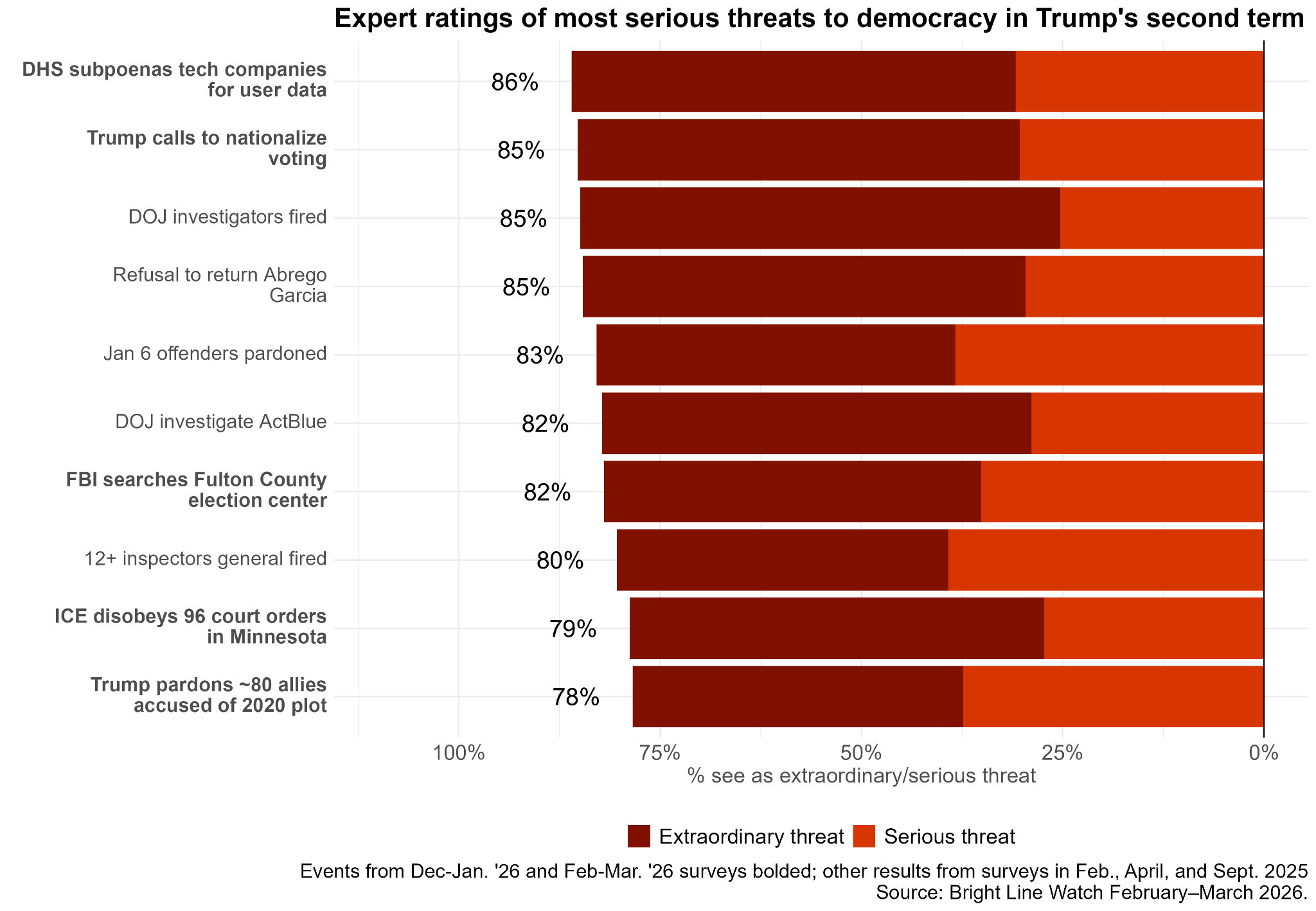
Approval of the events that experts rated as threats to democracy in the surveys was widespread among Republicans, particularly those who identify as more of a Trump supporter than a supporter of the Republican Party (see chart in appendix). Notably, we found widespread GOP approval of federal agents fatally shooting Renée Good (62%) and Alex Pretti (61%) during immigration operations in Minnesota, including 73% and 81%, respectively, among those who identify as more of a Trump supporter.
Election confidence
With the 2026 midterms approaching, Donald Trump and his allies are again raising unfounded questions about the integrity of the American election system. During his State of the Union address, for instance, Trump said “[Democrats] want to cheat. They have cheated. And their policy is so bad that their only way to get elected is to cheat.” He is using claims like these to campaign for the SAVE America Act, saying “It’ll guarantee the midterms. If you don’t get it, big trouble. My opinion. If you get this… they won’t be able to cheat.”
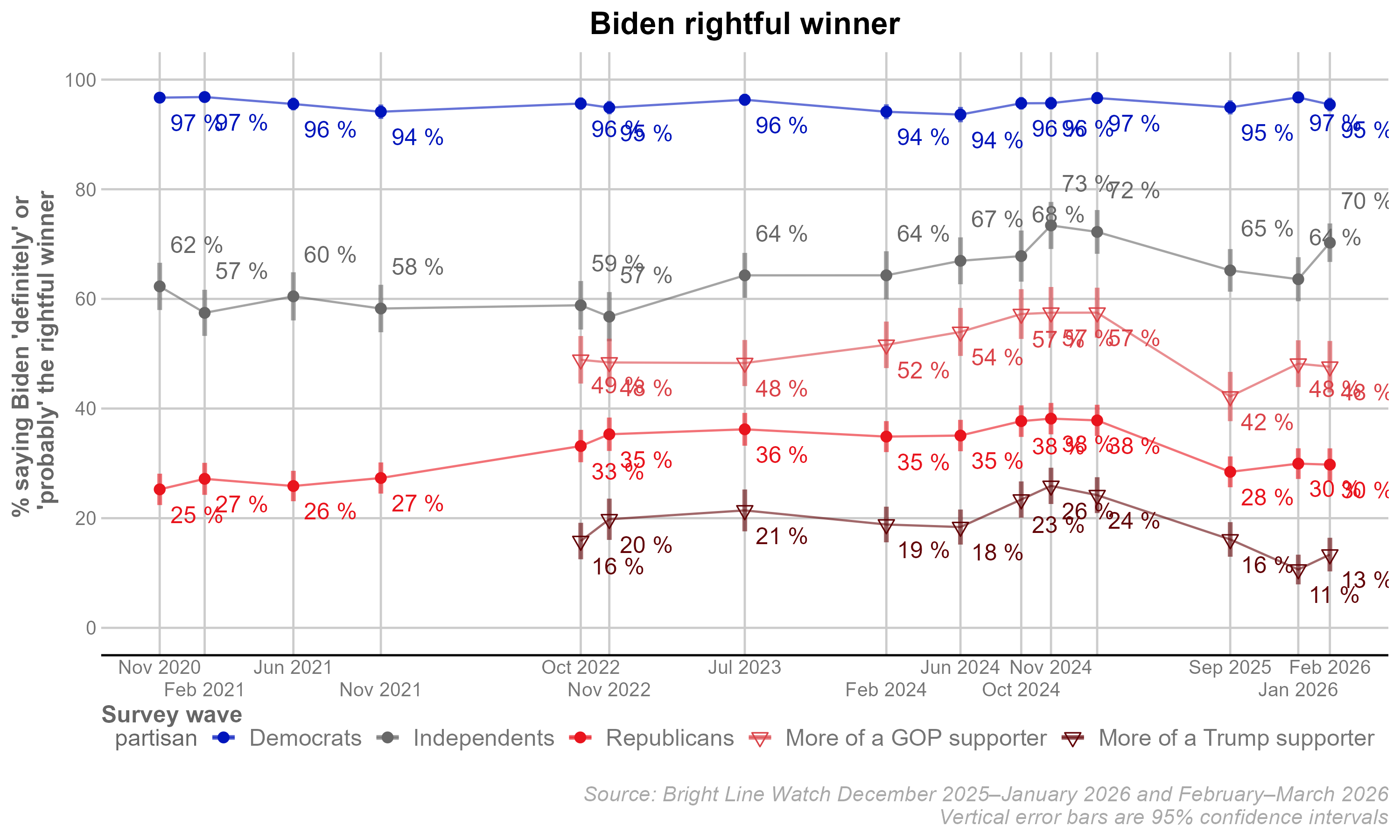
Statements like these threaten to undermine public confidence in the outcome of the election, as they did after 2020, which resulted in most Republicans continuing to refuse to accept Joe Biden as the rightful winner of the election (see appendix). The New York Times, for instance, reported, “With his words and deeds, the president — who pushed to overturn his 2020 defeat but declared his 2024 victory legitimate — appears to be undermining Americans’ trust that the midterms will be free and fair.”
To date, however, this pattern we saw after the 2020 election of dramatic polarization in confidence in the election system has not recurred. As the figure below shows, public confidence that votes nationwide will be counted as voters intend is comparable to the levels observed before the 2020 election and not sharply polarized. In fact, despite Trump’s rhetoric, Republicans (70%) are more likely to indicate that they are somewhat or very confident in the vote count than are Democrats (55%).
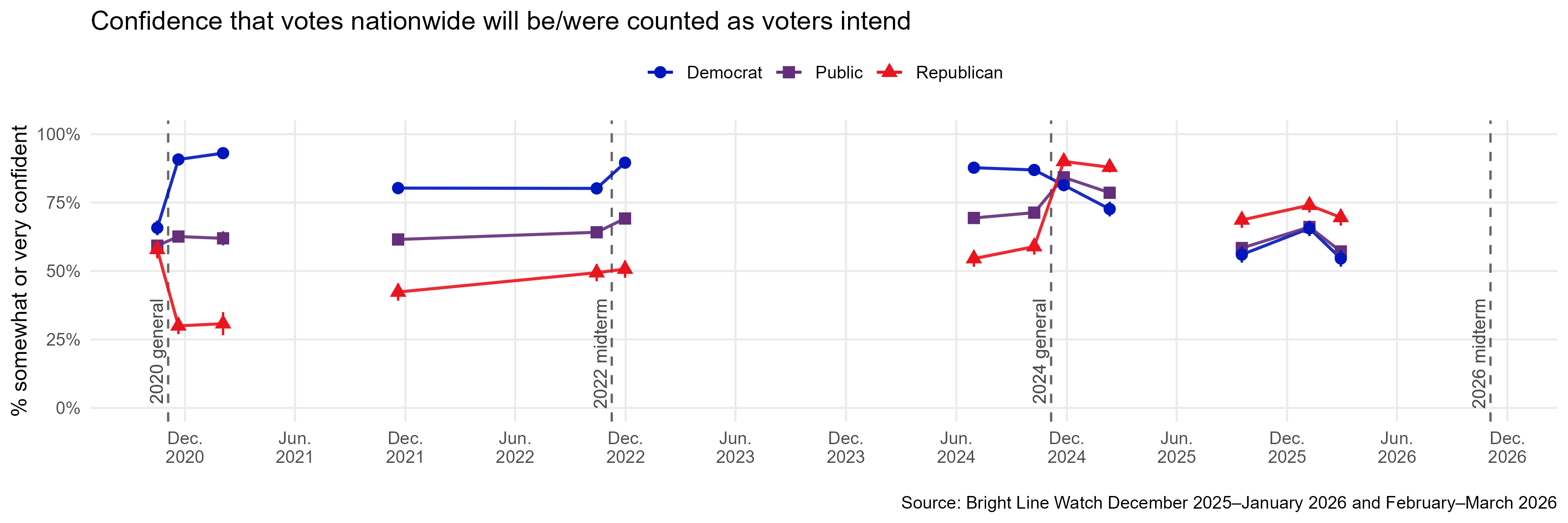
Voter confidence is also less polarized now than it was in the periods before the 2022 and 2024 elections.
Trump is most likely to reduce confidence in the 2026 election among his supporters after it takes place, the moment when the public is most attentive and the losing side is most suspicious. In 2020, confidence in the election among Republicans only dropped sharply after the election, plummeting from 58% in October to 30% in November. No similar pattern took place after the two most recent national elections, but the GOP performed better than expected in 2022 and Trump won in 2024. He accordingly did not have a strong reason to challenge the results. The 2026 election may create different incentives. With Democrats heavily favored to at least win back the House of Representatives and possibly the Senate, Trump could try to undermine the legitimacy of the results among his supporters as he did in 2020.
Appendix
Bright Line Watch conducted its 27th and 28th surveys of academic experts from December 22, 2025–January 7, 2026 and February 19–March 10, 2026, respectively. We conducted our 24th and 25th surveys of the American public from December 22, 2025–January 6, 2026 and February 24–March 7, 2026, respectively. Our public samples each consisted of 2,750 participants from the YouGov panel who were selected and weighted to be representative of the U.S. adult population. We also surveyed political science experts across a diverse range of subfields (564 in the first survey and 621 in the second). Our email list was constructed from the faculty list of U.S. institutions represented in the online program of the 2024 American Political Science Association conference. Estimates from the public surveys use weights provided by YouGov. Estimates from the expert surveys are unweighted because we do not collect demographic data to protect anonymity. Error bars in our graphs represent 95% confidence intervals. Data are available here.
37 democratic principles
- Government officials are legally sanctioned for misconduct
- Government officials do not use public office for private gain
- Government agencies are not used to monitor, attack, or punish political opponents
- All adult citizens enjoy the same legal and political rights
- Government does not interfere with journalists or news organizations
- Government effectively prevents private actors from engaging in politically-motivated violence or intimidation
- Government protects individuals’ right to engage in unpopular speech or expression
- Political competition occurs without criticism of opponents’ loyalty or patriotism
- Elections are free from foreign influence
- Parties and candidates are not barred due to their political beliefs and ideologies
- All adult citizens have equal opportunity to vote
- All votes have equal impact on election outcomes
- Elections are conducted, ballots counted, and winners determined without pervasive fraud or manipulation
- Executive authority cannot be expanded beyond constitutional limits
- The legislature is able to effectively limit executive power
- The judiciary is able to effectively limit executive power
- Lower courts are able to effectively limit executive power
- The Supreme Court is able to effectively limit executive power
- The elected branches respect judicial independence
- Voter participation in elections is generally high
- Information about the sources of campaign funding is available to the public
- Public policy is not determined by large campaign contributions
- Citizens can make their opinions heard in open debate about policies that are under consideration
- The geographic boundaries of electoral districts do not systematically advantage any particular political party
- Even when there are disagreements about ideology or policy, political leaders generally share a common understanding of relevant facts
- Elected officials seek compromise with political opponents
- Citizens have access to information about candidates that is relevant to how they would govern
- Government protects individuals’ right to engage in peaceful protest
- Law enforcement investigations of public officials or their associates are free from political influence or interference
- Government statistics and data are produced by experts who are not influenced by political considerations
- The law is enforced equally for all persons
- Incumbent politicians who lose elections publicly concede defeat
- Universities, businesses, and professional organizations operate independently of government pressure
- Military leadership remains politically neutral and does not favor or support any political party or candidate
- Officeholders do not use the military to advance political agendas or intimidate political opponents
- Law enforcement remains politically neutral and does not favor or support any political party or candidate
- Officeholders do not use law enforcement to advance political agendas or intimidate political opponents
Public approval of wave 27 events
Public approval of wave 28 events