Erosion of the rule of law in Trump’s second term
Bright Line Watch February–March 2026 survey
From February 19–March 6, 2026, Bright Line Watch and the Safeguarding Democracy Project at UCLA Law conducted their first joint survey of legal experts — federal judges, lawyers, and law professors — alongside Bright Line Watch’s frequent surveys of political scientists and the public.
The results provide the most detailed picture to date of experts’ assessment of the state of the U.S. legal system during Trump’s second term. The federal judges, elite lawyers, and academics in our sample perceive a significant erosion of the rule of law since Trump returned to office, including politicized law enforcement, a dysfunctional separation of powers, and executive-branch overreach. Legal experts generally view the erosion of the rule of law as more severe than the public currently perceives it to be.
We surveyed the following legal experts: 21 Article III federal judges, 113 elite lawyers, and 193 law professors. Survey invitations for Article III federal judges were sent to lists of active and senior judges in the U.S. District Courts and the U.S. Courts of Appeals. We invited elite lawyers by sending invitations to the membership lists of the American Law Institute, the National Association of Former United States Attorneys, and the American Academy of Appellate Lawyers; the leaders of the American Bar Association and members who serve in governance roles in it; and state Attorneys General. Law professors were recruited from the faculty of the law schools ranked in the top 50 in the 2025 U.S. News & World Report rankings (55 due to ties).
The responding Article III federal judges are active (33%) or senior (67%) and primarily serve at the U.S. District Court level (92%). They were nominated by both Democratic and Republican presidents (54% and 46%, respectively); 14% identify as legal conservatives by the definition below and the rest as legal liberals. All have served more than ten years on the bench.
The elite lawyers we survey are primarily attorneys in private practice (69%), but 57% have past or current government service experience in the law. They have a median of 35 years of legal experience and mostly identify as legal liberals (82%). Law professor respondents are primarily tenure-track, tenured, or emeritus faculty (81%) and overwhelmingly identify as legal liberals (89%). Approximately half work at public universities (51%); almost all of the rest are at private institutions (46%). The elite lawyers and law professors in our sample have served as heads of law-firm appellate or Supreme Court practices (9), U.S. Supreme Court clerks (6), high-level Department of Justice officials (4), high-level White House or executive branch officials (4), U.S. attorneys (4), state supreme court justices (4), Fortune 500 general counsels or chief legal officers (4), state attorneys general (2), and state solicitor general (1).
Below we report overall statistics for legal experts when responses are not measurably different between subgroups (federal judges, elite lawyers, and law professors) and report them separately otherwise. Similarly, when differences are measurable, we also disaggregate between legal expert respondents who said the Supreme Court should base rulings on its understanding of what the Constitution meant as it was originally written, whom we call legal conservatives (34 respondents; 14% of the legal expert sample), and those who say the Court should base its rulings on what it thinks the Constitution means in current times, whom we call legal liberals (87% of the legal expert sample). However, due to sample size limitations and imbalances in philosophy, we often cannot distinguish statistically between these subgroups. We also note that the legal expert samples we consider are not necessarily representative of the populations from which they are drawn; we intentionally do not gather identifying data to ensure their participation, so we are limited in our ability to assess their composition.
We also separately surveyed political science experts from the faculty list of U.S. institutions represented in the online program of the 2024 American Political Science Association conference and 2,750 participants from the YouGov panel who were selected and weighted to be representative of the U.S. adult population. Estimates from the public surveys use weights provided by YouGov. Estimates from the expert surveys are unweighted because we do not track respondent identity or measure demographic data to protect anonymity.
(Response rates and sample details are provided in the appendix below. Additional descriptive statistics about our legal expert participants are provided here.)
Our key findings are the following:
The state of the rule of law
-
We asked legal experts to rate adherence to the rule of law in the U.S. today and to offer retrospective and prospective assessments on a 0–100 scale. They rate today as the lowest point in at least a decade — below their retrospective ratings of 2015, 2017, 2020, 2021, and 2024 — and project no change by 2027 and only modest improvement by 2032. Federal judges rate the rule of law in the U.S. today more positively than do elite lawyers or law professors, though still below their own assessments of 2021 and 2015.
-
Unlike our overall sample, which is mostly made up of legal liberals, legal conservatives view the rule of law today in the U.S. as not measurably different from 2015. They rate the rule of law as stable from 2015–2021, declining by 2024, and recovering by 2026.
-
Legal experts (except for legal conservatives) place the U.S. closer to the ratings they give to a hypothetical partial rule of law country than a strong rule of law country.
-
When asked to comment on the most important threat to the rule of law in the U.S., three in four federal judges who answered the question expressed explicit or implicit concern about the Trump administration, including all seven Democrat-appointed judges and two of five Republican-appointed judges. One Republican-appointed Court of Appeals judge wrote that “The nation is strong as is its commitment to the rule of law, but the current president presents the greatest threat in decades.”
-
Three of twelve legal conservative law professors faulted Trump or the GOP in their comments. And more than half of the elite lawyers and law professors who served in high-level government roles (U.S. attorney, state Supreme Court justice) explicitly or implicitly cited the Trump administration in their responses.
Threat comparisons across administrations
A majority of legal experts say Trump’s second term poses a greater threat to the rule of law than either Trump’s first term or Biden’s presidency. A majority of legal conservatives share this view, though one in three view Trump’s second term as a lesser threat than Biden’s presidency.
More than half of all Americans see Trump’s second term posing a greater threat to the rule of law than his first term and Biden’s presidency.
State of the judiciary
Most legal experts agree that Trump is using executive power excessively. Of those, legal conservatives are far more likely than legal liberals to say the Supreme Court is constraining Trump. Divisions are narrower for lower courts, which both legal liberals and conservatives see as constraining Trump.
Only a minority of legal experts are confident that the Supreme Court will handle Trump administration cases impartially — a figure that masks a vast divide between legal conservatives (who are overwhelmingly confident) and liberals (who are not).
Approximately one in three legal liberals and one in six conservatives say that lower courts and the Supreme Court are influenced by fears of threats or reprisals by the executive branch.
Only two in ten legal experts agree that the Supreme Court has made appropriate use of the emergency docket since Trump’s return to office, though more than half of legal conservatives agree.
Politicization of justice
Nine in ten legal experts say the Trump administration has used the Department of Justice (DOJ) to go after enemies and provide benefits to allies. Legal liberals say these actions happen more frequently under Trump than Biden; legal conservatives disagree.
More than ninety percent of legal experts believe that the prosecution of New York Attorney General Letitia James and of former FBI Director James Comey were motivated by politics. (Our survey asked about Comey’s first prosecution.) These two prosecutions were viewed differently than several other cases involving political figures in which experts were divided or saw politics as playing little role.
Only one in five legal experts agree the federal government still merits the “presumption of regularity” in court (the doctrine that courts should presume government officials act lawfully and in good faith absent clear evidence to the contrary). Fewer than half of federal judges and only one in four elite lawyers believed that the government still merits the presumption of regularity. Only a narrow majority of legal conservatives agree the presumption is still warranted.
Eight in ten legal experts report that federal officials fail to comply with court orders somewhat or very often, and nearly nine in ten say political appointees in the Trump DOJ mislead federal judges somewhat or very often. All expert subgroups except legal conservatives perceive these transgressions to be more prevalent under the second Trump administration than under the Biden administration.
Fear of reprisals among federal judges, elite lawyers, and law professors
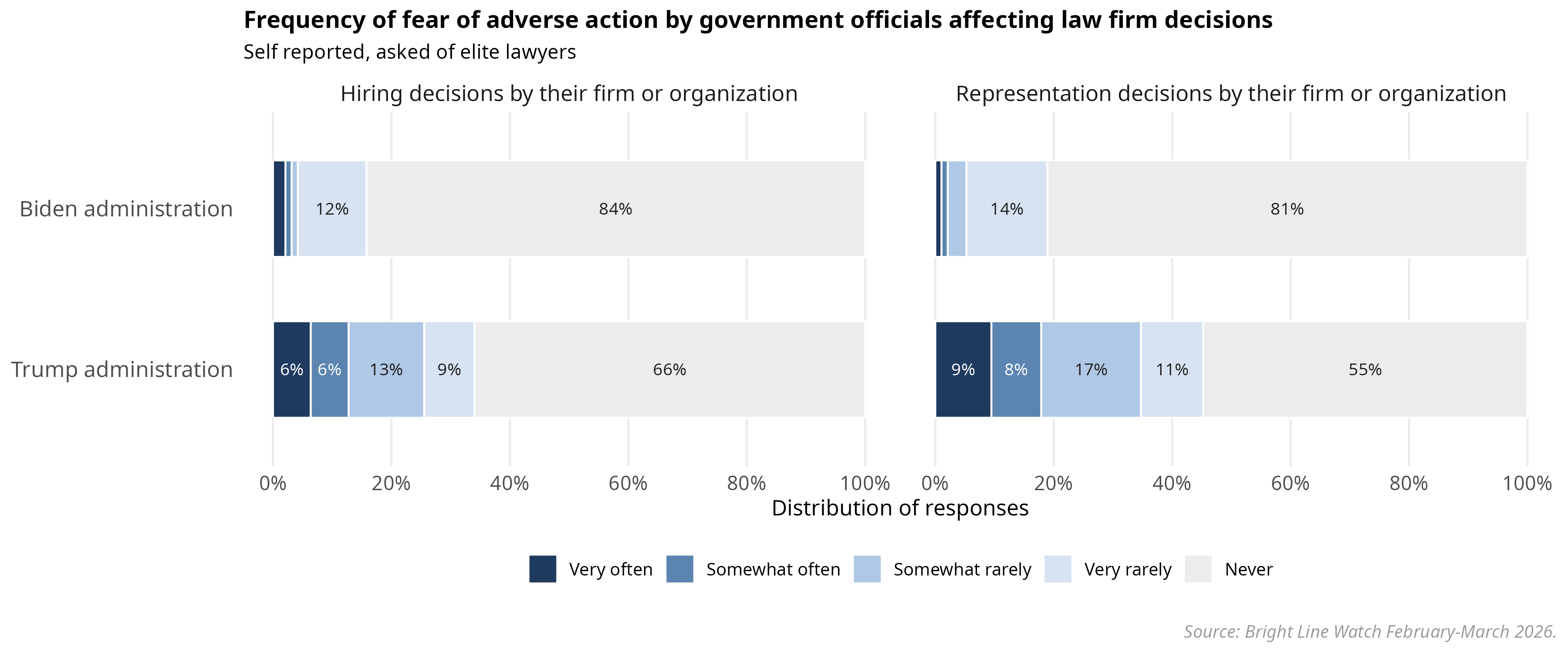
Nearly one in five elite lawyers report that representation decisions by their firms have often been affected by fear of adverse action by government officials or agencies during the Trump administration, compared to virtually none who say the same about the Biden administration. Hiring decisions show the same pattern.
Almost half of federal judges are concerned about harassment if they rule against the federal government, but fears of violence are much less common. Substantial minorities of elite lawyers are concerned about facing legal sanctions or professional consequences for taking a legal action against the government.
Core rule of law principles
Legal experts say standards are not being met for nearly every institutional check on executive power: majorities say the Constitution, legislature, and judiciary (including both the lower courts and the Supreme Court) are failing to limit the executive and that the standard of judicial independence is not being met.
Legal conservatives are substantially more confident than legal liberals in the limits from the Constitution and the Supreme Court and in judicial independence, though majorities agree that legislative limits on the executive are not being upheld.
On most rule of law and anti-corruption principles, legal liberals and conservatives rate U.S. performance as poor. Less than a fourth of legal experts believe that U.S. government agencies do not punish political opponents, law enforcement is not exploited for political purposes and remains neutral, investigations of public officials are not compromised, government officials face sanctions for misconduct, and government officials do not use public office for private gain. Legal experts also express little confidence in U.S. performance on civil liberties and freedom of expression principles.
Confidence in institutions
Legal experts indicate high confidence in federal district and circuit courts and the Federal Reserve, but very few express confidence in other institutions such as the Supreme Court, Federal Bureau of Investigation, the Department of Justice, Immigration and Customs Enforcement, the presidency, and Congress. Legal conservatives are more likely than legal liberals to express confidence in many institutions.
Threats to the rule of law
Legal experts identify numerous recent events as posing serious or extraordinary threats to the rule of law, including the Department of Homeland Security subpoenaing user data for anti-ICE accounts from tech companies, a federal judge finding that ICE disobeyed nearly 100 court orders in Minnesota, and Trump pardoning defendants in January 6 cases. On the other hand, a strong majority of legal experts consider the Supreme Court ruling against Trump’s tariffs to be an extraordinary or serious benefit to the rule of law. These assessments do not vary significantly across professional subgroups.
Overall state of rule of law
Bright Line Watch and UCLA Law’s Safeguarding Democracy Project asked legal expert respondents to rate the current state of the rule of law in the United States on a 0–100 scale. Participants were also asked to provide retrospective ratings for 2015, 2017, 2020, 2021, and 2024 as well as projected ratings for 2027 and 2032.
Overall, legal experts rated the rule of law in the U.S. today at its lowest point since 2015, consistent with the broader pattern of democratic erosion documented in previous BLW surveys of political scientists. This pattern holds across all three legal expert subgroups surveyed: federal judges, elite lawyers, and law professors.
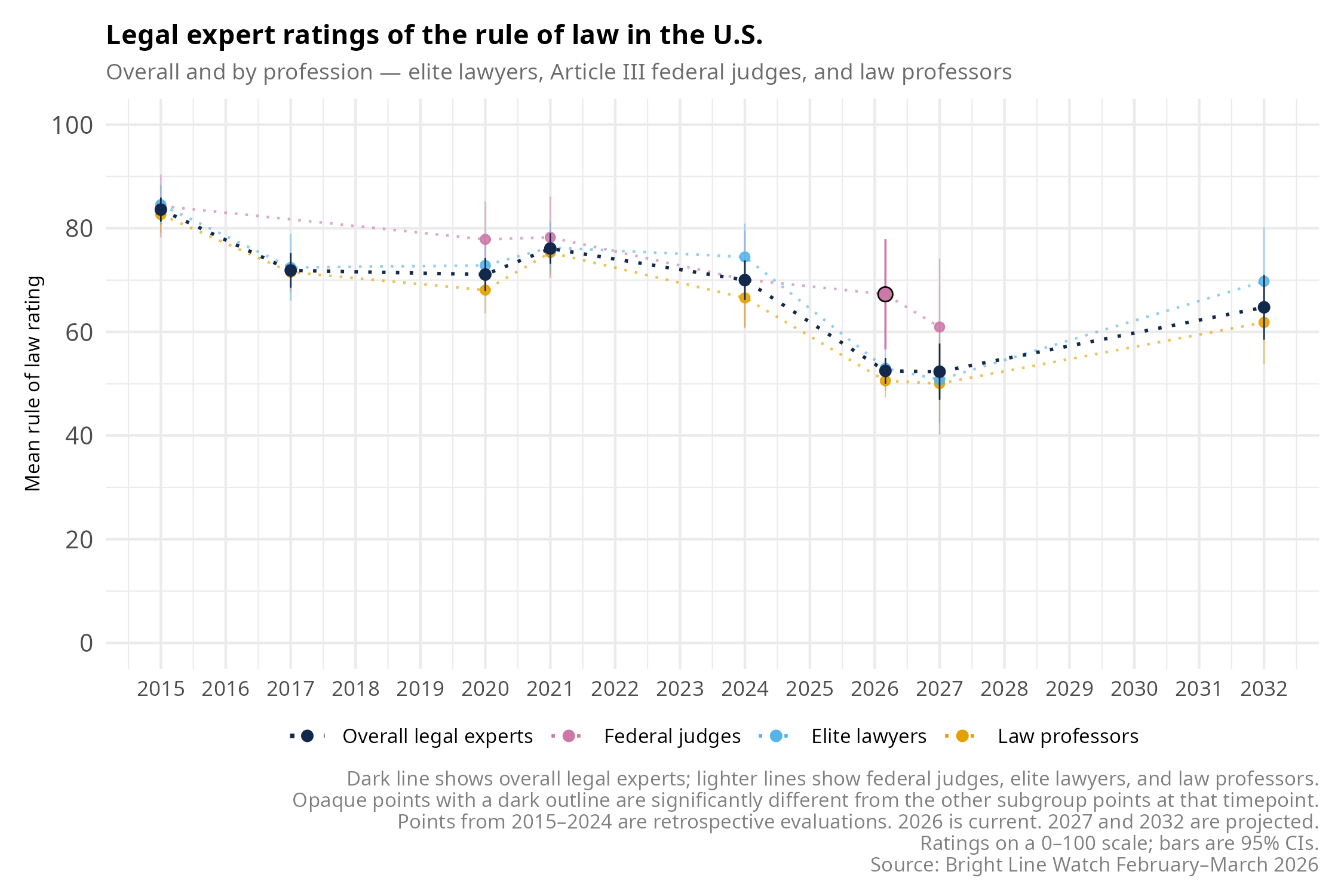
Legal experts (the black dots in the figure) rated the rule of law highest for 2015. Ratings declined for 2017 and 2020, recovered slightly for 2021, then fell again to approximately 2020 levels for 2024. Legal expert ratings of the rule of law for 2026 are the lowest observed for the post-2015 period, though assessments differ by profession. Federal judges rate the current U.S. rule of law the highest, though still meaningfully below their evaluations for 2021 and 2015, while law professors and elite lawyers offer more pessimistic assessments. Legal experts expect little change in the rule of law by 2027 and only a slight improvement by 2032 that would still leave the U.S. below prior rule-of-law levels.
By contrast, disaggregating by legal philosophy reveals a sharp divergence in assessments of the rule of law today and how it has changed since 2015.
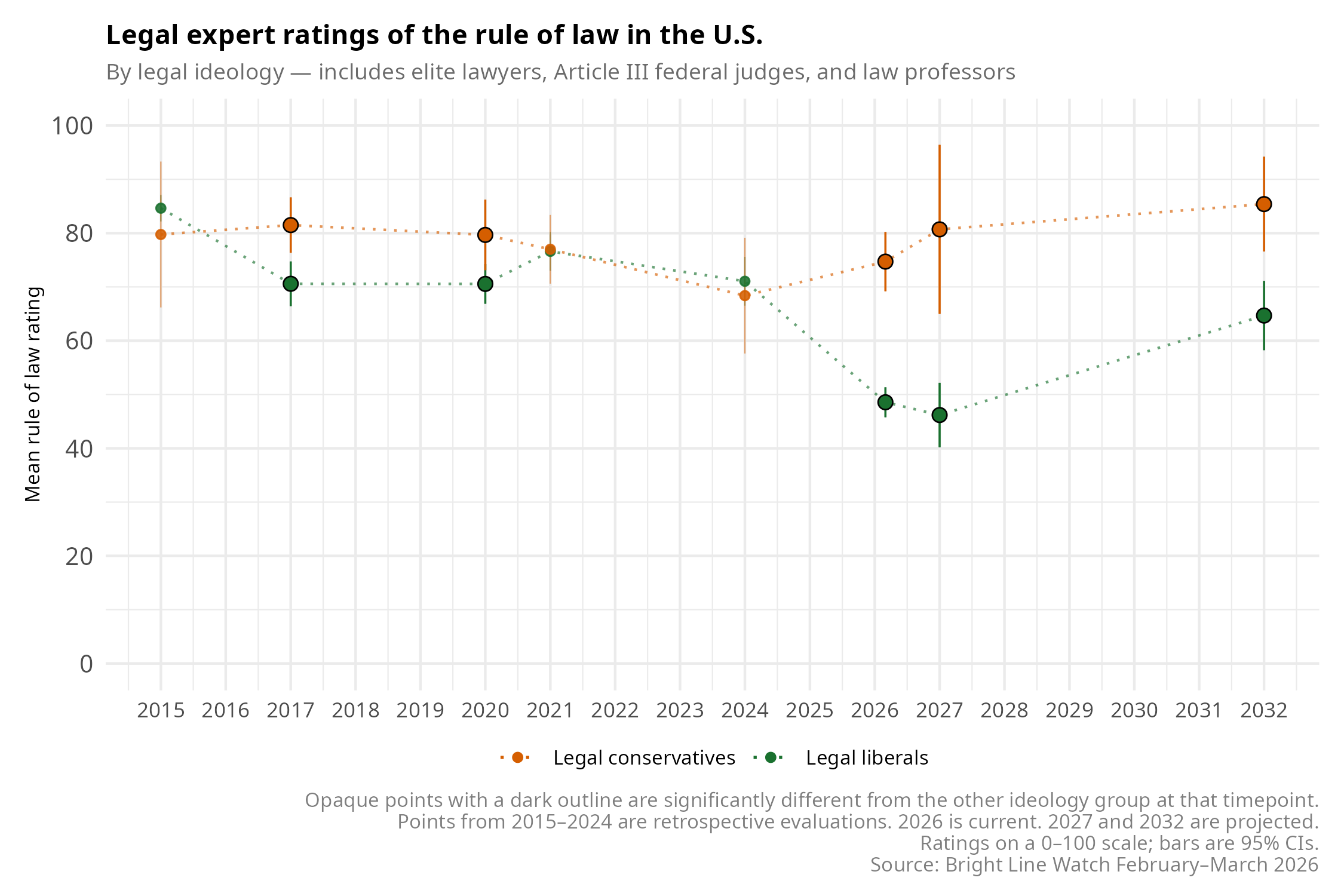
Unlike legal liberals, who perceive a substantial decline in the rule of law during Trump’s first term, a partial recovery during Biden’s term, and a larger decline during Trump’s second term, legal conservative ratings of the rule of law today are not measurably different from their ratings for 2015. The only significant decrease in the rule of law that legal conservatives perceive in the post-2015 period is between the beginning of Trump’s first term and the end of Biden’s term (from 2017 to 2024). Both subgroups project no measurable change by 2027, but both expect improvement by 2032.
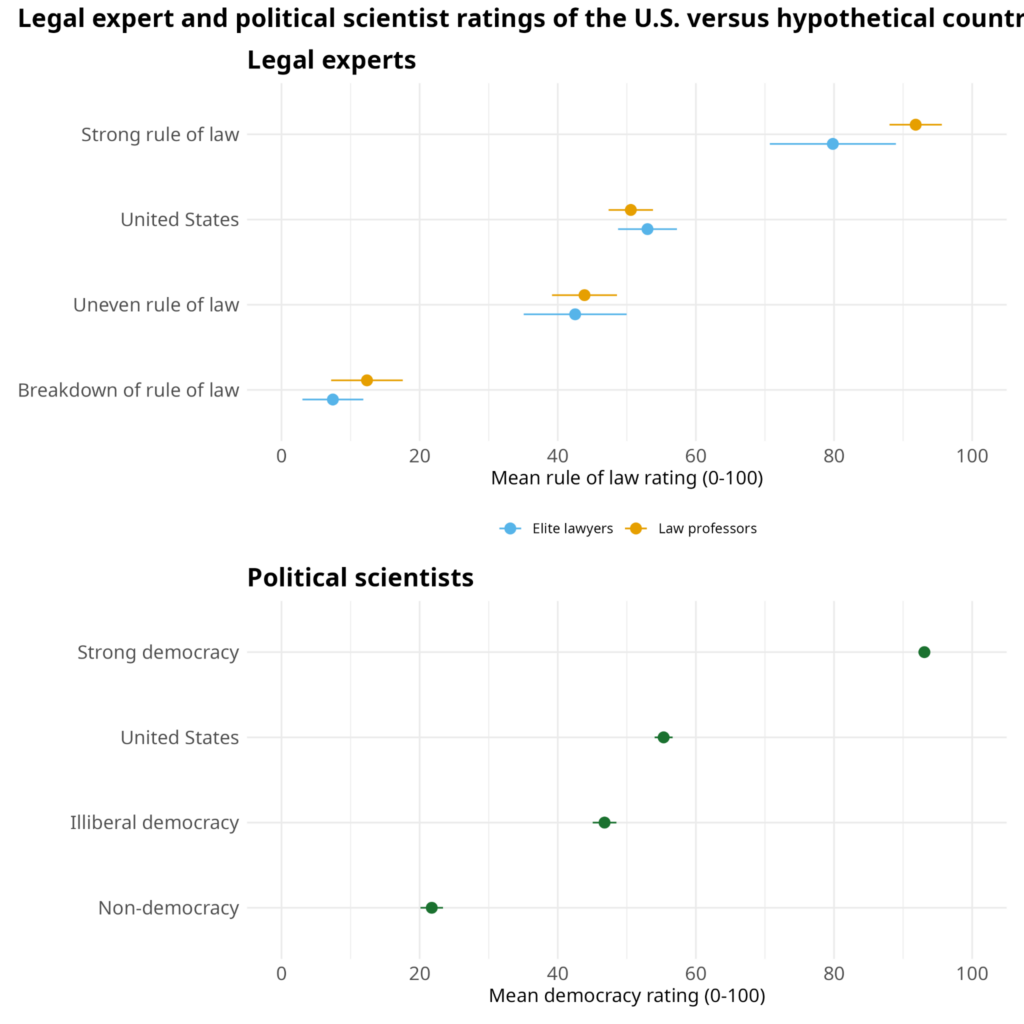
To contextualize these ratings, we asked the legal experts to rate the rule of law in three hypothetical countries described in the dropdown table below using the same 0–100 scale — a country with strong rule of law, one in which the rule of law is partially compromised, and a country with little or no rule of law.
Hypothetical rule of law systems
- Strong rule of law
- Judges are appointed through merit-based procedures and serve with full independence; courts regularly review and strike down unlawful executive actions; the elected branches respect judicial independence.
- Prosecutors and law enforcement agencies operate independently of political direction; charging decisions are insulated from political influence; investigations of public officials are free from interference.
- The law is enforced equally for all persons regardless of political affiliation or status; government officials are consistently held legally accountable for misconduct.
- Government protects individuals’ rights to free expression, peaceful protest, and press freedom; government agencies are not used to monitor, target, or punish political opponents.
- Universities, businesses, and professional organizations operate independently of government pressure; official statistics and audit institutions function without political interference.
- Government officials do not use public office for private gain; officeholders do not use law enforcement to advance political agendas or intimidate opponents; executive authority is effectively constrained by constitutional limits. - Partial rule of law
- Judges are appointed through mixed procedures subject to executive influence; the judiciary is partly independent; courts sometimes but not consistently review executive actions; the elected branches intermittently challenge judicial authority.
- Prosecutors and law enforcement agencies are partially subordinate to the executive; charging decisions are sometimes influenced by political considerations; investigations of public officials occasionally face political pressure.
- The law is unevenly enforced, with political status sometimes affecting outcomes; government officials are occasionally but not consistently held accountable for misconduct.
- Government generally protects rights to expression and protest but selectively restricts press access or targets critics through administrative means; agencies occasionally monitor or pressure political opponents.
- Universities, businesses, and professional organizations face periodic government pressure; official statistics and audit institutions are subject to occasional political influence over timing or presentation of reports.
- Some government officials use public office for private advantage with limited consequences; law enforcement is sometimes used to advance political agendas; executive authority occasionally exceeds constitutional limits with weak enforcement of constraints. - Little/no rule of law
- Judges are appointed at the executive’s discretion and lack independence; courts do not meaningfully review executive actions; the executive routinely disregards or retaliates against judicial decisions.
- Prosecutors and law enforcement agencies are directed by political leaders; charging decisions follow political directives; investigations of public officials are initiated or suppressed based on political loyalty.
- The law is enforced selectively based on political affiliation; allies of the government face minimal legal accountability while opponents face disproportionate scrutiny and prosecution.
- Government restricts expression, protest, and press freedom; agencies routinely monitor, target, and punish political opponents and critics.
- Universities, businesses, and professional organizations are subject to direct government control and coercion; official statistics and audit reports are controlled, delayed, or suppressed by political leaders.
- Government officials use public office for private gain without consequence; officeholders routinely use law enforcement to advance political agendas and intimidate opponents; executive authority is unconstrained by constitutional limits.
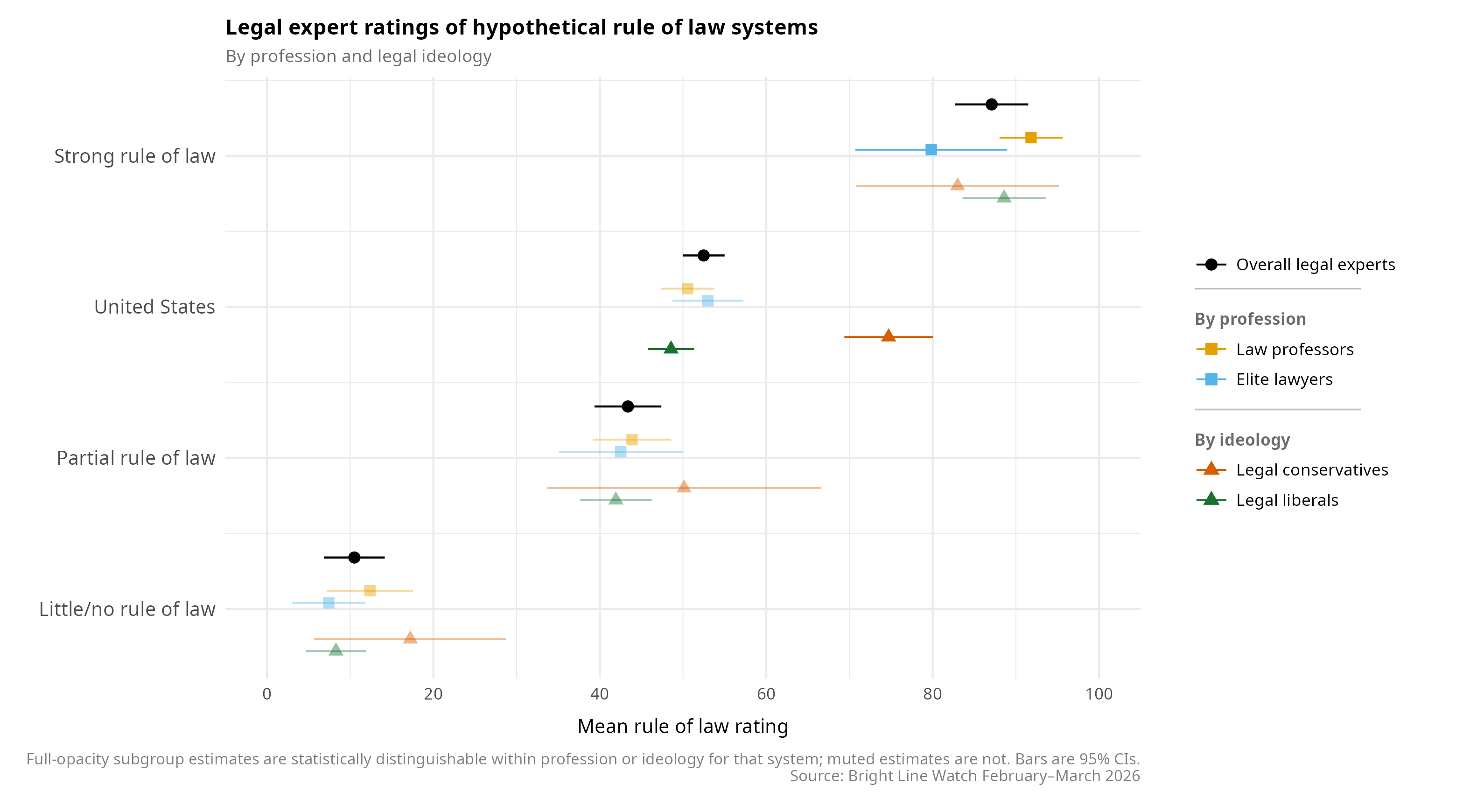
Unlike the polarized ratings we observe for the U.S., legal conservatives and liberals do not differ in their evaluations of any hypothetical country, and professional subgroups differ in only one case (law professors rate the strong rule of law country higher than do elite lawyers). Most notably, legal conservatives are the only subgroup that rates the current U.S. as closest to the strong rule of law hypothetical. Lawyers, law professors, and liberals all rate the U.S. as currently closest to the country with the partial rule of law system.
Notably, the ratings that legal experts give to the rule of law in the U.S. since 2015 track closely with ratings of U.S. democracy by political science experts, which we have collected contemporaneously since 2017.
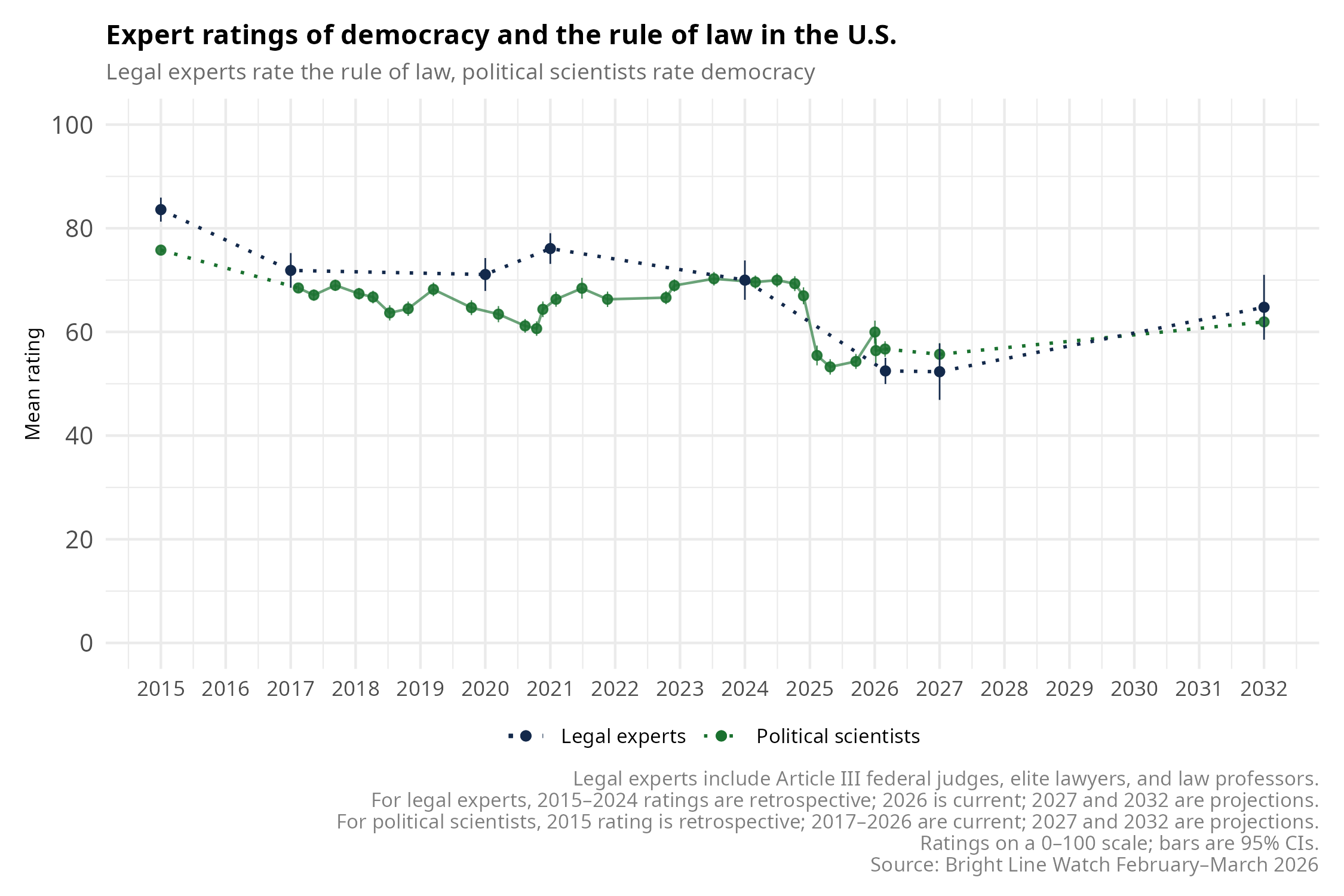
Ratings of the rule of law by legal experts and ratings of democracy by political science experts are at their lowest since 2015. In simultaneous February–March 2026 surveys, political scientists placed the United States closest to an illiberal democracy—consistent with legal experts’ assessment that U.S. rule of law most closely resembles a partial rule of law system.
Legal expert comments about the rule of law
Open-text responses to a question about the state of the rule of law in the U.S. and the single most important threat to it help illustrate the range of views that legal experts hold. Most notably, nine of twelve federal judges who answered the question expressed explicit or implicit concern about the Trump administration, including all seven Democrat-appointed judges and two of five Republican-appointed judges. For instance, a U.S. District Court judge wrote that “The President and Vice President of the United States is the single most [important] threat to the rule of law, with the Supreme Court majority ranking a close second.” Another wrote that “Lawlessness is rampant. The rule of law is on a precipice in the United States. The current leadership in the Executive Branch and the lack of leadership in the Legislative Branch are a double-fisted threat to the rule of law.” Most strikingly, a Republican-appointed U.S. Court of Appeals judge wrote that “The nation is strong as is its commitment to the rule of law, but the current president presents the greatest threat in decades.” Another Republican appointee expressed concern indirectly, stating “it is the trial courts that are most engaged in maintaining the Rule of Law and are most under threat.” Finally, a third GOP appointee pointed the blame elsewhere, writing that “The single most important threat to the rule of law currently is the lawlessness of anti-ICE rioters and thugs who forcefully interfere with our law enforcement officers who are doing their jobs.”
Law professors and elite lawyers express a similar range of views. For instance, one law professor wrote that “the second Trump term has done damage that is irreparable or at a minimum not reparable for generations.” Another wrote that “The rule of law is under serious threat, but is not in imminent danger of collapse. The single biggest threat is Donald Trump’s personalist and Caesarist view of the presidency.” These views are not confined to legal liberals. For instance, three of twelve legal conservative law professors surveyed fault Trump or the GOP. However, others disagree. One legal conservative law professor stated, for instance, that “Biden’s administration was the greatest threat to the rule of law probably in American history” and reports that they have “reluctantly concluded that the only way we are going to restore the rule of law is through a tit-for-tat strategy against the perpetrators of this injustice.” Similarly, a legal liberal lawyer wrote “I abhor Donald Trump. However, I do not think the rule of law is under siege.” Another stated that the state of the rule of law is “abysmal” at the top levels of the Department of Justice but concluded that assistant US attorneys are “still doing their job and appear to be focused on facts, not political favor.”
More than half of the elite lawyers and law professors who served in high-level roles such as U.S. attorney and state Supreme Court justice explicitly or implicitly cited the Trump administration when asked about the state of the rule of law and the single greatest threat to it. For example, a former U.S. attorney and legal conservative writes that “The rule of law is under threat because of Trump and his minions.” A former Trump administration official stated that the greatest threat is “enablers of Trump.” Two former White House counsels wrote that the rule of law is “in grave danger” and “under grave threat,” with both blaming Congress and one blaming the Supreme Court for not resisting the president. And a former U.S. attorney stated that the single greatest threat to the rule of law is “Using the Department of Justice to investigate political opponents or critics.” Others cited other factors such as the “consolidation of wealth and power channeled by Citizens United” (state attorney general) or placed the blame on Biden (U.S. attorney: “failure to uphold and enforce existing immigration laws”) or multiple branches of government (state supreme court justice).
The full set of comments is available here.
Comparative assessments of rule of law threats
We asked legal experts and survey respondents from a nationally representative sample of the American public to assess the relative threats to the rule of law posed by Trump’s first term and by Biden’s presidency compared to Trump’s second term. These questions were derived from a survey of legal experts conducted by Emily Bazelon of The New York Times.
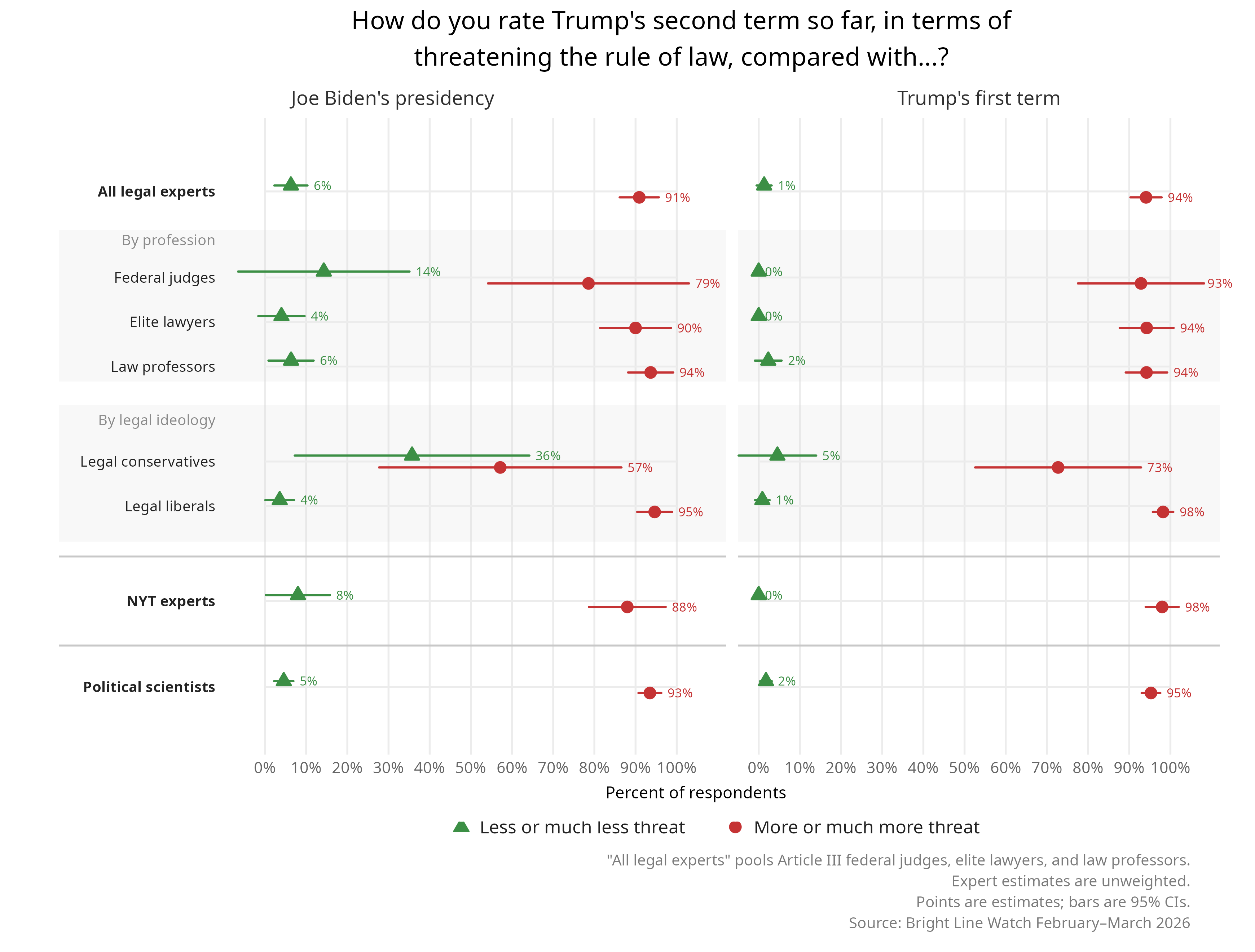
In total, 91% of legal experts rate Trump’s second term as more threatening to the rule of law than Biden’s presidency and 94% rate it as more threatening than Trump’s first term — views that do not differ measurably between federal judges, elite lawyers, and law professors. Even majorities of legal conservatives rate Trump’s second term as more of a threat than Biden’s term (57%) and Trump’s first term (73%), though legal liberals are much more likely to find Trump’s second term to be more threatening in both cases.
These findings differ from the over-time ratings of the rule of law in the U.S. presented above, which showed that legal conservatives rate the rule of law lower during Biden’s presidency than in Trump’s second term. In this case, however, 57% rate Trump’s second term as posing more of a threat to the rule of law than Biden’s (only 36% rate Biden’s presidency as a greater threat). One possible explanation is that legal conservatives currently regard the rule of law as stronger under Trump than under Biden, but also perceive greater risk or have greater fears about the threat to the rule of law in Trump’s second term.
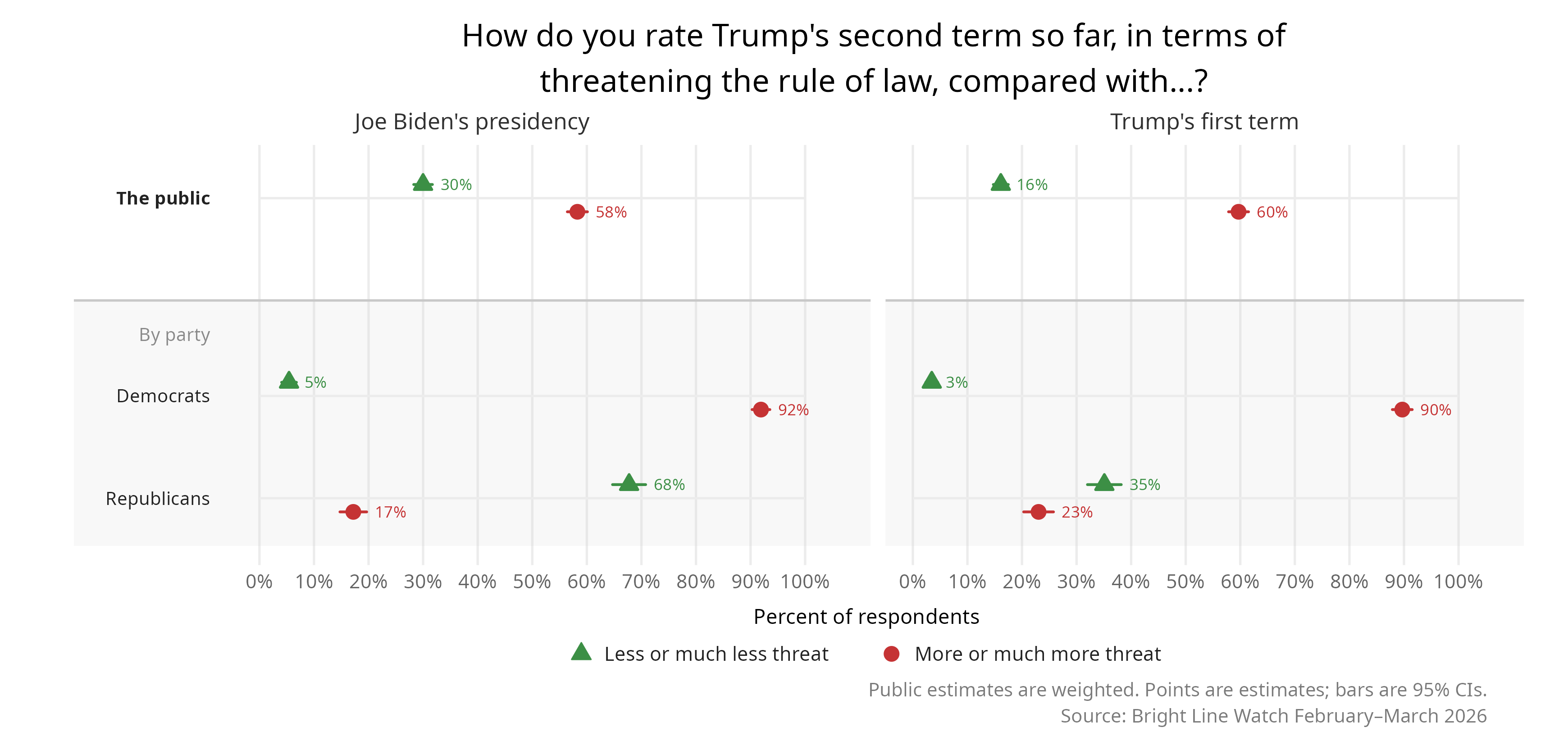
The public perceives Trump’s second term as bringing increasing threats to the rule of law, though perceptions track closely with partisanship. Six in ten public respondents (58%) regard Trump’s second term as threatening the rule of law more than Biden’s presidency, and 60% regard the threat as increased relative to Trump’s first term. The sense of increased threat is overwhelming among Democrats (92% relative to Biden; 90% relative to Trump I). Partisan independents track the public overall closely (61% and 63%, respectively). Republicans, by contrast, view Trump’s second term as more benign than Biden’s: 68% of Republicans regard Biden’s presidency as the more serious threat to the rule of law.
The state of the judiciary
Constraints on excessive executive power
The judiciary’s ability to check executive authority is widely regarded as essential to the rule of law. We asked all respondents to assess the effectiveness of the U.S. Supreme Court in checking excessive uses of executive power in the current Trump presidency. We also asked experts to assess the effectiveness of federal district and circuit courts using the same question format. (We assumed the public would be largely unfamiliar with courts below the Supreme Court.) Our overall legal expert sample aligns with the results of Emily Bazelon’s survey of legal experts in The New York Times, from which we adopted these questions.
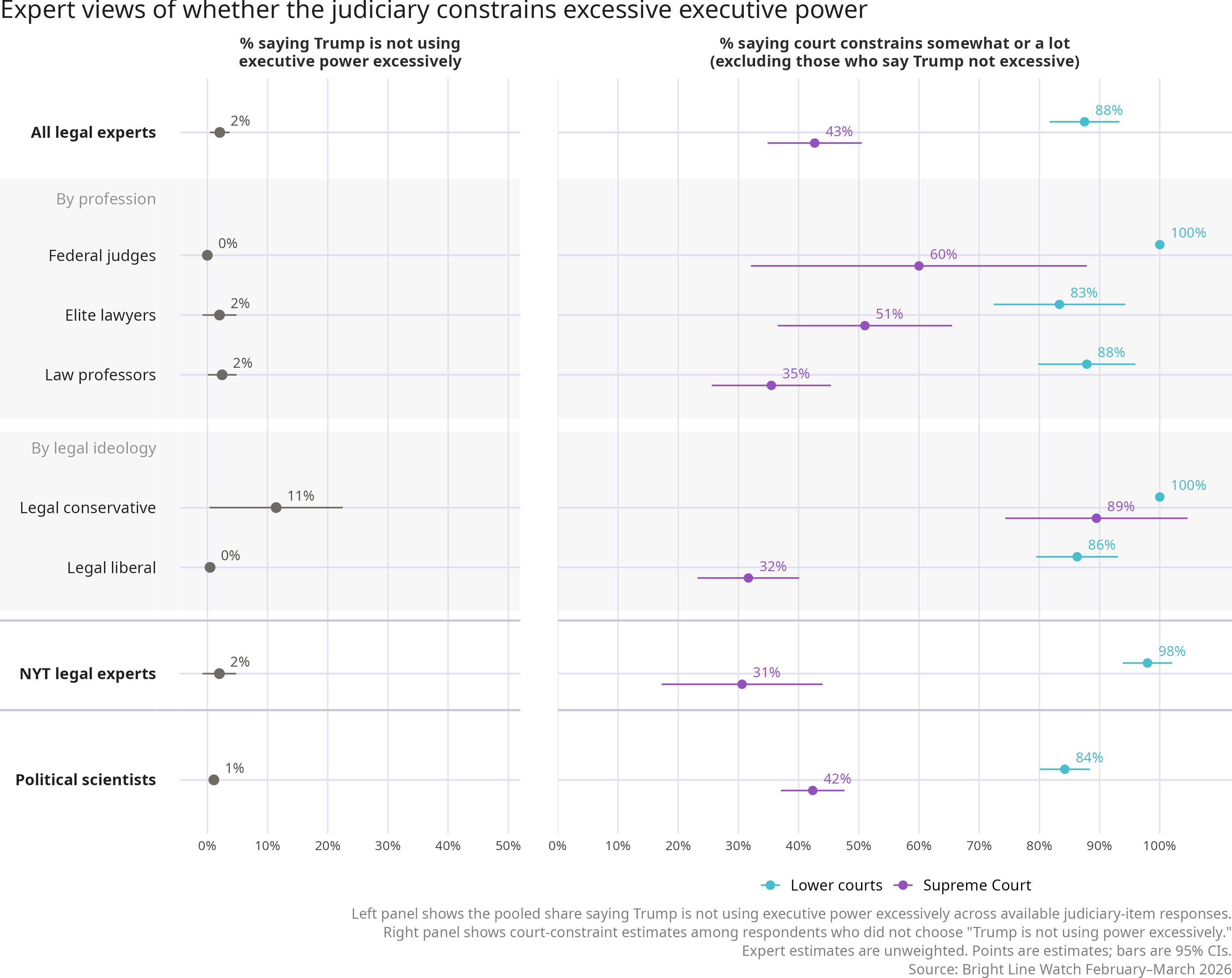
Among the experts, we found much more positive assessments of judicial checks at the district and circuit court levels than for the Supreme Court. First, very few experts (less than 3% for any expert subgroup, except 11% for legal conservatives) rejected the premise of the questions by responding that President Trump is not using power excessively.
Among those who indicate that Trump’s use of executive power is excessive, minorities of each expert subgroup said the lower courts are constraining excessive executive power “a lot” (29% among federal judges, 23% among elite lawyers, 18% among law professors, 29% among legal conservatives, 23% among liberals, and 13% among political scientists). A majority of each subgroup (60–72%) regard the lower courts to be constraining excessive executive power “somewhat,” and smaller minorities (none of the judges or legal conservatives and 12–17% among the other expert subgroups) regard the lower courts as ineffective on this count (constraining executive power “a little or not at all”).
Assessments of the Supreme Court are less sanguine for all subgroups except federal judges and legal conservatives. Among those subgroups, 7% or fewer regard the Court to be constraining excessive executive power “a lot,” while 30–53% say it only does so “somewhat.” For law professors, elite lawyers, legal liberals, and political scientists, the largest cohort (49–69%) said the Supreme Court is constraining excessive executive power “a little or not at all.” Federal judges were somewhat less negative, with 7% saying the Court constrains executive power “a lot” and 53% saying “somewhat” versus 40% saying “a little or not at all.” Legal conservatives were most optimistic, with 26% saying the Court constrains executive power “a lot” and 63% saying it does so “somewhat,” leaving only 11% who say it constrains executive power “a little or not at all” (among those who did not say Trump is not using executive power excessively).
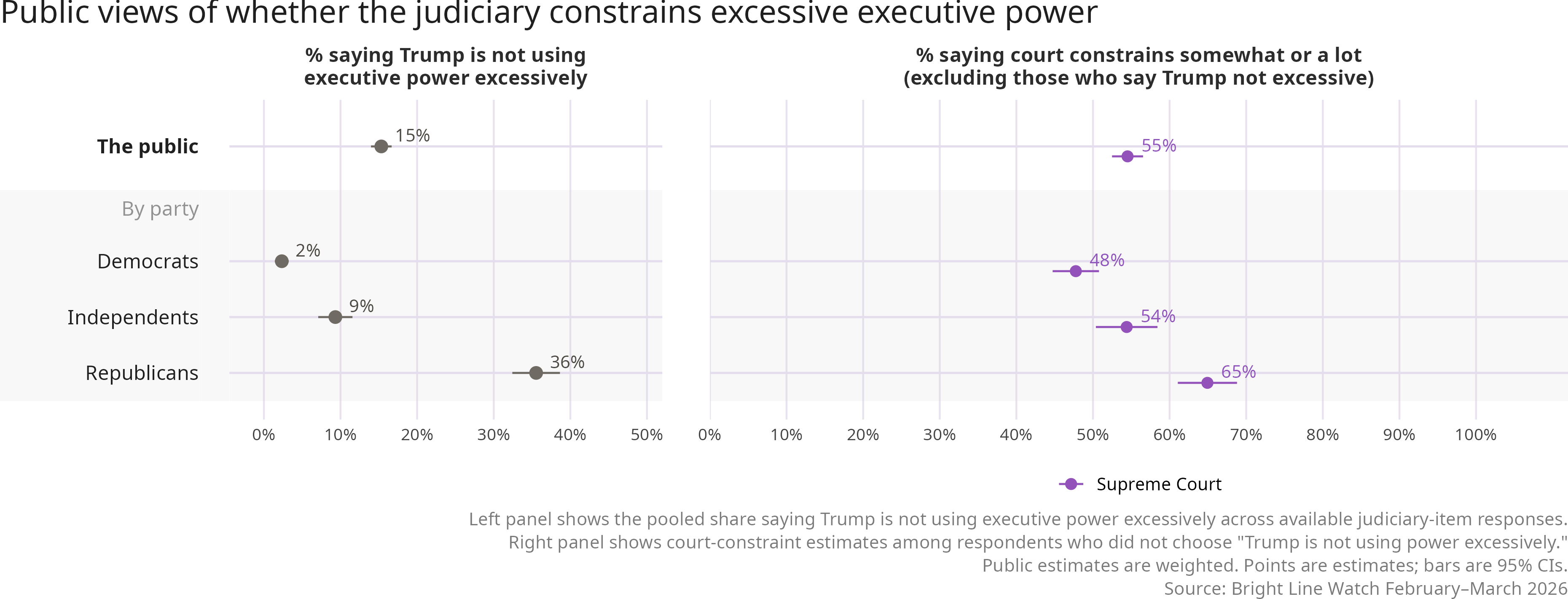
Public evaluations again reflect those of experts, but with a strong dose of partisan polarization. First, 15% of the public (including 36% of Republicans) reject the premise of the question, saying that Trump is not using power excessively. Among respondents who do think Trump is using power excessively, most regard the Supreme Court to be constraining excessive executive power only “somewhat” (36%) or “a little or not at all” (46%, including 52% of Democrats). By contrast, a majority of Republicans who do not dispute the premise of the question say the Supreme Court constrains Trump’s excessive use of executive power “a lot” (12%) or “somewhat” (53%).
Confidence in Supreme Court impartiality
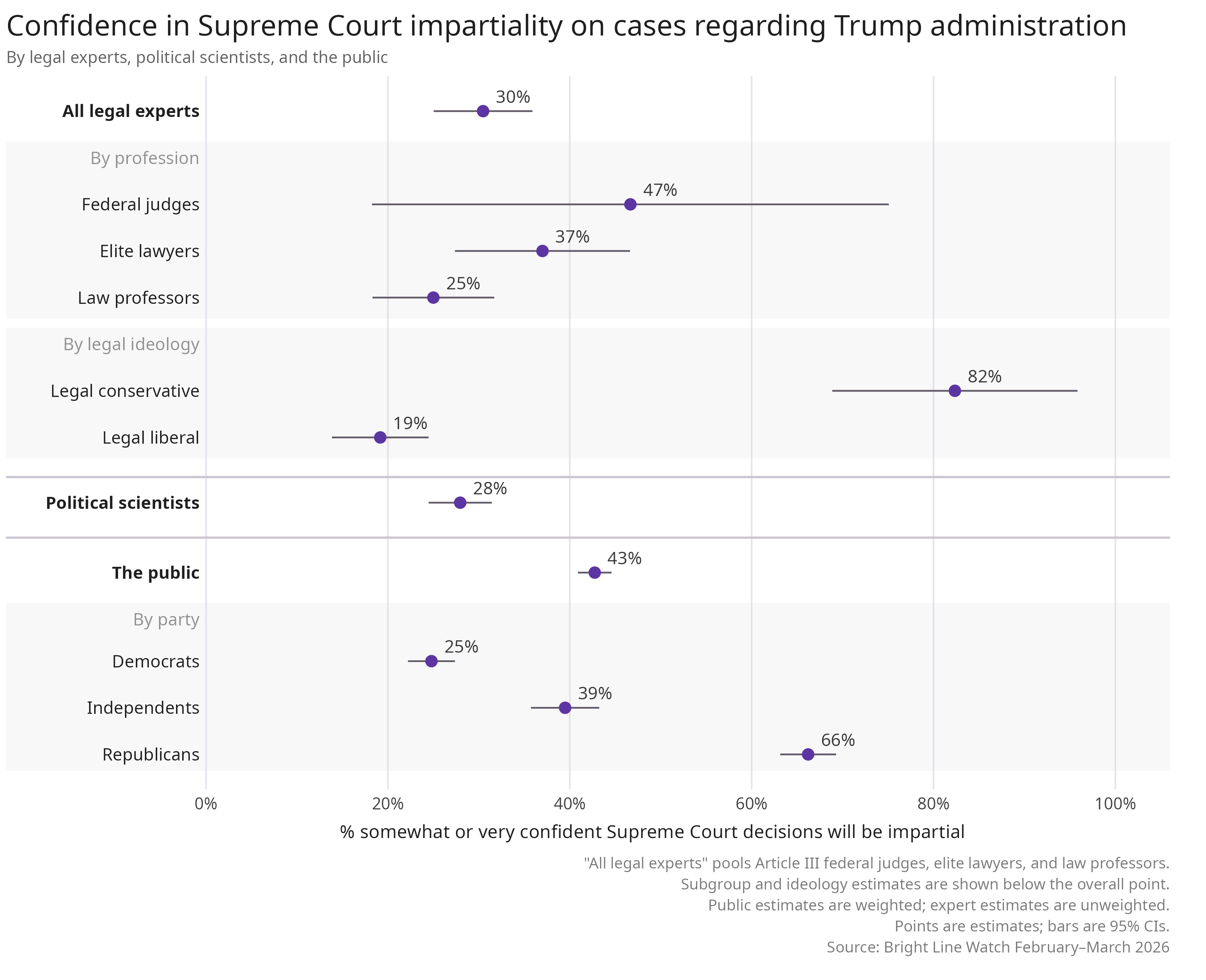
Legal experts overall also expressed limited confidence about the Supreme Court’s impartiality. Only minorities of the professional subgroups (47% among judges, 37% for elite lawyers, 25% for law professors, 28% among political scientists) said they are very or somewhat confident the Court will issue impartial decisions in cases involving the Trump administration — majorities in each professional subgroup said they are not very or not at all confident. Legal conservatives, on the other hand, express confidence in the impartiality of the Supreme Court (82%) at a much higher rate than legal liberals (19%).
The public overall shares experts’ skepticism, with 43% saying they are very or somewhat confident compared to 57% who say they are not very or not at all confident in the Court’s impartiality. However, we again observe sharp polarization, with 66% of Republican respondents saying they are confident compared to just 25% among Democrats and 39% among independents.
Judicial intimidation
To explore why judges might not act as effective checks on executive authority, we asked respondents to what extent they think lower court and Supreme Court justices are influenced by fears of threats and reprisals from the executive branch.
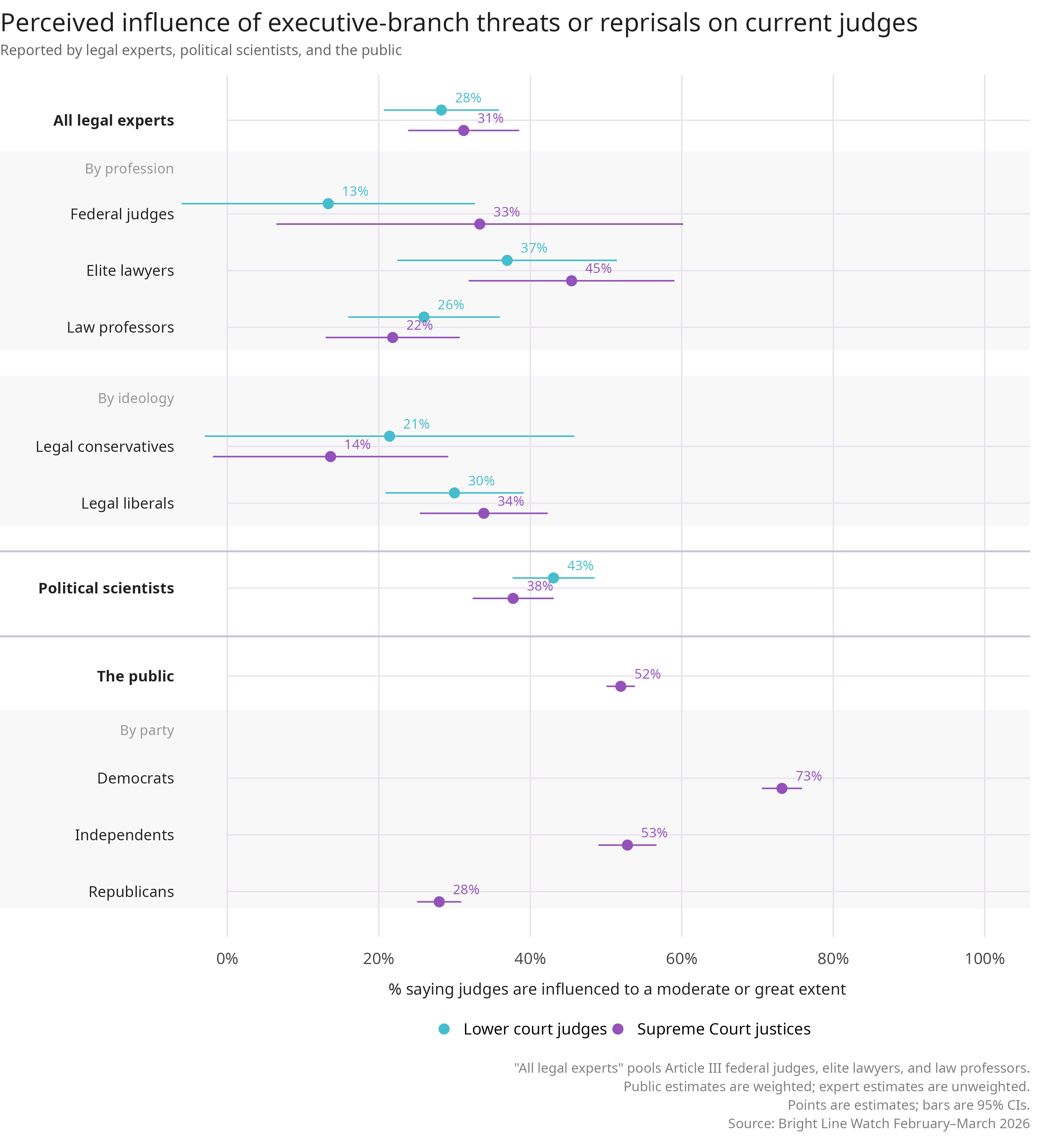
Substantial minorities of legal experts expressed concern that fears of threats or reprisals from the executive branch influenced judges, with 28% saying lower court judges are influenced to a moderate or great extent and 31% saying so for Supreme Court justices. Political scientists were more likely to say that lower court judges are influenced than legal experts (43% vs. 28%), but do not differ significantly from them with respect to the Supreme Court (38% vs. 31%).
Legal liberals and conservatives did not differ significantly with respect to lower court judges, but they did differ on Supreme Court justices: legal liberals were more likely than legal conservatives to say that such fears influence justices to a moderate or great extent (34% vs. 14%). The only significant difference among professions is between elite lawyers and law professors on Court influence – the former were more likely than the latter to say that such fears influence justices to a moderate or great extent (45% vs. 22%).
Just over half of the public overall says that the Supreme Court is influenced by fears of threats or reprisals (we didn’t ask the public about lower courts) – a larger proportion than legal experts and political scientists (52%, 31%, and 38%, respectively). The public is significantly polarized by party: a strong majority of Democrats perceive Supreme Court justices to be influenced by fears of threats and reprisals (73%) compared to only a minority of Republicans (28%).
Emergency docket
In October 2025, Mattathias Schwartz and Zach Montague of The New York Times surveyed 65 federal judges on, among other questions, whether they agreed with the following statement:
The Supreme Court has made appropriate use of the emergency docket since President Trump returned to office.
In this survey, we repeated this question for our expert samples, including federal judges and other legal experts.
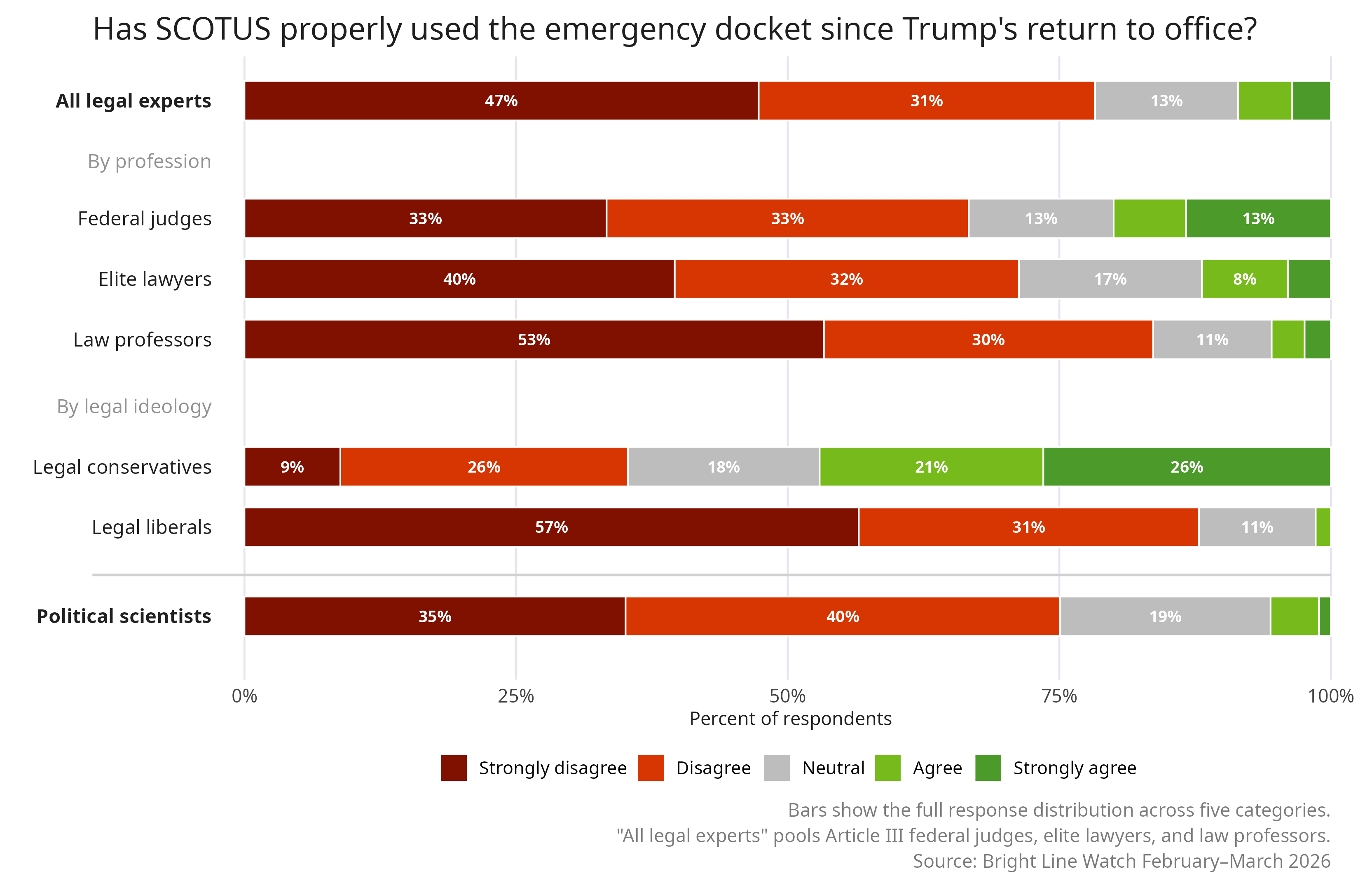
Majorities of federal judges surveyed by the Times and Bright Line Watch (72% and 65%, respectively; not a statistically significant difference) disagreed with the Supreme Court’s use of the emergency docket. Legal liberals are much more likely to disagree with recent usage of the emergency docket than legal conservatives, though a substantial minority of the latter also expressed doubts (88% vs. 35%). Political scientists align closely with legal experts overall (75% and 78%, respectively).
Politicization of justice
DOJ use for political ends
Drawing again from Emily Bazelon’s survey of legal experts in The New York Times, we asked respondents whether the Biden and Trump administrations directed the DOJ to go after political and personal enemies and provide favors or benefits to the president’s political and personal allies. The results reveal a consensus on the current administration across legal expert subgroups and among political scientists as well as sharp partisan divisions in the public.
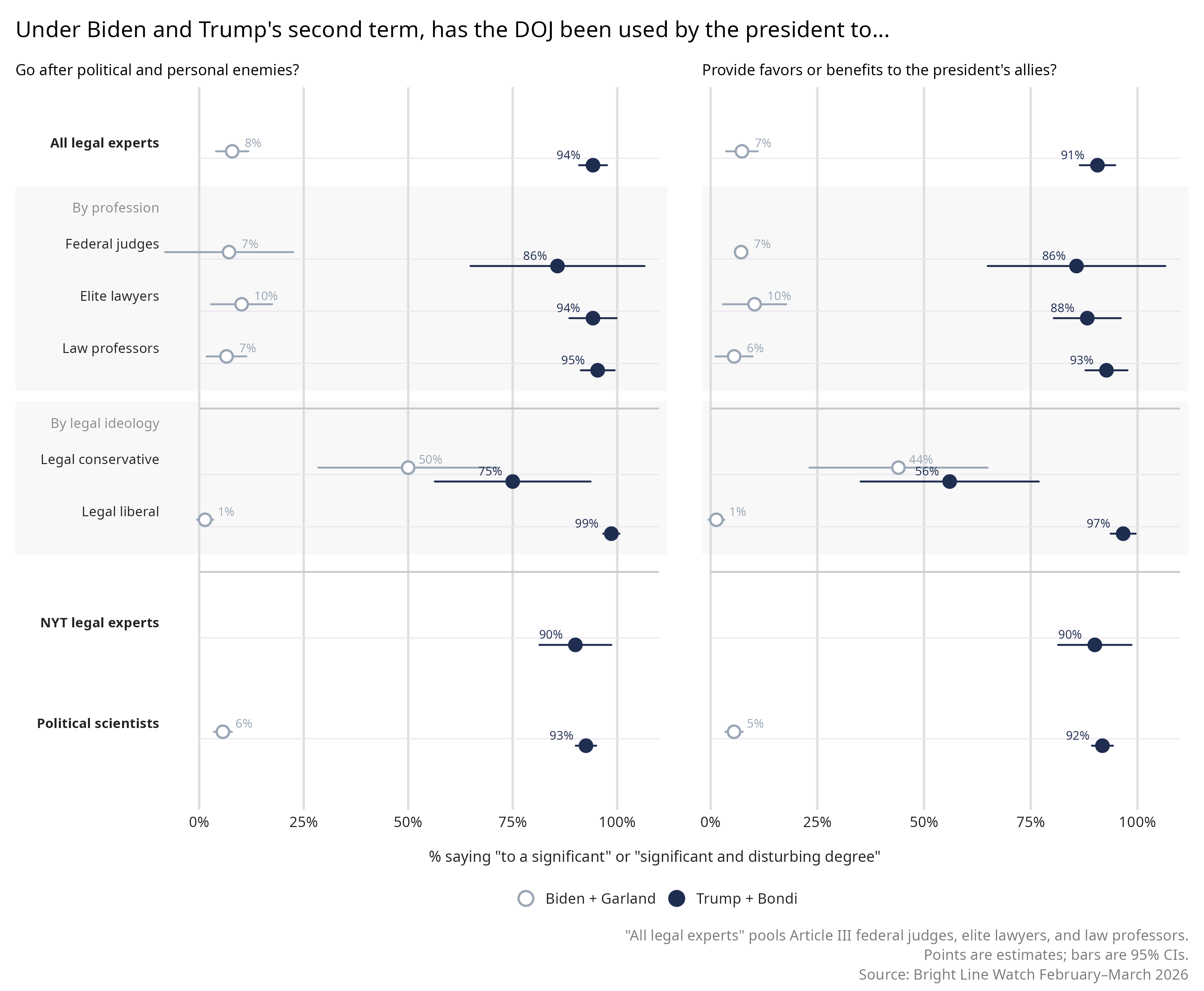
Overwhelming majorities of all legal expert subgroups — federal judges, elite lawyers, law professors (86%, 94%, 94%; no significant differences), legal conservatives (75%), and legal liberals (99%) — say the Trump administration is going after political enemies to a significant or greater degree (93% of political scientists say the same). The proportions of legal experts indicating the Trump administration provides favors or benefits to the president’s allies are similarly high among professions (86–97%; no significant differences); though the gap by ideology persists, there is still majority consensus (56% of legal conservatives, 97% of liberals).
Uniquely, legal conservatives see no difference between the Biden and Trump administrations in these regards. Many previously condemned Biden commenting on DOJ investigations into Trump and criticizing David Weiss, the special counsel appointed to investigate Biden’s son Hunter. On the other hand, legal liberals and all legal professional subgroups are much less likely to say that Biden misused the DOJ to go after enemies and provide favors to allies (1–10% for both).
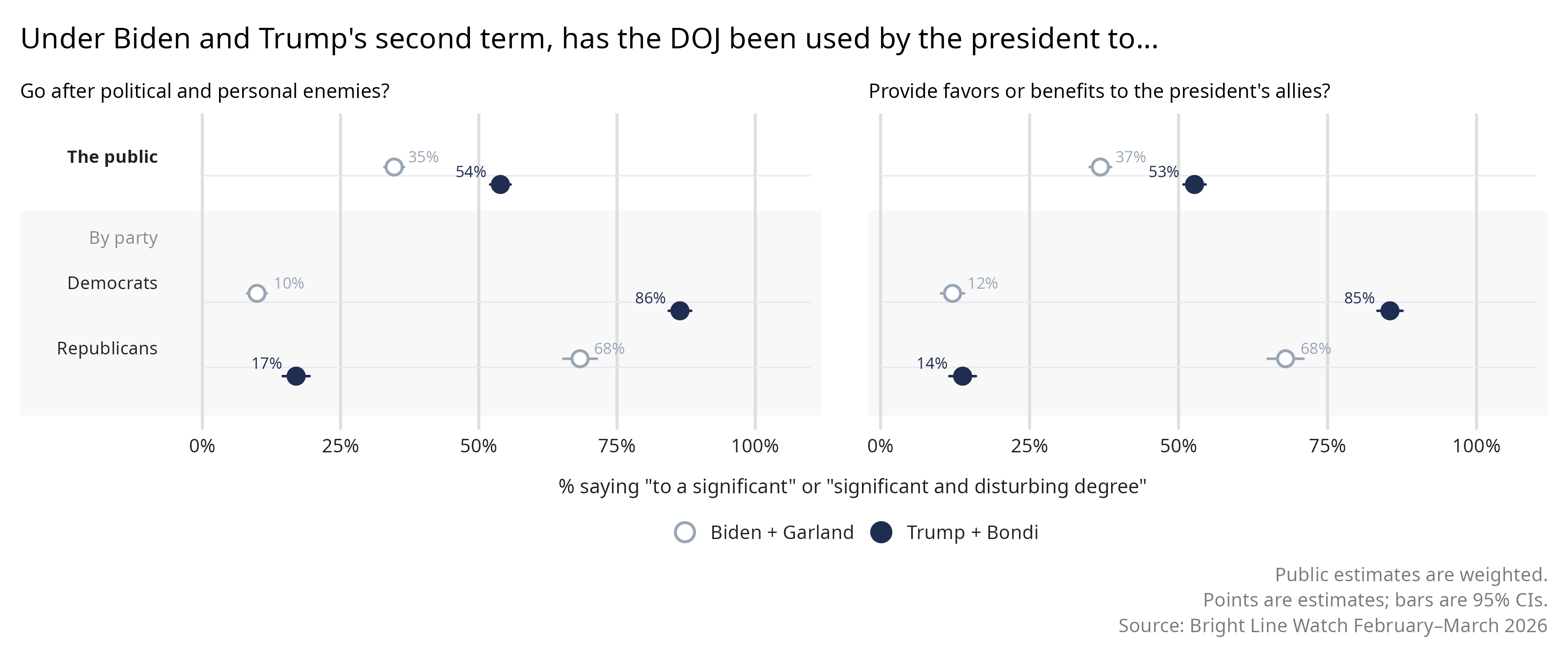
The pattern of sharp public polarization on perceptions of the Trump and Biden administration’s respect for the rule of law persists. Among Republicans, far more regard the Biden administration (68%) than the current Trump administration (17%) as having politicized prosecutions. Among Democrats, these proportions are reversed and even more lopsided, with 86% holding that Trump’s Justice Department goes after political enemies and only 10% believing that Biden’s DOJ did so. Partisan independents (25% of the public sample) line up slightly closer to Democrats than Republicans on these questions, with 56% holding that the Trump administration politicizes prosecutions and 30% believing Biden did.
The same partisan divergence appears in assessments of whether the Trump and Biden administrations provided favors or benefits to the president’s allies. 68% of Republicans and 12% of Democrats say the Biden administration did, but they switch places on the Trump administration with 14% and 85%, respectively. Independents are again slightly closer to Democrats, 36% saying Biden provided favors and 56% saying Trump does.
Politically motivated prosecutions
We asked elite lawyers, law professors, and political scientists whether specific prosecutions were politically motivated. (We did not ask federal judges given ethics concerns about commenting on current or potential future cases.)
The set of prosecutions by era are as follows:
Biden era
- In 2023, the Justice Department indicted Hunter Biden for allegedly lying on his application to purchase a handgun.
- In 2023, the Justice Department indicted former Congressman George Santos, a New York Republican, for allegedly committing wire fraud, conspiracy, and identity theft.
- In 2023, Justice Department Special Counsel Jack Smith indicted Donald Trump for allegedly retaining classified documents after leaving the presidency in 2021.
- In 2023, Justice Department Special Counsel Jack Smith indicted Donald Trump for allegedly participating in criminal conspiracies in his efforts to overturn the 2020 presidential election.
Trump era
- In 2025, the Justice Department indicted former FBI Director James Comey for allegedly lying to and obstructing Congress related to the Russia investigation. (Note: That case was dismissed, but Comey was indicted by the Justice Department again in April 2026 on unrelated charges.)
- In 2025, the Justice Department indicted New York Attorney General Letitia James, a Democrat, for allegedly committing mortgage fraud.
- In 2025, the Justice Department indicted Congresswoman Sheila Cherfilus-McCormick, a Florida Democrat, for allegedly stealing federal disaster funds and making illegal campaign contributions.
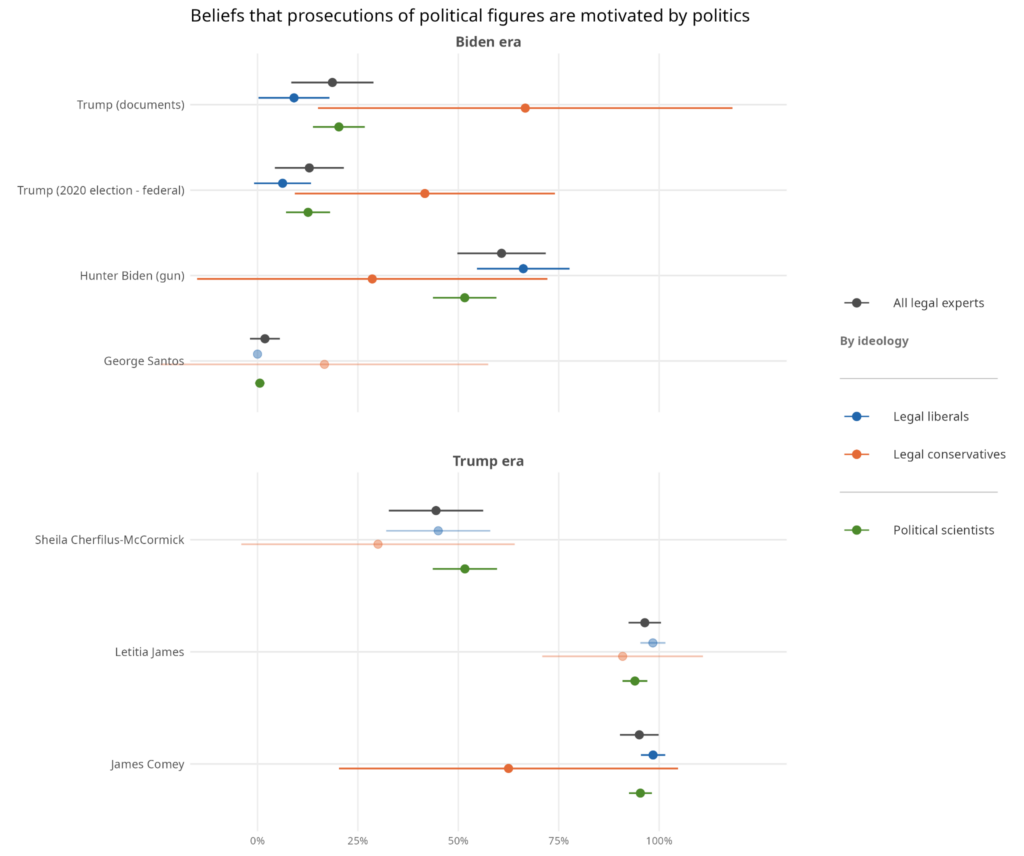
The figure below shows the share of our expert and public samples who indicated that the prosecution was or is motivated by politics. Because lawyers and law professors do not differ measurably in their evaluations of these cases, we aggregate them in the figure. Due to consistently low sample sizes and resulting imprecision, we do not disaggregate legal liberals and legal conservatives in the main text (figure disaggregated by ideology in appendix).
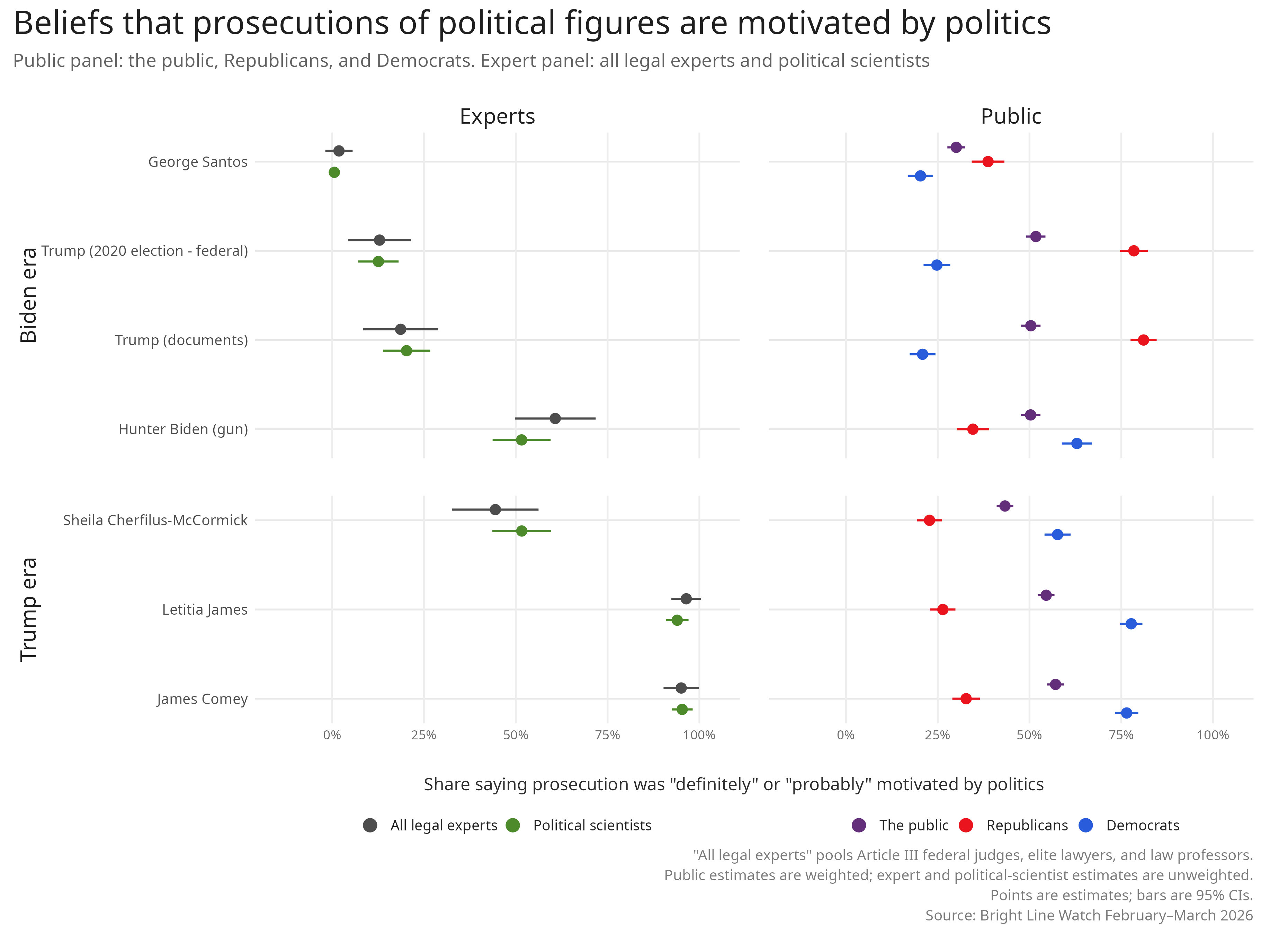
Legal experts and political scientists were most likely to rate the first prosecution of James Comey (95% from both) and Letitia James as motivated by politics (96% and 94%, respectively). Legal expert and political scientist views split on Hunter Biden’s 2023 indictment for allegedly lying on his application to purchase a handgun (61% of legal experts and 52% of political scientists perceive political motives) and the 2025 indictment of then-Congresswoman Cherfilus-McCormick (44% and 52%).
Only a small minority of legal experts and political scientists view the 2023 Trump indictments as politically motivated (19% and 20%, respectively, for the classified documents case; 13% for the indictment for allegedly attempting to overturn the 2020 election). Finally, almost no legal experts or political scientists view the 2023 George Santos indictment as politically motivated.
Close to half of the overall public say these prosecutions were politically motivated with the exception of the Santos case (30%). Most notably, large majorities of Republicans say the Trump indictments were motivated by politics (81% for documents, 78% for 2020 election).
Presumption of regularity
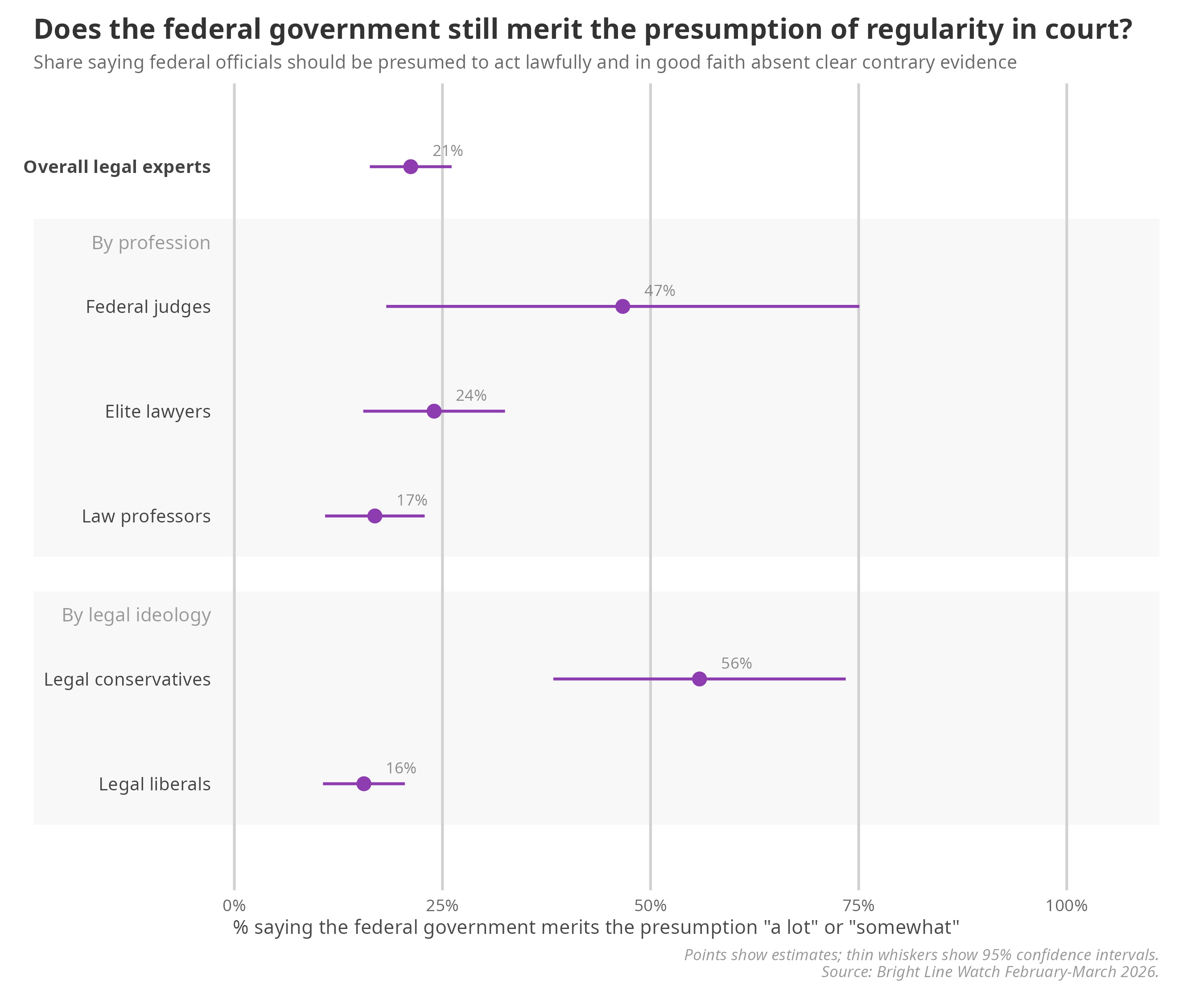
The “presumption of regularity”—the doctrine that courts should presume federal government officials act lawfully and in good faith absent clear evidence to the contrary—is a foundational principle of American law. Remarkably, a majority of legal experts now disagree with the view that the federal government still merits the presumption of regularity in federal court. Only 41% of federal judges agree that the presumption of regularity is still merited. Endorsement is even lower among elite lawyers (24%) and law professors (17%). Legal conservatives are the most likely to endorse the presumption of regularity, but still only 56% agree (compared to 14% among legal liberals).
Compliance with court orders
The rule of law depends on the government making accurate representations in court and complying with court orders. We therefore asked legal experts to assess how often DOJ political appointees have misled federal judges and how often federal officials have failed to comply with court orders during the second Trump administration. We also asked how often these actions took place under Biden.
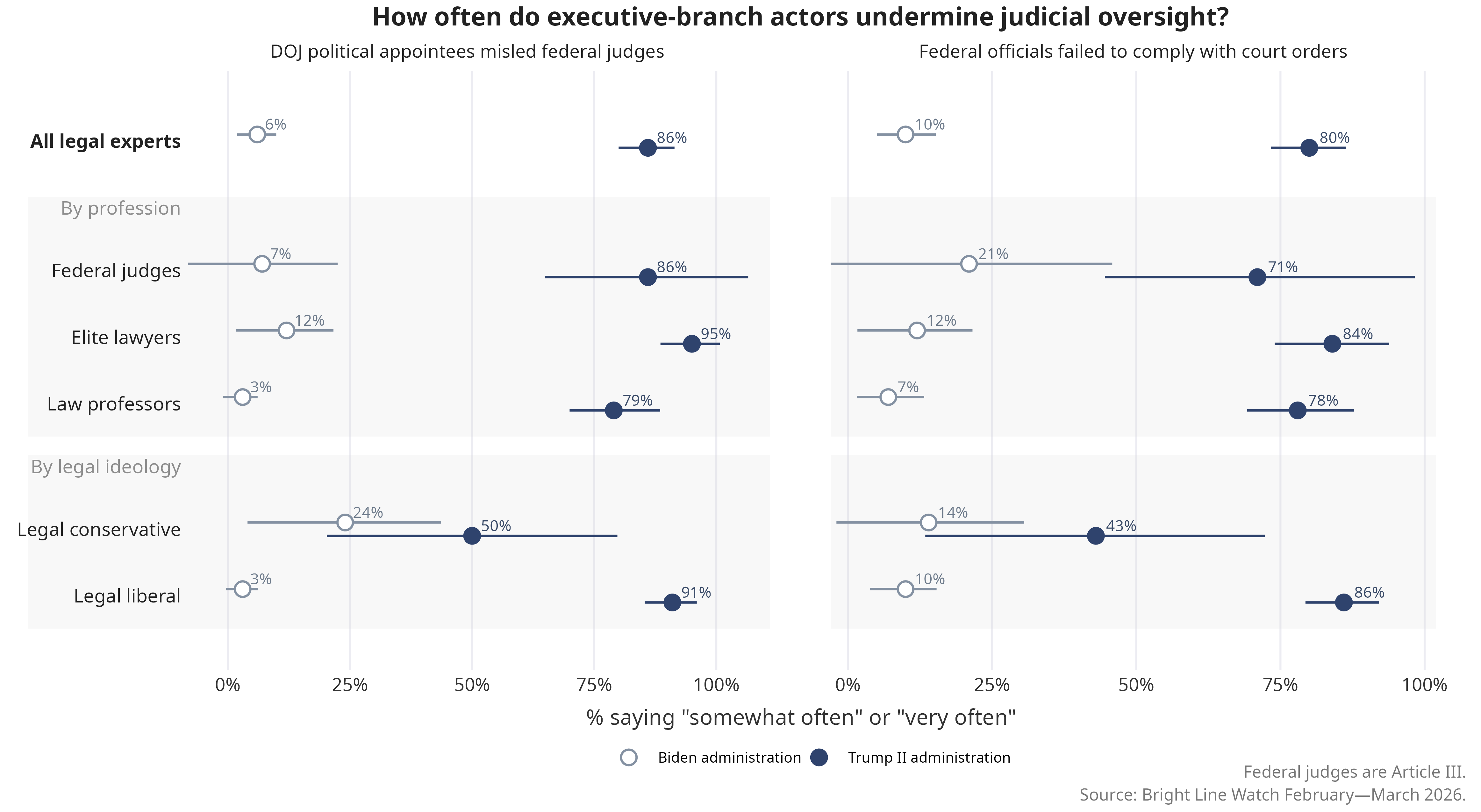
In total, 86% of legal experts say that DOJ political appointees in the Trump administration mislead federal judges somewhat or very often, and 80% say that federal officials in the Trump administration fail to comply with court orders somewhat or very often. These estimates correspond with recent estimates of more than 200 instances of court concerns over noncompliance with judicial orders, distrust of government information and representations, and findings of “arbitrary and capricious” administrative action. The results also align with more than 400 instances of failure to comply with federal court orders in immigration habeas corpus proceedings. Notably, legal expert estimates of misleading judges and non-compliance for the second Trump administration are sharply elevated compared to perceived rates under Biden (86% vs. 6%, and 80% vs. 10%, respectively).
Across professions, the only significant difference is between elite lawyers and law professors on the frequency of DOJ political appointees misleading federal judges under the current administration (95% vs. 79%).
Differences are greater between legal conservatives and legal liberals. Legal liberals are virtually unanimous in saying that Trump officials often mislead federal judges and defy court orders (91% and 86%, respectively). Perceptions of these behaviors are lower among legal conservatives but many still express significant concern — 50% say Trump DOJ appointees often mislead judges and 43% say federal officials often fail to comply with court orders. Both groups perceive these behaviors as happening at relatively low rates under Biden (misleading judges: 3% for legal liberals vs. 24% for legal conservatives; court orders: 10% and 14%, respectively), though the differences in perceived frequency between administrations are only statistically significant for legal liberals.
Fear of reprisals among legal professionals
During the current administration, judges have repeatedly warned that they face personal attacks from politicians as well as direct threats of violence. According to the U.S. Marshals Service, the agency that protects judges and other legal officials, reported threats against federal judges have remained above 500 per year since 2023, reaching 564 in fiscal year 2025. A common method of harassment has been anonymous pizza deliveries to judges’ homes, often sent in the name of U.S. District Judge Esther Salas’s son, Daniel Anderl, who was murdered in 2020 by a man targeting his mother while posing as a delivery man.
We therefore asked federal judges and other legal experts whether they are personally concerned about facing consequences for taking an action against the second Trump administration. We also asked our sample of lawyers whether their firm or organization’s decisions were affected by fear of reprisals during the current administration and under Biden. The results reveal that substantial minorities are concerned about facing targeted action for acting against the federal government in their official and legal capacity and that these fears are affecting some hiring and representation decisions by law firms and other organizations.
We specifically asked legal experts whether they were concerned about the following consequences if they ruled against the government (judges), took a legal action against it (elite lawyers), or publicly argued against it (law professors):
- Social consequences (for example, exclusion from social events)
- Harassment (online or in-person)
- Professional consequences (for example, losing job or promotion)
- Legal sanctions (for example, prosecution or fine)
- Violence (the use of physical force to harm someone)
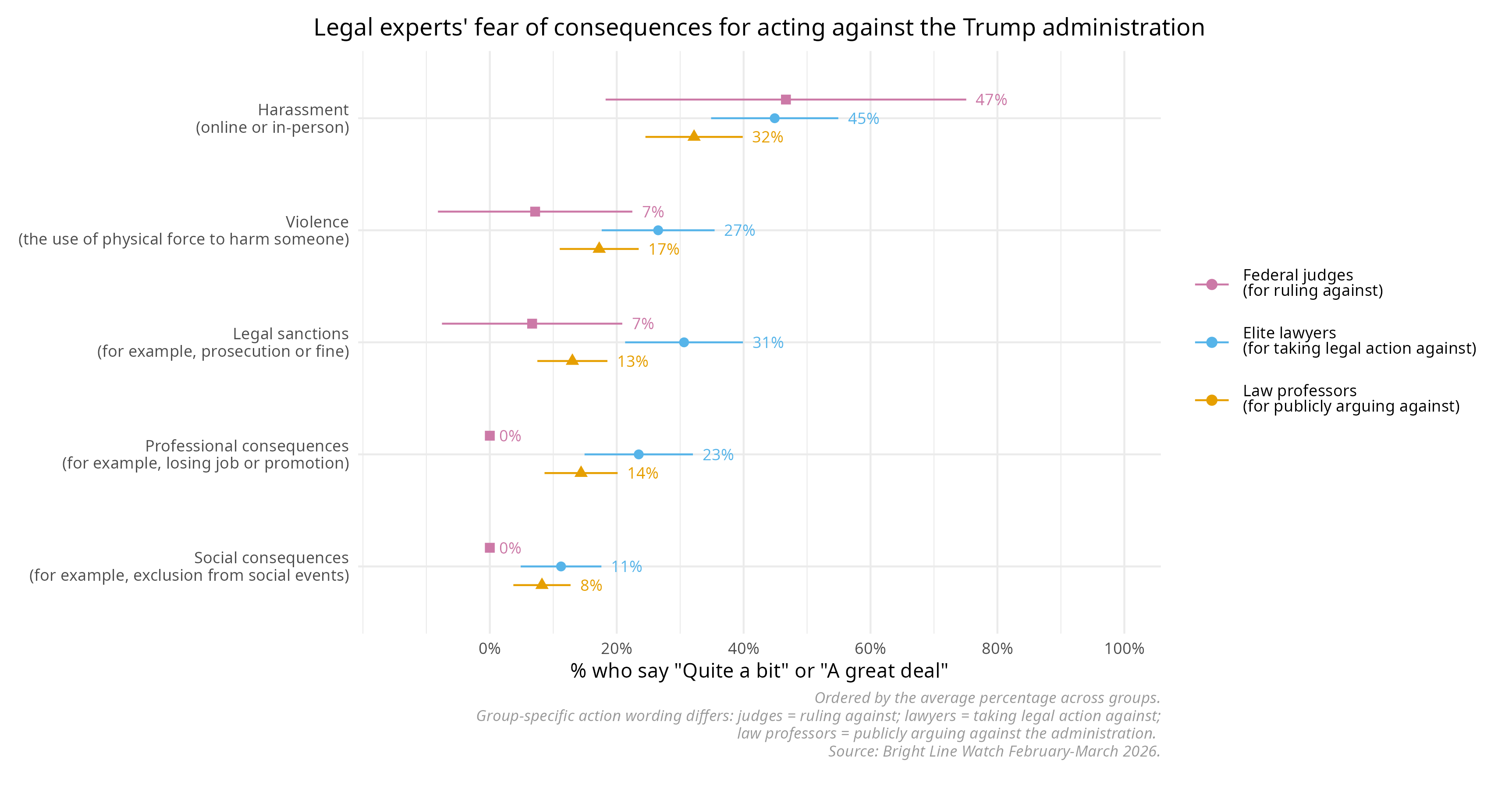
A significant proportion of all subgroups reported concern about harassment either online or in-person if they oppose the federal government (32% for law professors, 45% for elite lawyers, 47% for judges). Concern about violence ranged from 7% among judges to 27% among elite lawyers. Elite lawyers were also most frequently concerned about facing legal sanctions (31%) or professional consequences (23%).
Soon after Trump’s second inauguration, Trump signed several executive orders targeting some of the country’s largest law firms, including Paul Weiss and Perkins Coie. To avoid being targeted, other major law firms signed preemptive deals with the administration, promising extensive pro bono work for the president’s priorities. At the end of our survey period in early March 2026, the DOJ requested to drop its appeal against law firms who had challenged the executive orders in court, but then reversed course the following day.
Our survey asked lawyers about how fears of potential adverse action by the government affected decisions by their firm or organization. Nearly one in five (18%) reported that representation decisions by their firm were affected somewhat or very often by fear of adverse action by the federal government during the Trump administration, significantly higher than the 2% who said the same about representation decisions during the Biden administration. Findings are similar for hiring — 13% said fear of adverse actions affected hiring and personnel decisions by their firms somewhat or very often compared to 3% during the Biden administration. (We do not disaggregate expert responses by ideology because these questions measure lawyers’ self-reported experiences.)
Rule of law principles
We asked legal experts to evaluate nineteen rule of law principles on two dimensions: how essential each is to the rule of law, and how well the United States currently meets that standard. The full list of 37 principles asked of political scientists and the public appears in the appendix below.
Federal judges were only asked to evaluate seven principles due to survey length constraints. For the purposes of presentation, we organized the principles into three categories: institutional checks and balances, rule of law and anti-corruption, and civil liberties and expression.
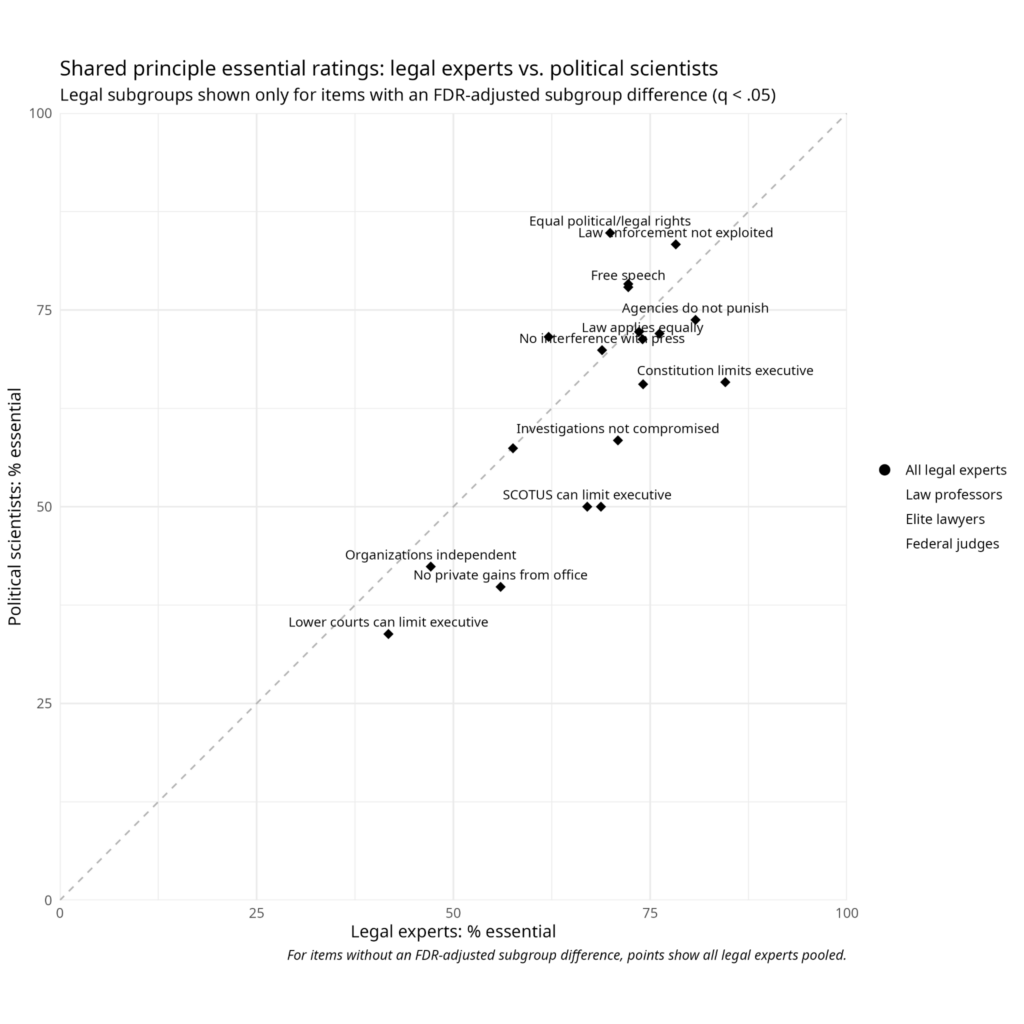
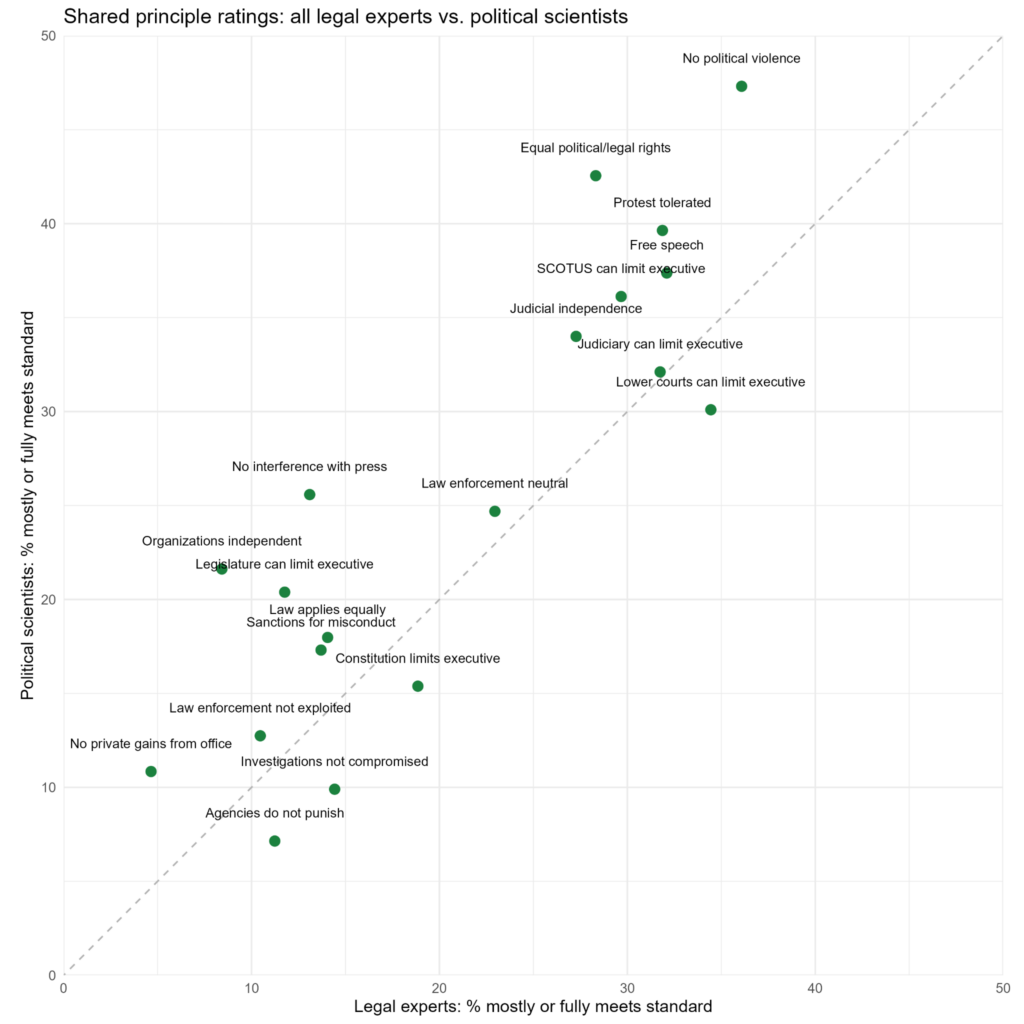
The figure below shows the percentage of legal experts who indicated that the principle in question is essential to the rule of law and mostly or fully met in the U.S. The lower right region of the figure indicates the areas in which the rule of law is most acutely threatened – principles that most respondents see as essential to the rule of law but where few see the principle as being upheld. This set includes principles measuring constitutional limits on executive authority and ones concerning the impartiality of government agencies and law enforcement.

In the figures below, we display the share of legal experts who indicate that a principle is essential to the rule of law on the left, and the share who say the standard is mostly or fully met in the U.S. today on the right. These are presented separately for each category of principles: institutional checks and balances, rule of law and anti-corruption, and civil liberties and expression. Individual points are only shown when we observe statistical differences between professional or ideological subgroups after applying a false discovery rate correction. We otherwise only show a pooled point.
Institutional checks & balances
- Executive authority cannot be expanded beyond constitutional limits
- The legislature is able to effectively limit executive power
- The judiciary is able to effectively limit executive power
- Lower courts are able to effectively limit executive power
- The Supreme Court is able to effectively limit executive power
- The elected branches respect judicial independence
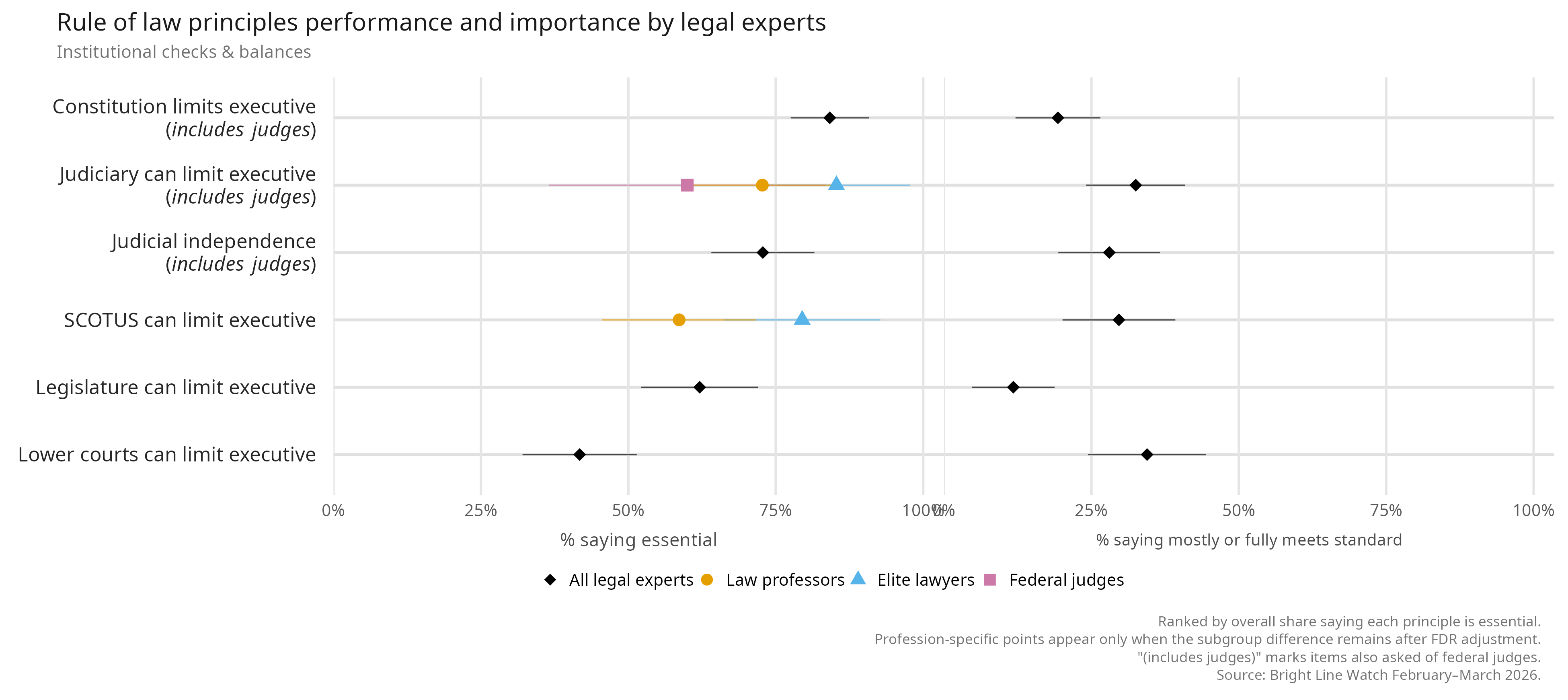
Legal experts identify constraints on executive power as the most essential principles to the rule of law: 84% for constitutional limits on executive authority, 74% for the judiciary’s ability to limit the executive, and 73% for the elected branches respecting judicial independence. Majorities also view the ability of the Supreme Court (68%) and legislature (62%) to check executive power as essential, whereas just 42% place a similar priority on lower courts as a check on executive authority.
Legal professionals diverge on two of these principles. Federal judges are less likely to rate the judiciary’s ability to limit the executive branch as essential to the rule of law (61%) than are elite lawyers (85%). Elite lawyers are also more likely to rate the Supreme Court’s ability to limit the executive branch as essential than are law professors (80% vs. 59%, respectively; we did not ask federal judges to evaluate this principle due to space limitations).
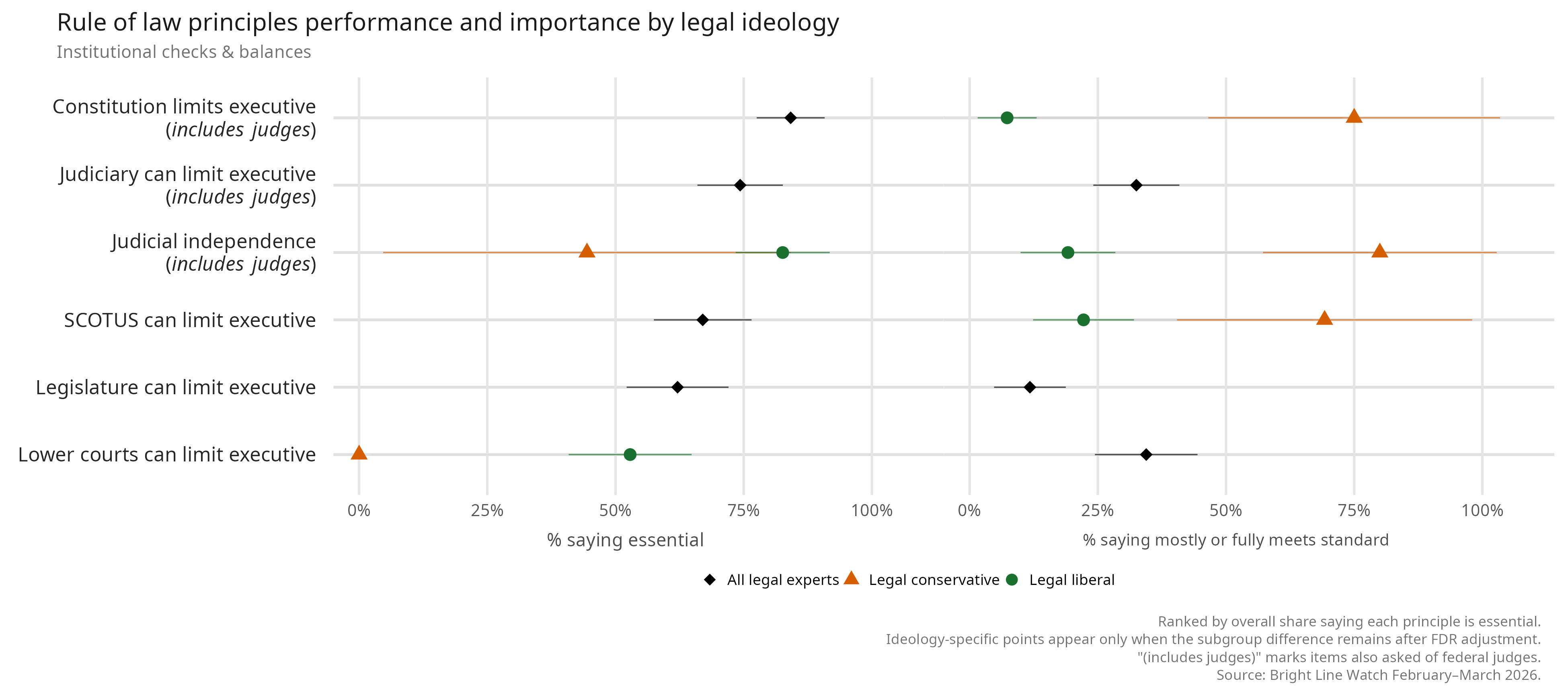
Legal conservatives and liberals do not differ measurably in the areas where professional subgroups do. They instead differ on the importance of elected branches respecting judicial independence (rated essential by 44% of legal conservatives versus 83% of liberals), and whether lower courts are able to effectively limit the executive (0% and 53%, respectively).
We also asked whether these standards are being met in the United States today. Legal experts are least likely to say that the legislature can limit the executive (12% say the standard is met) and that executive authority is not expanded beyond constitutional limits (19%). Few stated that standards were being upheld for respecting judicial independence (27%) and for limits on the executive by the Supreme Court (30%), lower courts (34%), and the judiciary as a whole (33%). There is broad agreement in these assessments across professional subgroups.
However, legal conservatives and liberals diverge sharply in their assessments of whether some of these principles are upheld. Legal conservatives are far more likely than are legal liberals to say that the Constitution limits executive authority (75% and 7%, respectively), that elected branches respect judicial independence (80% and 19%, respectively), and that the Supreme Court is able to limit executive power (70% and 22%, respectively). The ratings they give otherwise do not differ measurably.
Rule of law and anti-corruption
- Government officials are legally sanctioned for misconduct
- Government officials do not use public office for private gain
- Government agencies are not used to monitor, attack, or punish political opponents
- Government effectively prevents private actors from engaging in politically-motivated violence or intimidation
- Law enforcement investigations of public officials or their associates are free from political influence or interference
- The law is enforced equally for all persons
- Officeholders do not use law enforcement to advance political agendas or intimidate political opponents
- Law enforcement remains politically neutral and does not favor or support any political party or candidate

Among anti-corruption principles, legal experts are most likely to rate the following as essential: that agencies not be used to punish political opponents, that law enforcement not be exploited for political ends and remain politically neutral, that the law apply equally to all citizens, that investigations of public officials be free from political interference, and that officials face sanctions for misconduct. Each is rated essential by 69–81% of respondents. Lesser majorities place the same priority on the government preventing political violence and on officials not using public office for private gain (58% and 56%, respectively).
Elite lawyers are more likely than law professors to say that law enforcement not being exploited for political reasons is essential (91% vs. 72%). Federal judges are also more likely than law professors to say that the law enforced equally for all persons is essential (90% vs. 67%). Legal professions do not differ measurably on the importance of the remaining principles.
When asked whether these standards are met in the U.S. today, legal experts express negative views. For instance, only 36% of legal experts say the standard of government preventing political violence is met. Even fewer have faith that law enforcement is politically neutral and not exploited for political purposes, that agencies are not punishing political opponents, that the law applies equally, that investigations of political opponents are not compromised, and that there are sanctions for government officials who commit misconduct (11–25%). Only 5% of legal experts are confident that government officials do not use public office for private gain. The only difference between professional subgroups that we observe in these ratings is that federal judges are more likely to indicate that the standard of political neutrality for law enforcement is being met compared to law professors (55% vs. 13%).

Notably, legal liberals and conservatives do not measurably disagree on the importance of these principles to the rule of law or on whether these principles are being upheld with one exception — legal conservatives are far more likely to say that the principle that the law applies equally is being upheld in practice (50%) than are legal liberals (7%).
Civil liberties & expression
- Government does not interfere with journalists or news organizations
- Government protects individuals’ right to engage in unpopular speech or expression
- Government protects individuals’ right to engage in peaceful protest
- Universities, businesses, and professional organizations operate independently of government pressure
- All adult citizens enjoy the same legal and political rights
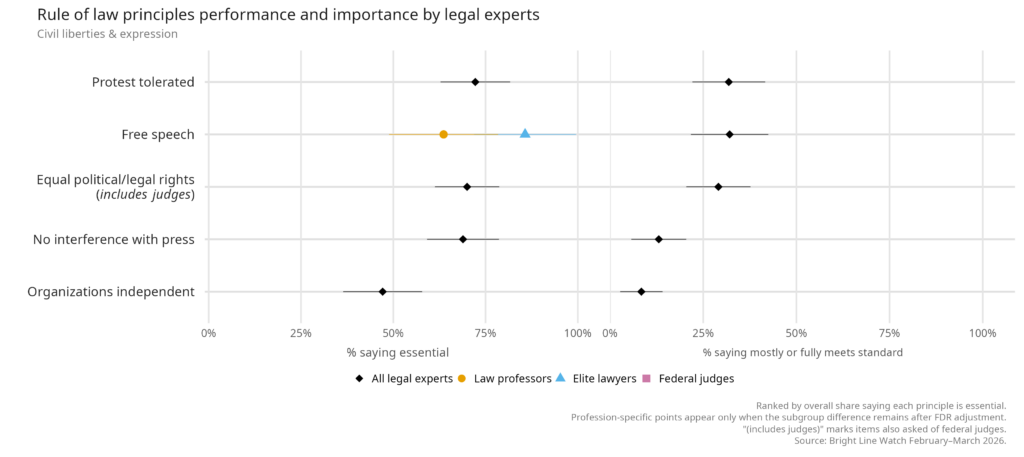
Legal experts place the highest priority on the government protecting the right to protest and to free speech, preserving equal political and legal rights, and not interfering with the press — 69–74% rate these principles as essential to the rule of law. They place somewhat less priority on universities, businesses, and professional organizations operating independently of government pressure, which 48% rate as essential.
In practice, about a third of legal experts are confident that the government is currently protecting rights to protest and freedom of expression and is guaranteeing equal political and legal rights. Even fewer think that the government does not interfere with the press or independent organizations, with 13% and 8%, respectively, saying these standards are met. We only observe differences between elite lawyers and law professors on whether free speech is essential to the rule of law, the former rating higher than the latter.
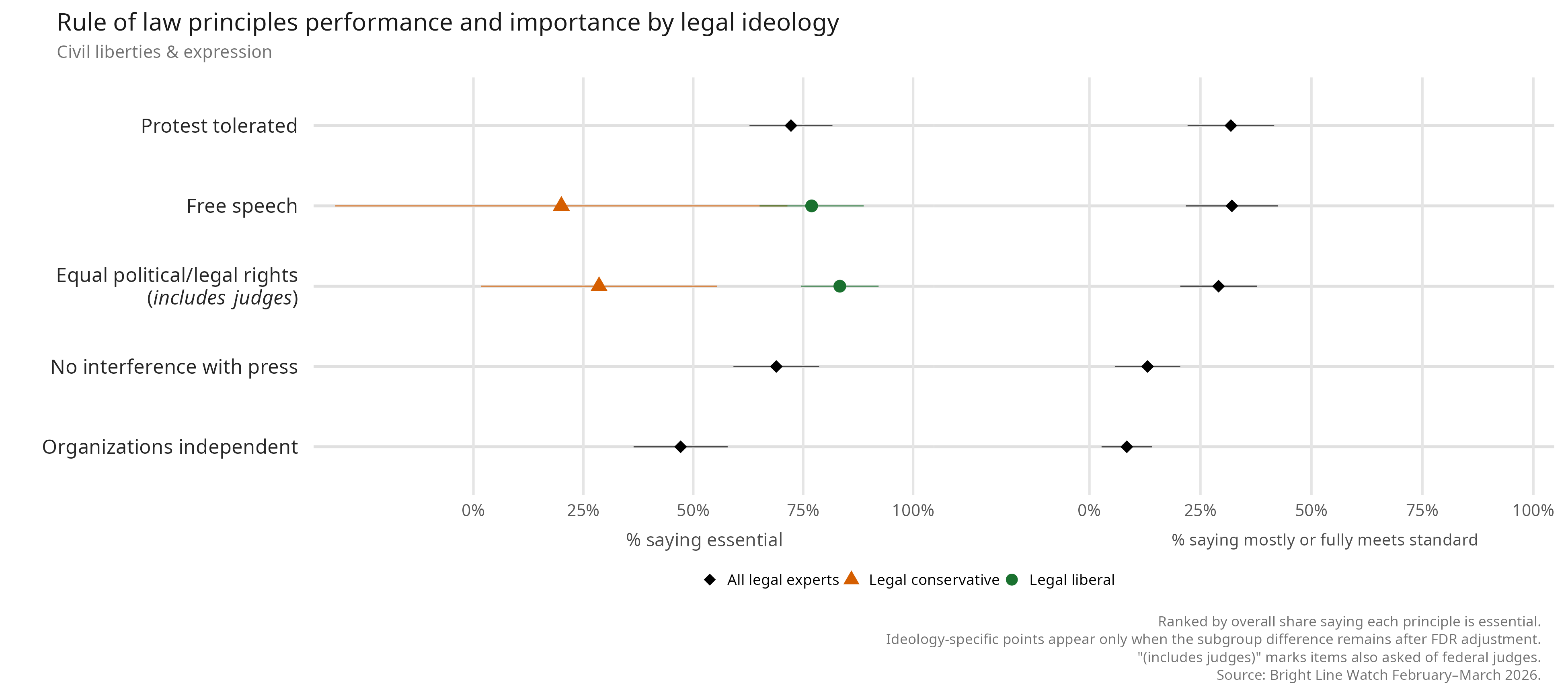
Legal conservatives are substantially less likely than liberals to regard free speech protection (18% vs. 76%) and equal political and legal rights (26% vs. 78%) as essential to the rule of law. We find no statistical differences between these subgroups in assessment of current U.S. performance on these principles.
Confidence in institutions
We asked legal experts and political scientists about their confidence in a range of U.S. institutions using wording drawn from the Marquette Law School Poll. (Survey responses from the public are provided in the appendix.)
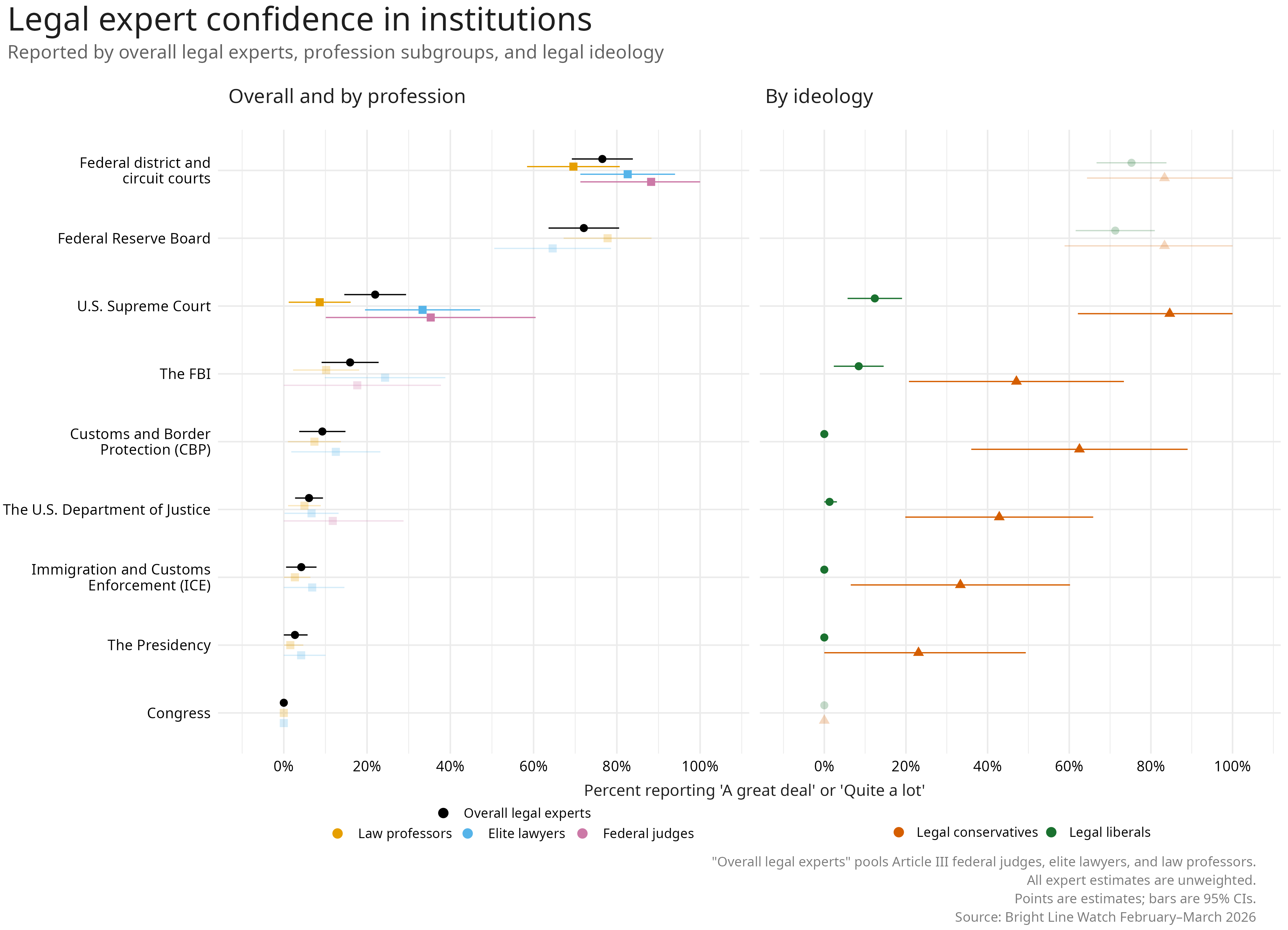
Legal experts and political scientists were the most likely to express confidence in federal district and circuit courts (77% and 63%, respectively) and the Federal Reserve (72% and 71%), with no differences among legal experts by profession or ideology. Confidence was lower and more polarized for other institutions measured, however.
The gap in trust between experts is most significant on the Supreme Court; most legal conservatives express confidence in the Court (85%) but very few political scientists and legal liberals do so (13% and 12%, respectively). Similarly, lawyers and judges are more likely to express confidence in the Court than law professors (33%, 35%, 9%). Legal conservatives also express more confidence than legal liberals and political scientists in the FBI (47% versus 8% and 8%, respectively), Customs and Border Protection (63%, 0%, 7%), and the Department of Justice (43%, 1%, 3%). Confidence is much lower among legal conservatives and negligible for legal liberals and political scientists for Immigration and Customs Enforcement (ICE) (33%, 0%, 3%), the presidency (23%, 0%, 1%), and especially Congress, an institution in which not a single legal expert surveyed indicated confidence (3% of political scientists).
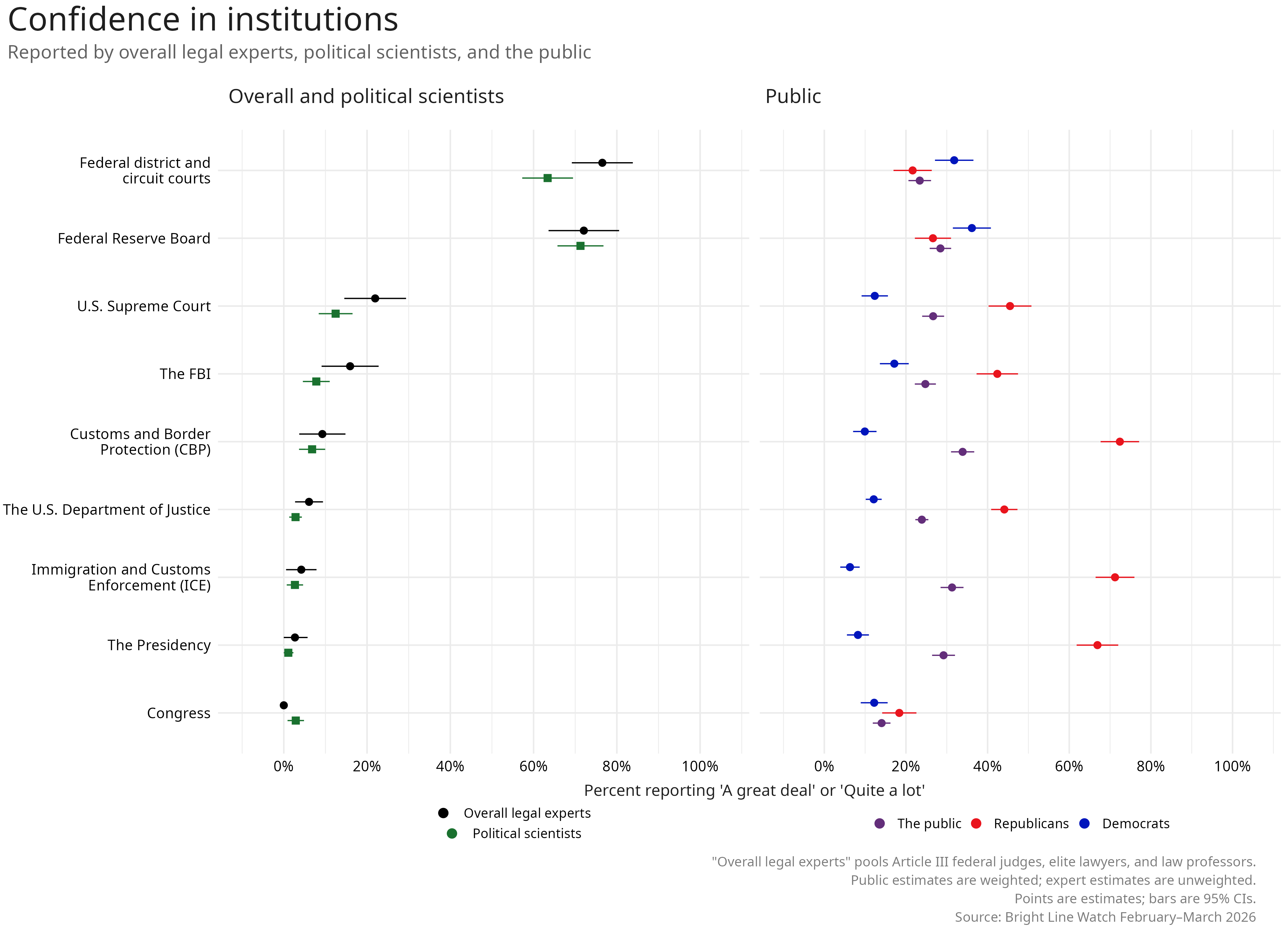
Experts trust a very different set of institutions than the public — they are skeptical in every institution except for the Federal Reserve and federal lower courts. Specifically, legal experts and political scientists express far less confidence in the presidency, Congress, and the surveyed federal enforcement agencies (FBI, CBP, DOJ, and ICE) than the public, but much more confidence in lower courts and the Federal Reserve.
Legal experts overall are less confident than both Democrats and Republicans in Congress, DOJ, and the presidency. The contrast between legal experts and Republicans is sharper, where legal experts are much more skeptical of ICE, CBP, the FBI, and the Supreme Court.
Comparing legal experts by ideology with public partisans, Republicans are closer to legal conservatives than to legal liberals and do not differ significantly from legal conservatives on CBP, DOJ, or the FBI. Legal conservatives are nonetheless less confident than Republicans in the presidency, ICE, and Congress. Legal liberals, by contrast, are less confident than Democrats in the DOJ, Congress, CBP, the presidency, ICE, and the FBI.
Events threatening and benefiting the rule of law
We asked legal experts to evaluate the effect of a set of thirty events from the past on the rule of law (due to sample size limitations, we asked judges to evaluate only five). In previous surveys, we asked political scientists to evaluate the threat to democracy of actions taken by or during the Biden administration, including the threat posed by Biden pardoning Hunter Biden, other Biden family members, and other targets like Anthony Fauci (47%, 44%, 23% said threat, respectively). Due to survey length limitations, we mostly constrained the list to events that occurred during Trump’s second term, or to events from previous years that we deemed especially relevant to the administration’s actions today. Legal professionals were first asked whether the event would benefit, threaten, or not affect the rule of law in America. Those who said it would benefit or threaten the rule of law were then asked about the extent of such an effect. The set of events that experts rated was the following:
Full list of events
- The Colorado state Supreme Court rules that the 14th Amendment to the US Constitution prohibits Trump from appearing on Colorado ballots because of his actions on January 6, 2021.
- The U.S. Supreme Court overturns the Colorado decision that bars Donald Trump from appearing on the ballot.
- The Supreme Court rules that the president has “absolute immunity from criminal prosecution for actions within his conclusive and preclusive constitutional authority” and “at least presumptive immunity from prosecution” for all official acts.
- Joe Biden grants a “full and unconditional” pardon of his son Hunter Biden, absolving him of existing federal charges and shielding him from future prosecution for federal crimes.
- Joe Biden grants a preemptive pardon to five members of his family besides Hunter Biden, shielding them from future prosecution for federal crimes.
- Donald Trump issues an executive order seeking to deny citizenship to people born in the U.S. whose parents are not lawful permanent residents.
- Donald Trump pardons nearly all individuals charged in connection with the Jan. 6 Capitol attack, including violent offenders.
- The Trump administration fires Department of Justice officials who worked on criminal investigations of Trump’s actions as president.
- The Trump administration issues executive orders that impose penalties on some major law firms.
- FBI Director Kash Patel shuts down the FBI’s public corruption investigation unit and fires agents who worked on investigations related to Trump.
- Donald Trump writes on Truth Social that a federal judge who ruled against him “should be IMPEACHED!!!”
- The Supreme Court holds that federal courts cannot issue universal or nationwide injunctions.
- President Trump tries to fire Federal Reserve Governor Lisa Cook after his administration accuses her of mortgage fraud.
- Trump directs Attorney General Pam Bondi to prosecute his political enemies in a Truth Social message.
- Trump pardons his former attorney and chief of staff as well as nearly 80 other allies accused of plotting to overturn the 2020 election.
- Six Democratic lawmakers with military or intelligence backgrounds issue a video stating that military personnel should not obey unlawful orders.
- Trump accuses Democratic lawmakers of “seditious behavior, punishable by death” for releasing a video stating that military personnel should not obey unlawful orders.
- Trump pardons [Juan] Orlando Hernandez, the former president of Honduras, who was serving 45 years in prison for helping drug traffickers import cocaine to the U.S. (first name omitted in survey wording)
- Federal judges rule that Lindsey Halligan and Alina Habba were unlawfully appointed as U.S. Attorneys.
- Federal agents fatally shoot Renee Good during immigration operations in Minnesota.
- The Department of Justice begins a criminal investigation into Federal Reserve Chair Jerome Powell.
- Federal agents fatally shoot Alex Pretti during immigration operations in Minnesota.
- ICE disobeys 96 court orders in the District of Minnesota in January, according to Chief U.S. District Judge Patrick J. Schiltz.
- FBI agents search a Fulton County, Georgia election center for ballots from the 2020 election with the Director of National Intelligence present.
- The journalist Don Lemon is charged with federal civil rights crimes after live-streaming a protest at a church in St. Paul, Minnesota.
- U.S. attorneys’ offices ask job applicants to explain how they would advance President Trump’s policy priorities.
- The Department of Homeland Security sends administrative subpoenas to tech companies requesting personal information about users whose social media accounts track or criticize the agency.
- The Supreme Court rules that President Trump exceeded his authority to impose tariffs under existing law, invalidating many of the tariffs he imposed on foreign goods.
- After the U.S. Supreme Court strikes down his previous tariff program, President Trump says “I am ashamed of certain Members of the Court” and says “[i]t is my opinion that the Court has been swayed by Foreign Interests.”
- After the U.S. Supreme Court strikes down his previous tariff program, President Trump imposes a new temporary tariff of 15% on imports.
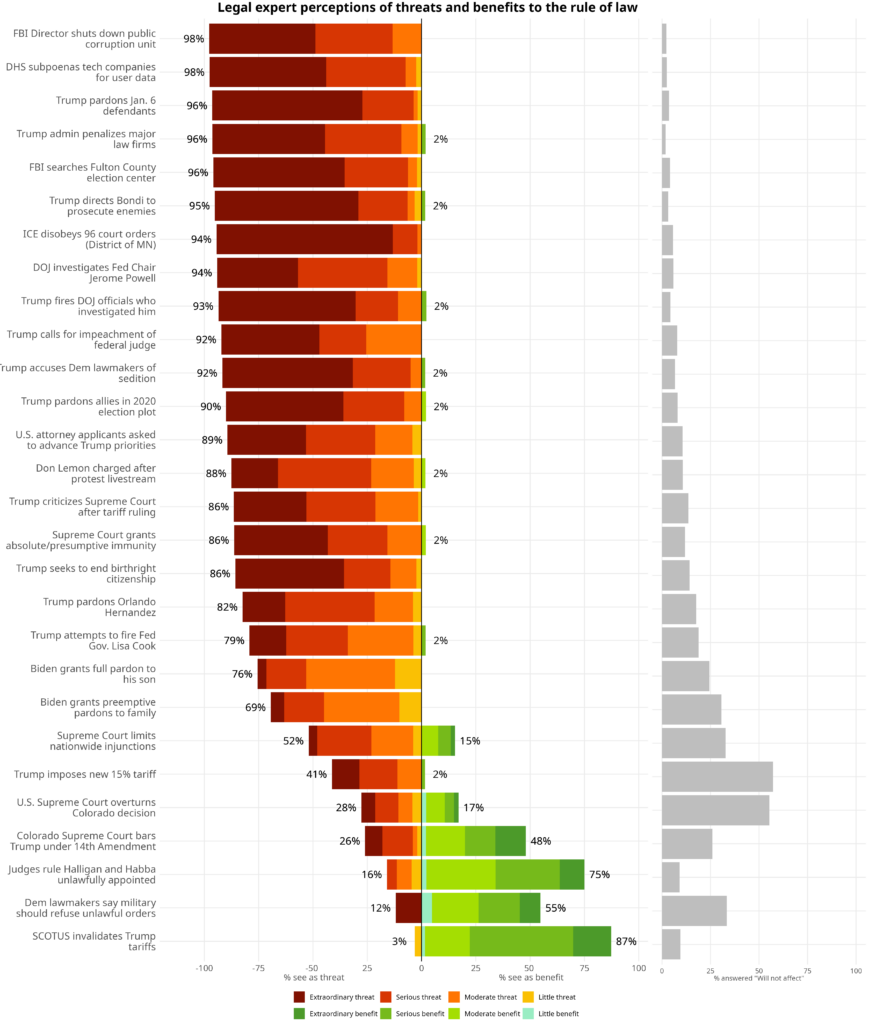
Many of the events we asked about were rated by most legal experts as either serious or extraordinary threats to the rule of law, including many related to Immigration and Customs Enforcement (ICE). For instance, 90% of experts said the Department of Homeland Security (DHS) sending administrative subpoenas to tech companies seeking user data for social media accounts that criticize ICE is an extraordinary or serious threat to the rule of law. Another event, deemed a serious or extraordinary threat to the rule of law by 93% of respondents, was ICE’s disobedience of at least 96 court orders in the District of Minnesota. The chief federal judge in Minnesota, Judge Patrick J. Schiltz, compiled the list of defied orders, which he wrote was more than “some federal agencies have violated in their entire existence.”
Legal experts also shared alarm (with 93% perceiving a serious or extraordinary threat to the rule of law) about Trump pardoning nearly all individuals, including violent offenders, charged in connection with the January 6, 2021 attack on the U.S. Capitol. When Bright Line Watch asked political scientists about the pardons in February 2025, they similarly rated them as among the greatest threats to democracy (83% said extraordinary or serious).
Actions that weaken sanctions for misconduct by government officials were also rated as serious threats to the rule of law by legal experts. Examples include FBI Director Kash Patel’s order to shut down the agency’s public corruption unit (98% overall; 84% serious or extraordinary) and Trump firing DOJ officials who investigated him (93% overall; 83% serious or extraordinary).
Overall, the events we asked about were widely considered threats to the rule of law and assessments did not meaningfully vary by profession or ideology. However, legal experts agreed that the Supreme Court ruling against Trump in the recent tariff case was an extraordinary or serious benefit to the rule of law (65%). The case was a significant defeat for one of the administration’s top priorities, prompting Trump to say that he was “ashamed of certain Members of the Court.”
Appendix
This report was designed, written, and analyzed with the assistance of Jack Haubold (Dartmouth College class of 2027).
Sample information
Detailed aggregated background descriptives for each legal expert sample are available here. The tables and text below provide response rates and sample sources.
| Sample | Response rate | Respondents who answered at least one non-consent question | Total invited |
| Article III federal judges | 1.5% | 21 | 1434 |
| Elite lawyers | 1.7% | 113 | 6466 |
| Law professors | 4.5% | 193 | 4253 |
| Political scientists | 7.5% | 652 | 8718 |
Elite lawyers were recruited from membership and leadership lists drawn from the American Law Institute, the National Association of Former United States Attorneys, the American Academy of Appellate Lawyers, American Bar Association governance and leadership bodies, state attorneys general, and heads of appellate or Supreme Court practice at Am Law 100 firms (though none responded from this final group). The table below indicates the proportions of the responding elite lawyer sample that were sampled from each source.
| Source | Number of respondents | % of responding sample |
| ABA Sections, Divisions, and Forums | 41 | 36% |
| American Law Institute | 21 | 19% |
| ABA House of Delegates | 15 | 13% |
| ABA Special Committees and Commissions | 10 | 9% |
| American Academy of Appellate Lawyers | 9 | 8% |
| ABA Standing Committees | 7 | 6% |
| National Association of Former United States Attorneys | 5 | 4% |
| ABA Board of Governors | 2 | 2% |
| U.S. faculty at top universities (individuals from this list who primarily identified as a lawyer over law professor) | 2 | 2% |
| List of state attorneys general | 1 | 1% |
All law professors’ emails in our sample were collected from faculty pages at universities with law schools ranked under U.S. News top 50 law schools (2025). Article III federal judge emails were collected or inferred for all Article III federal judges.
Statistical methods
For binary-threshold outcomes, we converted responses to binary indicators using pre-defined thresholds and estimated sample and subgroup comparisons with logistic regression models fit using survey::svyglm(). For continuous outcomes, we used survey-weighted linear regression models, also fit with survey::svyglm(). In both cases, we reported predicted probabilities or means, pairwise differences, 95% confidence intervals, and p‑values.
Public estimates used survey weights. Expert comparisons used the same modeling framework with equal weights across expert respondents. For comparisons across samples and subgroups, we applied a false discovery rate (FDR) adjustment within the rule-of-law performance battery, the rule-of-law importance battery, and the threats/benefits battery for recent events.
For categorical items with substantively distinct response groupings, such as responses indicating greater versus lesser threat, we defined separate binary indicators for each grouping and estimated subgroup differences for each indicator.
Supplementary figures
Law professors reporting consequences after opposing Biden or Trump administrations
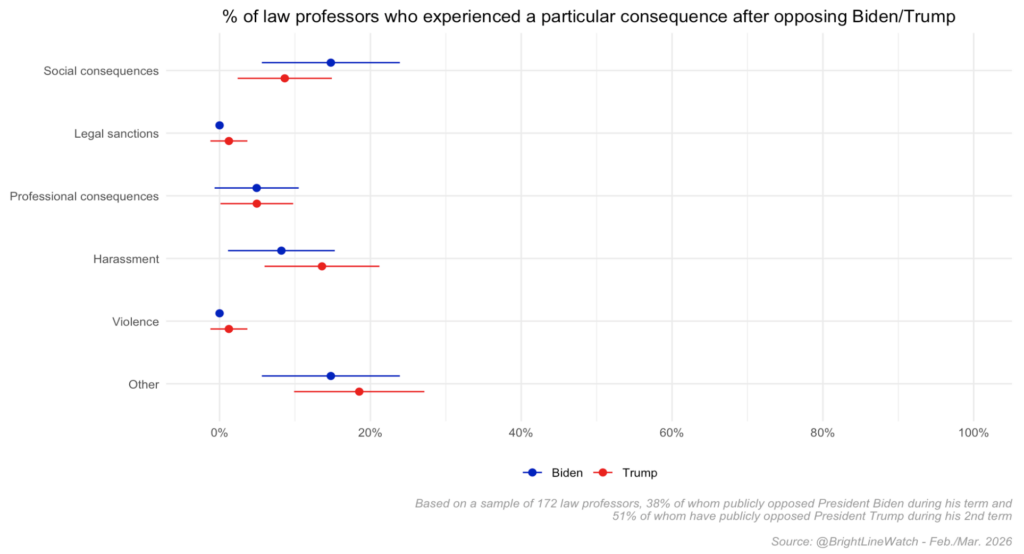
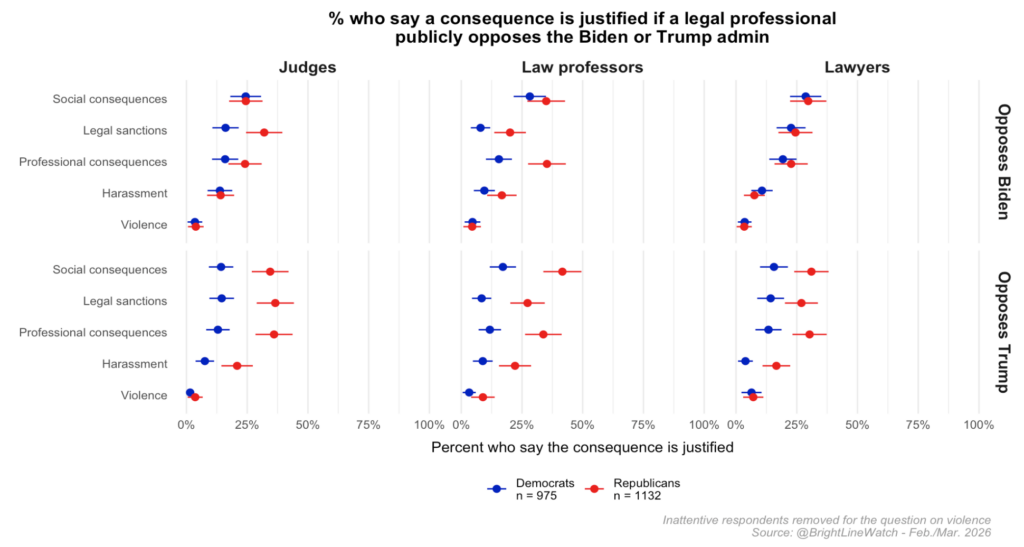
We also asked members of the public whether they believe certain consequences are justified if a legal professional publicly opposes either the Biden or Trump administration. Republicans are more likely than Democrats to view adverse consequences as justified if a professional publicly opposes the Trump administration, a pattern largely consistent with their overall partisan evaluations.
Legal expert evaluations (0–100) of hypothetical rule of law systems compared with political scientists of hypothetical democracies.
Beliefs that prosecutions of political figures are motivated by politics, split by legal ideology.
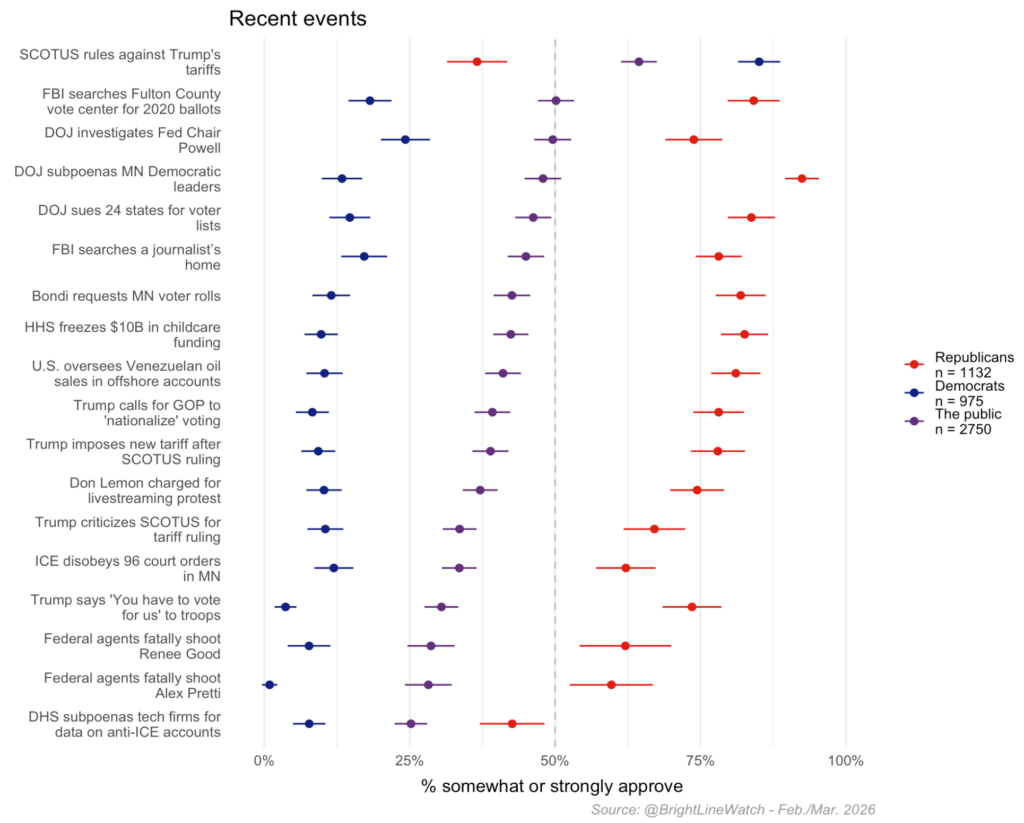
Public approval of recent events
Political scientist ratings of the threat to democracy, and legal experts threat to rule of law, of 29 recent and events
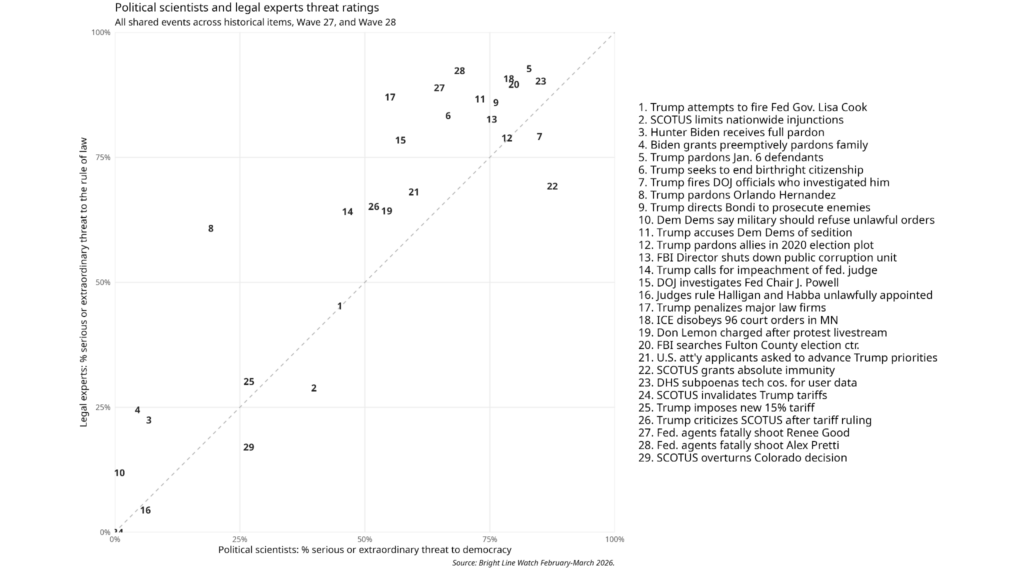
Figures comparing political scientist and legal expert perceptions of importance and performance of rule of law principles